Pages

Showing posts with label Brand. Show all posts

Wednesday, April 25, 2012

A Big Payoff from Online Company Communities

strategy + business magazine:


Membership engages customers, who spend more across the board.

Authors: Puneet Manchanda, Grant Packard, and Adithya Pattabhiramaiah (all University of Michigan)
Publisher: Ross School of Business Working Paper
Date Published: January 2012
Image representing Facebook as depicted in Cru...
Image via CrunchBase
Studies show that consumers are spending more of their leisure time online, and U.S. marketers are flocking to third-party social networks such as Facebook and Twitter to reach them. But companies as diverse as Amazon, Buy.com, Disney, IKEA, Kraft Foods, Lego, and Procter & Gamble are also making major investments to build their own consumer-centered online communities. According to a 2011 survey, nearly half of the top 100 global brands host some kind of network.
... This paper, among the first to tackle the question empirically, tracked the effect of consumer membership in one company-sponsored online network on the amount of money members spent on the firm’s products. Although based only on a single case study, the results appear to be a significant affirmation of the economic value of these networks: The authors found that revenue from members increased by an average of 19 percent after they joined, a result of closer ties with other customers and more engagement with the company.
The revenue increase, called “social dollars” in the paper, represents spending that is over and above the members’ purchase history with the firm — and it similarly exceeds the spending of a control group of comparable consumers who did not join the network.
This increase in income is “economically significant for the firm as it more than covers the fixed cost of setting up the community as well as the variable cost of operating it,” the authors write. The increase is neither a novelty nor a cannibalizing threat to a company’s retail stores, they add. Rather, they say, the jump in social dollars “persist[s] over time, arise[s] in both online and offline channels, and affect[s] all product categories sold by the firm.”
The authors based their analysis on data obtained from a large North American retailer of entertainment and information-related media, such as books, movies, and music. The firm is the largest retailer in its market in terms of sales and operates in both retail store and online environments; about 10 percent of its total revenues came from Internet purchases in 2009.
The company’s online community is similar to Facebook’s — members can manage a profile page that allows them to post personal and product-related messages, convey a sense of their personality and interests, and display their status in the community. There are private and public discussion boards so users can establish friendly ties, start up special interest groups (for example, the “Vampire Movie Lovers Club”), and publish Top 10 lists or product reviews. ...
After controlling for several factors, the authors found that the quantity and quality of friendly relationships with other customers was key. Customers who had many friendly relationships, or who befriended more important or prominent customers, were likely to spend more on the firm’s products. Those who displayed more products on their profile page also tended to rack up purchases.
It doesn’t require many participants to earn a return on the investment of establishing an online community, the authors found. Based on the projected volume of social dollars taken in, and the costs and firm-level margins available in public financial statements, the authors’ conservative estimate is that the firm broke even on its investment when 33,000 of its existing customers signed up.
“Given that the firm acquired 260,000 members within the first fifteen months after community launch, this was clearly a very profitable investment for the firm,” the authors write, “especially as this number is comprised of a mix of both current and newly-acquired customers.”
Aside from the direct economic benefits of setting up the community, the firm has much to gain in other ways. For example, the data paints a clear picture of each customer’s preferences and behavior, the authors write, which is “an informational boon for customer relationship management and other life-cycle based marketing strategies.”
By monitoring which products are becoming more popular and identifying who is discussing them, marketers can optimize their promotional strategies. And the firm also disclosed to the authors that the massive amount of user-generated content produced via the community strongly improves the company’s position in major online search engines.
A segment of a social network
A segment of a social network (Photo credit: Wikipedia)
“While it is likely that hosting customer communities on third-party websites such as Facebook provides reach to a broader audience,” the authors conclude, “this strategy does not offer the same level of access and control over customer interaction management and data offered by a firm-sponsored social network, nor is the third-party community interaction data commonly available to the firm in a manner that can be easily linked to customer-level purchase behavior.”
Bottom Line:
Consumers who join a company’s online community spend significantly more on the firm’s products than they did prior to signing up or in comparison with similar customers who are not part of the network. The findings indicate that online communities more than justify the investment to create and maintain them, and provide a unique way for companies to connect with customers and monitor their purchases and behavior.
Enhanced by Zemanta

Thursday, January 19, 2012

Five Painless Ways to Raise Prices this Year

| Blog | Daily Dose | Entrepreneur.com


BY Carol Tice| 23 hours ago|


Five Painless Ways to Raise Prices this Year

It may sound odd, but small businesses are increasingly handing out pay raises. …

Apparently, the pay-raise trend is pretty widespread. A Pepperdine University/Dun & Bradstreet Credibility Corp. study showed 43 percent of small businesses have already hiked worker pay in the past year, and 42 percent said they plan to raise pay this year. …

This may be a critical time to raise prices for many businesses in any case, as prices are rising or remaining high for many basic materials.

With the economy still so uncooperative, how can you sell customers on a price hike? Here are five ideas:
  1. English: Customers buying up tea before the pr...
    Image via Wikipedia
    Phase it in.
    Let customers know prices are going up next month, or next quarter. … Give clients a chance to buy in volume ahead of time to save money. It feels like a deal, but, sooner or later, customers still end up paying the new price. …
    Related: More Small Businesses Plan to Push Up Prices in 2012

  2. Offer valued-customer discounts. Take a page from grocery stores and offer one price for your loyal frequent shoppers, and a higher one for occasional users. That way you can start grossing more without alienating your core customer base. Don't make those customers haul around a loyalty card, either -- keep the information on who gets the good prices on file yourself.
  3. English: A business ideally is continually see...
    Image via Wikipedia
    Revamp or repackage old products or services.
    Add new features, bundle existing products to create a new one or redesign your packaging. Freshen it up, and you've added value -- or at least created the appearance of added value -- and can command a better price for it.
  4. Introduce new products. … What can you sell that your competitors don't? Add fresh items that can't be easily price compared and you can charge a better markup on them.
    Related: Four Rules for Pricing Products

  5. Review and retool your product assortment. Do you know which of your products has the lowest margins, and which has the highest? … Then drop slower-moving, low-net products and add more high-end ones. Also review competitors' pricing to see whether some products are priced unnecessarily low. Small, strategic increases on a few popular items can add up quickly, while customers may barely notice the difference.
Enhanced by Zemanta

Want to Become Known as an Industry Expert? 3 Tips to Get You Started

Forbes

1/18/2012 @ 1:33PM

Cari Sommer, Contributor

…For those of you who’ve decided that this is the year to up your visibility, you may be asking yourself “how?’’  How will you become known as the one to go to for relevant press stories, speaking events or other high profile events?  How will you make yourself and your brand stand out in your space?

It starts with building your reputation as an expert. You may be thinking, “Well that’s easy, I AM an expert.”  … It’s great that you feel confident about your knowledge base, but now your focus should turn to getting others to see you in the same light.

Here are a few tips for doing so.
  1. Call yourself an expert. … We fear that others will perceive us as bragging or that there’s some magical threshold we must pass before we can TRULY be considered an expert. Wrong! If you feel confident enough to put your name out there and speak about a particular market segment or industry, feel confident enough to tell people that you’re doing so. Be on the lookout for opportunities to contribute to conversations—whether through social media or relevant industry groups.  You can also start to build relationships with a targeted group of bloggers or journalists by letting them know your specific areas of expertise and your willingness to chime in if and when they need a specific quote, facts or data.
  2. Share Generously. …  As you have interesting industry news to share—whether it’s about a particular trend you’re seeing or up-to-the-minute data you’ve gathered, let people know about it. Blog about it, email industry influencers about it—maybe even think about putting together a press release.    Sometimes business owners question whether and how much they should share—they think that their knowledge is their ‘special sauce’. When it comes to brand building, application of that knowledge is what counts.  …
  3. Stay Focused: While the ability to appoint oneself an expert opens up a world of possibility in terms of business and personal brand-building, the flip side is the worry that the title doesn’t mean anything anymore.  … Maybe, but that doesn’t mean you should avoid the dialogue. Instead, it’s an incentive to be really clear on your skill set and what you want to be known as.   …
Making yourself known to industry influencers (media and beyond) is an ongoing effort.  It takes time and constant attention. But in today’s noisy world, there’s no short cut in making yourself and your business visible in your space.

Cari Sommer Cari Sommer Contributor
+ Follow on Forbes
I am the Principal of Cari Sommer Media + Communications (www.carisommer.com), a consulting firm that works with high growth companies to stand out from the crowd through powerful content, thought leadership and top notch publicity. I developed this expertise first- hand through my role as the co-founder and the head of press relations of the angel funded company
Image representing Urban Interns as depicted i...
Image via CrunchBase
 Urban Interns (www.urbaninterns.com), which has been widely publicized in outlets such as the Wall Street Journal, Crains, Inc, Tech Crunch, Entrepreneur, Mashable and Reuters. Prior to becoming and entrepreneur, I was a litigator for seven years at an international law firm, where I first learned how to convincingly convey a point of view-- a much needed skill for any entrepreneur. I am a graduate of
The Cornell University Emblem
Image via Wikipedia
Cornell University and Brooklyn Law School. I am a mentor-advisor to Cornell students in e-Lab, the Cornell undergraduate incubator program, and a member of the President’s Council of Cornell Women.
Enhanced by Zemanta

Friday, December 30, 2011

The Power of the Post-Recession Consumer

An analysis of attitudes and spending reveals a return to traditional values, driven by consumers searching for quality, affordability, and connection.

strategy+business magazine
February 22, 2011 / Spring 2011 / Issue 62
by John Gerzema and Michael D'Antonio

Illustration by Lars Leetaru

English: The financial crisis affectes the rea...Image via WikipediaThe wave of hyper-consumerism that propelled the U.S. economy through the last decades of the 20th century and into the first years of the 21st century has passed. …Consumer spending patterns are changing as part of a trend that has been quietly gathering strength over the past 10 years. …People are returning to old-fashioned values to build new lives of purpose and connection. They also realize that how they spend their money is a form of power, and are moving from mindless consumption to mindful consumption, increasingly taking care to purchase goods and services from sellers that meet their standards and reflect their values.

This change in consumer attitudes … is …, in part, a reaction to economic hard times. But it is also closely related to the civic dissatisfaction that is rocking the political establishment, and additionally has some roots in environmental awareness and changing aspirations. That is why this Spend Shift movement, as we call it, is here to stay. It will create opportunities for businesses that heed its message, and penalize those that do not. (For another perspective, see “Values vs. Value,” by Timothy Devinney, Pat Auger, and Giana M. Eckhardt, s+b, Spring 2011.)

Our view of the Spend Shift is based on two years of gathering and analyzing data, and traveling around the U.S. to discover how the recession has affected people’s lives. We started with Young & Rubicam’s BrandAsset Valuator (BAV), which is a poll of consumer values, attitudes, and shopping behaviors that goes back nearly 20 years. …

The BAV data revealed that even before the recession took hold in mid-2008, there were dramatic shifts in what people expected in the consumer marketplace and how they defined and pursued what they considered the good life. … More recently, the BAV surveys show sharp increases in the number of consumers who want positive relationships with marketplace vendors and who focus more on corporate behavior. Between 2005 and 2009, a growing number of people rejected status-driven values such as snobbishness and exclusivity, and embraced attributes related to bringing people closer together or making the world a better place. Among the once-prized brand attributes that declined in this period were: “exclusive” (down 60 percent), “arrogant” (down 41 percent), “sensuous” (down 30 percent), and “daring” (down 20 percent). On the opposite side of the scale, the brand attributes Americans found more important as they began to sense the impending recession and then suffered through the crisis were: “kindness and empathy” (up 391 percent), “friendly” (up 148 percent), “high quality” (up 124 percent), and “socially responsible” (up 63 percent).

… Between 2005 and 2009, U.S. consumers expressed a nearly fourfold increase in their preference for companies, brands, and products that show kindness in both their operations and their encounters with customers. This desire for companies to be more empathetic toward consumers is the biggest shift in any attitude that we have ever seen during the BAV survey’s two-decade history. …
1. United by Change
The Spend Shift is a far-reaching and inclusive phenomenon that can’t be defined by any particular demographic. According to our data, 55 percent of all Americans are part of this movement; in addition, about one-quarter of the U.S. adult population embraces many of the Spend Shift attitudes and characteristics (we call them Fast Followers). Although the word values tends to polarize U.S. citizens, the Spend Shift is blind to geography, education, age, and income. …

What unites all these Spend Shifters is a common sense of optimism and newfound purpose. As the shock of economic loss wears off for many people, they are redefining what it means to be successful and happy. They are living with less and yet feeling greater satisfaction. …
2. The New Thrift
…Consumer spending will no longer be able to grow faster than personal income, as it did during the 30 years leading up to the crisis. … If you look at historical savings rates in the U.S., people have on average saved 10 percent of their income going back as far as six decades. It was only in the mid-1980s that … ordinary people [ere encouraged] to get out over their skis. In only 20 years, average American households swung from being net savers to being net borrowers. Now, however, consumers are returning to traditional values that have long defined the U.S. ideal.

English: Weight Watchers Center, Newton Highla...Image via Wikipedia… In the post-recession economy, resourcefulness and self-sufficiency are viewed as virtues, and excessive consumption as a sign of weakness. … We examined the 2009 performance of a basket of “retooling” companies — those that are in the top 10 percent of our data on being “helpful,” “reliable,” “educational,” and “durable,” such as LeapFrog, Weight Watchers, Craftsman, and DeWalt, because they help people help themselves. The performance of these companies against all others is notable: They performed 249 percent better than other companies when respondents were asked whether they would recommend these brands to a friend, 234 percent better when respondents were asked if they used the products regularly, and 210 percent better on whether the products were worth a premium price.

…[Many] people, … are seeking ways to experience a sense of competence, self-sufficiency, and accomplishment. … If you have an idea for helping people learn new skills and connect with others, your business has a good chance of success.
3. Transparency Breeds Trust
… Companies serving these customers, who know more and expect more, will need to continuously listen, respond, and innovate. They are in for a challenge: Our data shows that confidence in all types of big organizations, including big government and big business, has declined by nearly 50 percent in the past two years. …

Wary consumers are going beyond just reading labels to get the best products and the best deals. The most tech-savvy are using online services as they stand in the supermarket aisle to get instant access to information on prices and on a company’s social or environmental record. …

… Today, however, customers have equal (and sometimes superior) access to data. As a result, transparency becomes all the more crucial. Today’s stakeholders … crave a true, authentic story. They will be interested in how a company thinks and how it makes decisions. …
4. Companies That Care
… The ability of a company to identify with its customers is now a prerequisite for any brand in the post-crisis age. Today, openness, humility, and understanding are critical. Generosity binds a company to its community and its stakeholders.

The rising importance of generosity reflects the fact that the post-crisis era will be defined by inclusion rather than exclusion. … Spend Shifters are buying artisanal food because they trust companies that reveal how their food is produced and handled. They patronize cooperative small businesses because such businesses use their profits to build up their local regions. Passionate customer groups will also band together to fund niche offerings that speak directly to the areas about which they feel most strongly. Because 71 percent of U.S. consumers are now aligning their spending with their values, businesses that practice in a new way will find a vibrant marketplace. Instead of selling shoes, such businesses sell empathy and respect. … Instead of serving food, companies create communities of hope. Instead of making cars, they promise fairness, openness, and shared discourse.

Consumers will be looking for signs that companies care about their impact on communities and are investing in making things better. … The vanguard companies understand that showing kindness and humanity is now a competitive advantage.

Microsoft is a telling example. … In our BAV survey, Microsoft always scores high on measures of its reputation, exceeding Apple by a wide margin. … Despite its massive size, Microsoft is still widely associated with the single personality of its founder, Bill Gates. He gives Microsoft a human face and, more important, his philanthropy gives the company a heart. …

When we talked to Akhtar Badshah, Microsoft’s senior director of global community affairs, he told us that in its response to the recession, Microsoft pursued three main areas of focus: education, innovation, and jobs and economic opportunity. … The key point is that Microsoft uses both its money and its true areas of expertise to maximize the good it can do as a citizen corporation, showing how a company can be charitable by redeploying its existing assets and infrastructure as tools for social and economic development.
The Consumer Connection
… Although the growth of consumer spending appears to be slowing, we believe that people are simply reallocating the way they spend — looking for a connection to the creator of the product; banding together to get better deals; and pushing service and product creators to do more, price better, and connect more deeply to their wants and needs.

English: A graph illustrating numbers of net j...Image via WikipediaEven as people find themselves less rich, they are deploying their dollars in a more calculated and strategic way to influence institutions such as corporations and government. …

The most successful companies will respond to this shift by adopting a business model in which all three parties — the business, the customer, and the community — win in every transaction. Although the Spend Shift will dampen domestic demand for some products, the market for values-oriented goods and services offers opportunities for growth in what might otherwise be considered mature categories. We examined the performance of a group of companies and brands that scored in the top 20 percent in the BAV survey on the values we had noted were becoming increasingly important — self-reliance, adaptability, honesty, quality, and community. And we found that in aggregate they enjoyed nearly three times as much usage and preference as brands that did not represent these values.

We believe that the future face of capitalism will be defined by delivering value and values. Those that embrace this reality and adapt will find extraordinary opportunities. Those that ignore it will do so at their peril.

Reprint No. 11107

Author Profile:

Enhanced by Zemanta

Friday, July 15, 2011

How to Become Ubiquitous

Harvard Business Review wordmarkImage via Wikipedia


Harvard Business Review
8:04 AM Thursday July 14, 2011
by Dorie Clark | Comments ( 22)
This post is part of the HBR Insight Center Marketing That Works.

… I steeled myself for the onslaught: replying to the hundreds of emails that had built up while I'd been on a luxurious 12-day vacation to Spain. Like many professionals, I have a complicated relationship with holiday — coveting the idea of relaxation, while dreading the idea of being out of touch. …

Sea side of Marbella
The trip had been incredible — the best of Barcelona, Madrid, and Marbella — but I returned feeling guilty and slightly panicked. … And that's when I spotted Mimi, one of the most connected players in town. She smiled and walked over to my table. "How's it going?" she said. "You're everywhere."

In that moment, I realized you don't have to be present in order to be ubiquitous.

Ubiquity, of course, is a major marketing goal. You want to be top of mind for your customers, so they're calling you (not your competitors) … .  Here are four strategies to consider:
  1. Schedule your social media presence. … Every few months, I'll lock myself away for an afternoon and come up with a few hundred nuggets to post on Twitter. You can schedule them weeks or months in advance via services like Hootsuite or Tweet Deck. … Similarly, you can use Wordpress or other services to schedule upcoming blog posts.
  2. Respond quickly when it matters. … If you have a corporate assistant, ask him or her to monitor your email and call you if anything urgent arises. If you're a solo practitioner, shell out for a virtual assistant through a service like Elance. …
  3. Enlist messengers. Perhaps the best way to seem like you're everywhere is to get other people talking about you. … Specifically ask for referrals (which "forces" people to talk about you), cultivate reporters, attend networking events, and create a robust portfolio of content, from blog posts to white papers. …
  4. Go somewhere cool. Sometimes, inevitably, you'll miss something important because you're away. … You may never make [your suitors] happy — but you can at least intrigue them. "I'm on vacation" is a fairly boring, lazy-sounding excuse. But — "I apologize for the delay in getting back to you; I just got back from Puerto Rico"… is a fascinating conversation starter. So consider this your permission to go somewhere fabulous and make the best of it.
What are your strategies for becoming ubiquitous? And how do you ensure the people who matter are talking about you?
Dorie Clark
Dorie Clark
Dorie Clark is a strategy consultant who has worked with clients including Google, Yale University, and the National Park Service. She is the author of the forthcoming What's Next?: The Art of Reinventing Your Personal Brand (Harvard Business Review Press, 2012).
Enhanced by Zemanta

Wednesday, July 13, 2011

Forget Your Elevator Pitch — What's Your Dumbwaiter Pitch?

Harvard Business Review wordmarkImage via Wikipedia


Harvard Business Review
12:01 PM Tuesday April 20, 2010
…Today, elevator pitches are the economic equivalent of speeches at a beauty pageant: predictable, often vapid, always bland.

…Try a Dumbwaiter Pitch instead. … Its goal? To strip an organization right down to its bones, and see how compelling it really is.

What's the one-word description of your business? …The most common answer is: hmming, hawing, and silence. The second most common answer is an imaginary benefit. The third most common answer is a raw product… . All three answers reveal a business with whose foundation, its economic concept, is confused, muddled, and perhaps even nonexistent. …


What's Twitter's Dumbwaiter Pitch? I'd say: "alerts." And that's powerful in a roiling, seething world where risk and volatility are vastly amplified. Information that alerts you to possibilities and opportunities matters more than ever before. … Twitter is one of the few companies in the economy with a solid, compelling Dumbwaiter Pitch.

In simplicity lie the seeds of explosively powerful propositions. In complexity, only confusion, incoherence, and uncompetitiveness.

Reductive, simplistic, restrictive? Think again. Nearly every disruptive business, in fact, has a Dumbwaiter Pitch as pure, simple, and powerful as Niagara Falls. Google? Search. Apple? Beauty. Lego? Creativity. …
The Dumbwaiter Pitch is so powerful because it cuts through the obfuscation, glad-handing, and double-talk … and asks them to get straight to the real point. And, of course, like the sharpest of scalpels, it reveals where there never was any meat on the bones to begin with.

Only businesses with a razor-sharp, laser-focused vision — and a disruptive economic concept — can craft a Dumbwaiter Pitch. Do you have what it takes? What's the one-word description of your business?

Umair Haque
Umair Haque
Umair Haque is Director of the Havas Media Lab and author of The New Capitalist Manifesto: Building a Disruptively Better Business. He also founded Bubblegeneration, an agenda-setting advisory boutique that shaped strategies across media and consumer industries.
Umair Haque
Enhanced by Zemanta

Monday, June 27, 2011

Five Tips to Transform Your Business

A look at the best turnaround tactics from small companies around the U.S.
Entrepreneur.com
By Entrepreneur Staff   |   June 27, 2011 

… The economic downturn has been merciless on small business owners. But there are many resilient entrepreneurs who refuse to give up, remaining steadfastly determined to turn their companies around. And indeed they do.

Consider the advice gleaned from the turnarounds featured in our 'Small Business Comebacks' series and how it might be useful in your business.

1. Rally your team for ideas. When revenues at Suzanne Bates' Wellesley, Mass.-based executive coaching firm took a $600,000 recessionary dip in 2009, she turned to her employees to help find a solution. The 10-employee team at Bates Communications brainstormed how to make coaching services more relevant -- and current clients more engaged in the business. …

As a result, Bates Communications pulled in $2.3 million in annual revenue for 2010, compared with $1.3 million the previous year.
Read more: Rallying the Team for a Recovery

2. Analyze sales data to market more effectively. Recognizing that its' own website sales would not carry it through the recession, New Hyde Park, N.Y.-based Tuccini Corp., shifted greater attention to selling its fragrances through Amazon.com. Founder Nick Uresin gathered and tested pricing data three times daily for five months to determine how price adjustments -- and the timing of those changes -- affected sales. For example, he learned that adjusting product prices at 6 p.m. drew in more orders than at, say, 2 p.m.

Using the data, he came up with formulas that led to creating a software program to track sales and automatically adjust prices. For the past four years, Uresin had also been developing another software system to monitor where orders were coming from. Combined, the two systems would help Tuccini greatly improve sales and purchasing.

In 2010, the company more than doubled its annual sales to $3.3 million, compared with the previous year. It also paid off a $500,000 line of credit. The company is now debt-free.
Read more: Rebuilding Sales After Deep Discounts

3. Shift resources into initiatives that drive revenue. At brand strategy firm Parker LePla, the recession knocked 2009 revenues … down 15% from the previous year. Co-founder Lynn Parker suspended the usual year-end bonuses for employees and used the savings to boost the … advertising budget by more than 80 percent. New initiatives included an online sponsorship with local NPR radio station KPLU, which gave the … company a mention each time a listener visited the station's website and clicked on an audio clip.

"… it was a very successful purchase," says Parker, who also created a new division of the company focusing on digital branding to get clients thinking about a website's overall user experience.
The digital division quickly began to generate new business, accounting for as much as 30 percent of annual revenue. Today, Parker LePla employs 11 full-time employees and 2010 annual revenues totaled $2.5 million.
Read more: A Reinvention for the Long Haul

Image representing GovernmentAuctions.org as d...Image via CrunchBase4. Revamp your pricing structure. … GovernmentAuctions.org stopped requiring an annual subscription for customers to view its listings of government auctions, it started to win back customers. The new pricing model started with a free three-day trial followed by only monthly subscription fees – a more lucrative offer for price-conscious consumers.
"If we made it less risky for our customers, they would be more likely to activate an account," says co-founder Ian Aronovich.

Today, nearly 60% of the people who opt for the company's free trial stay on to sign up for a monthly subscription. The new pricing model generates nearly six times more revenue for every customer who stays for a full year compared with the original $40 flat rate.
In 2010 the company earned … a 58% increase … in annual revenue from the year before.
Read more: How Pricing can Power a Turnaround

5. Re-examine your business model.
… HuePhoria LLC had once found success selling its hand-painted party glassware to upscale gift boutiques. … [The] … microbusiness began forging relationships with drop-shippers, other manufacturers and retailers willing to manage the inventory and ship product on-demand. It was a way to expand product offerings without the hassle and expense of housing the inventory.

Taking a page from direct-sales companies … in which sales reps, mostly women, sell products during parties they throw for their friends, HuePhoria also launched "Ball Moms" in November 2010. The direct-sales program offers women start-up kits for $150 to $599 so they can host parties and sell HuePhoria products for a 25% cut of all sales.

With eight direct-sales reps, Ball Moms now account for 44% of HuePhoria's revenues, while drop-shipping accounts for 35% and third-party retail sales only 19%.

Sales in the first quarter of 2011 are up 72%, compared with the same period last year. …
Read more: Banking on a New Business Model

~ Jane Porter, Jason Fell, and Kelly K. Spors contributed to this article.
Enhanced by Zemanta

Friday, May 6, 2011

The value proposition in multichannel retailing

Consumers love low prices, but retailers shouldn’t overlook the way shoppers perceive value online and in stores.

McKinsey Quarterly
MAY 2011 • Jeffrey Helbling, Josh Leibowitz, and Aaron Rettaliata
Source: Marketing & Sales Practice


multichannel retailing value proposition article, influencing perceptions of price, Marketing

… Yet while price competition is tough, our consumer research and client experience show that perceptions of value still matter in the ever-more-complex multichannel-retailing environment. Retailers can employ proven tactics to shape perceptions and take advantage of the fact that consumers care about more than just the price tag when they buy.
A recent survey we conducted1 shows that price is just one of a range of factors consumers take into account when buying products: they also consider the degree of trust they have in a retailer, its product assortment, and their previous buying experiences (Exhibit 1). So even in the most competitive product categories, … retailers can look beyond price and actively shape perceptions of the value they offer. None of this happens by chance; retailers can implement strategic moves to get credit for superior value.


  • Exhibit 1: Consumers consider more than price in deciding whether to purchase a product.

    • Consider, for example, how consumers view leading sellers of women’s apparel in the United States (Exhibit 2). While actual average prices at Kohl’s and JCPenney are similar (the x-axis), consumers clearly perceive Kohl’s as offering lower prices (the y-axis). Amazon.com—which typically has among the lowest prices in categories such as consumer electronics—charges more for similar types of apparel than Kohl’s and JCPenney do, yet retains a “halo” of value among the consumers we surveyed.


    • Exhibit 2: There is a gap between what US retailers charge for women’s apparel and how their prices are perceived.

      • In our experience working with dozens of offline, online, and multichannel retailers, we’ve found that they can use certain pricing moves to play the value card. The first is identifying key value items—products that have the greatest impact on value perceptions. … Second, these items must be priced competitively to create a public perception that a retailer offers good value, and discounts on them can be recouped with higher prices on less visible products. Finally, prices should be the same no matter which retail channels a consumer uses: stores, the Web, or catalogs.
        Retailers also can carefully craft product assortments in ways that influence value perceptions. For instance, in categories with clear “good,” “better,” and “best” ranges—such as flat-screen TVs—retailers can display models side by side, attract consumers with hot prices on good models, and then encourage trading up by clearly articulating the features and benefits of the better and best options. …
        Second, value “heroes” with low price points should be overrepresented in online, in-store, and external marketing. An apparel retailer, for example, can disproportionately showcase $15 men’s business shirts in marketing materials while keeping the majority of its product assortment well above that price point. Third, tactics such as free shipping, in-store pickup, generous return policies, and price-match guarantees are critical drivers of value perceptions. For the consumer pondering the wall of TVs—or, for that matter, browsing a Web page of them—any money saved by purchasing one elsewhere may seem trivial compared with benefits such as free shipping, in-store pickup, a range of financing and extended-warranty plans, and options for expert installation.


        About the Authors
        Jeffrey Helbling is a principal in McKinsey’s Chicago office, Josh Leibowitz is a principal in the Miami office, and Aaron Rettaliata is an associate principal in the Pittsburgh office.
        Notes
        1 Multichannel pricing survey of 6,000 US consumers and price checks (conducted during September and October 2010) of more than 1,100 items at 20 retailers.
        Enhanced by Zemanta

        Tuesday, March 15, 2011

        Growth through Focus: A Blueprint for Driving Profitable Expansion

        Rather than seek increased revenues and profits by expanding products and markets, companies should follow a seven-step strategy for achieving more with less.

        strategy+business magazine
        by Sanjay Khosla and Mohanbir Sawhney

        Illustration by Philippe Lardy
        Faced with economic headwinds, many global corporations are struggling to grow their businesses profitably. … [Many] business leaders continue to seek growth by extending their existing product lines and brands, as well as by entering new geographic regions. After all, growth is supposed to be about “more” — more products on the shelf, more categories, more brands, and more markets.
        Capabilities value contribution to strategyImage via WikipediaHowever, this approach is exactly the opposite of what business leaders should do to drive increased revenues and profits. … We have found that “growth through less,” or more precisely “growth through focus,” is the best prescription for growth, regardless of the economic environment. …
        Growth through focus is not as easy as choosing what strategic bets to make. Rather, it requires the leadership team to follow a systematic approach that spans everything from strategy and vision to execution and measurement. We propose a framework that consists of seven steps that an organization must go through in its quest for growth through focus. Our framework is grounded in three key ideas: focus in strategy, simplicity in communication, and empowerment in execution.
        Growth and the Winemaker’s Logic
        To understand the logic behind growth through focus, consider what winemakers know about getting the best out of grapevines. … To improve the quality of grapes, winemakers carefully prune grapevines and remove excess bunches of grapes to reduce yields. The remaining bunches ripen more fully and ultimately produce more concentrated wine.
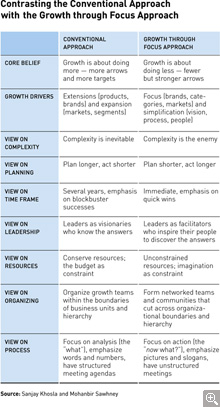
        …To improve the quality of growth, business leaders need to cut back on marginal products, brands, and markets so that they have a better chance of winning in their chosen areas of focus. …
        The logic of growth through focus also suggests a very different view on planning and leadership. Many companies tend to make long-term strategic plans, but they often have a short attention span in execution. … We recommend the reverse: Plan quickly and then stay the course for a long time, as long as five years. Leaders should resist the temptation to change strategies too often.
        Seven Steps in Growth through Focus
        Our experience suggests that growth through focus requires the organization to progress systematically through a set of seven steps: discovery, strategy, vision, people, execution, organization, and metrics. Taken together, they represent a powerful formula for driving profitable growth.
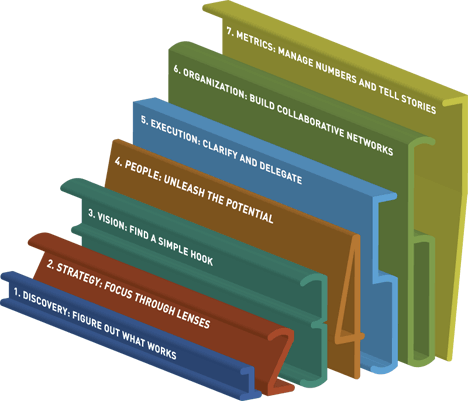
        1. Discovery: Figure Out What Works
        … The first step in the growth journey is to discover what is working well and where the company is already winning. These pockets of excellence help identify focus areas for growth. An effective way to uncover what works is to conduct a series of workshops with the top leaders from the company. …
        … In addition, great insights often come from engaging with suppliers, creative and media agencies, and consultants who have worked with the company for a long time. On the other end of the spectrum, it is also important to listen to people who push back — and to manage dissent. As the process goes on and the framework and vision are agreed upon, debate on the strategic framework should cease and the emphasis should switch to execution.
        2. Strategy: Focus through Lenses
        The discovery process produces a set of success themes. In the second step, these themes need to be clustered and prioritized to define the focused bets that the company should make. …
        Once you find out what works, you can focus on it and scale the success to other markets, products, and brands. …
        3. Vision: Find a Simple Hook
        Once the focus areas have been defined, the findings need to be summarized in a compelling yet simple vision. The vision serves as a rallying cry for the organization to align its efforts behind a clearly understood goal. …
        To make the vision compelling yet easy to understand, we recommend creating a “hook.” The hook should be kept consistent over time and across customer touch points. It can be a color, a number, an acronym, a phrase, or a symbol. …
        Once a vision is chosen, it needs to be launched with a bang through a seminal event designed to inspire the team. …
        In communicating the vision, pictures are often worth a thousand words or PowerPoint slides. Simple visuals that depict the “from–to” journey can serve as powerful communication tools. …
        4. People: Unleash the Potential
        Once the vision and strategy have been defined and powerfully communicated, the next step is to find the right people and to place disproportionate resources in their hands. The right people need to be placed in all functions — supply chain, R&D, marketing and sales — to ensure that you have the skills to win. …
        Once new leaders are appointed, they need to be given the freedom to operate within the strategic framework so that their potential can be truly unleashed. Leaders should be challenged to act as entrepreneurs within large companies that have traditionally been perceived as process-driven and bureaucratic. …
        5. Execution: Clarify and Delegate
        With the discovery, strategy, vision, and people in place, the next challenge is execution. This is the most important step in the journey, and it is also the most difficult. Execution has two key elements. First, everyone needs to be clear about who will do what, to avoid ambiguity about roles and responsibilities. Second, decision making needs to be moved closer to customers and consumers so that the people responsible for results have the operating freedom they need. …
        To accelerate execution, we recommend a strong bias for action. Business leaders should demand a dramatic reduction in internal documents and meetings. … For the most part, we suggest a “no PowerPoint” policy in presentations; meetings are often far more productive if they focus on discussion based on pre-reading. Numbers may help tell the story, but too often, we find that numbers become the story and the big picture gets lost.
        6. Organization: Build Collaborative Networks
        Growth initiatives rarely fit within organizational silos of function, geography, and business unit. Rather, they need to be managed by creating communities and networks across the company, formal as well as informal. …
        This approach of matching skills with priorities and connecting communities to get the best mix of global and local ideas, within a clearly defined strategy, has a powerful effect in leveraging scale and expertise.
        7. Metrics: Manage Numbers and Tell Stories
        As the execution and organization processes get under way, it is important to keep score. Scorecards should be objective, and they should be kept simple. Overly complex metrics take attention away from the measures that really matter and can obfuscate execution priorities. …
        Managing growth requires a focus on numbers, but numbers alone are not enough. Storytelling is a powerful tool for propagating the culture of winning in the organization. … Leadership should make it a point at every large internal meeting to put successful people on the stage to share their stories with their colleagues. Success stories become part of the culture, and successful people become heroes in the eyes of their peers and managers. Moreover, highlighting the achievements of successful teams creates “positive shame”; the teams that are not on the stage feel strong peer pressure. This positive pressure is far more effective than the “negative shame” that would be created if the less-successful teams were berated in reviews.
        Avoiding the Traps
        With any transformation initiative, there are pitfalls to avoid and hurdles to overcome on the way to success. Here are a few to keep in mind in implementing growth through focus.
        One common pitfall is to seek to build scale before fixing underlying problems. …To convert potential into actual revenues and profits, however, you first need a business model that works. You must have the distribution reach, the supply chain, the manufacturing capabilities, and the right products before you can scale the business. …
        Another potential trap in implementing growth through focus is neglecting or mismanaging the parts of the business that do not fall within the core focus areas. This is the “tail” of your business — … Simply cutting off the tail can be disastrous, because the decline of the tail is often faster than the growth of the core. Further, the non-core businesses often have fixed costs that are linked to the core businesses. Finally, cutting and divesting can have a huge demoralizing effect, because people often have strong emotional ties to some of these businesses.
        What you need is a clear plan to manage the tail. We find it helpful to cluster the non-core businesses into two buckets — “milk or divest” and “local jewels.” The two buckets need very different management approaches. The first category includes businesses that do not make money and have no hope of making money, despite repeated promises of future turnarounds. These need to be divested over a defined time frame. … Local jewels are successful local businesses that can be retained in the portfolio but managed at arm’s length by local teams, leaving the global teams to focus on the core businesses. … These businesses should be left to determine their own destiny but should be held accountable for revenues, margins, and cash flow.
        Too often, when companies rationalize and focus, they slash expenses across the board. Two areas that take the brunt of cost cutting are people-related expenses (recruitment, training, travel) and brand advertising. However, talent and brands are the two most valuable assets for driving growth. We recommend increasing investments in hiring and developing talent, even ahead of the company’s needs. We also recommend increasing investments in building brands. The good news is that the growth-through-focus approach yields significant cost savings through elimination of management layers, reduction of overhead, and elimination of marginal businesses. Focus frees up resources that can be used to invest in the future.
        Once a strategic direction has been established, it is important to stay the course until the strategy has been fully implemented. … In our experience, the transformation process takes as long as five years to play out. …
        Finally, keeping a positive tone is vital to the success of growth through focus. … The energy that comes from winning is infectious. It inspires people to achieve goals that they have never before considered possible. Leaders should act as evangelists and cheerleaders, spreading the positive energy and making sure the teams are having fun at winning.
        … To win in your businesses, you must harness the power of focus. By following the seven steps in our blueprint, business leaders can drive profitable growth even in difficult economic times.

        Building Scale for Focus: A Tale of Two Acquisitions

        Growth through focus involves a reduction in the number of products, categories, brands, and markets that the company should focus on. But it also demands an increase in the scale of the businesses that the company chooses to focus on. Scale can be generated by building on the brand and product assets that the company has in its portfolio through organic growth. However, organic growth may not be enough to get to the required scale, particularly when the company is betting on markets or categories in which it is not a market leader. Further, in some emerging markets, building distribution networks from scratch is a Herculean task. This is where acquisitions play an important role in the growth-through-focus approach. They can help the company acquire scale in its chosen domains. The acquisition strategy should be driven by the focus strategy, and a clear logic should link the acquisition to the strategic framework for growth….
        The focus lenses chosen in the second step of our approach can be used to identify and prioritize acquisition targets. …
        —S.K. and M.S.
        Reprint No. 00034

        Author Profiles:

        • Sanjay Khosla is president of Developing Markets and Global Categories for Kraft Foods. He has more than three decades of leadership experience in global consumer packaged goods companies and has lived and worked around the world.
        • Mohanbir Sawhney is the Robert R. McCormick Tribune Foundation Clinical Professor of Technology and director of the Center for Research in Technology and Innovation at Northwestern University’s Kellogg School of Management. He has coauthored five books and many articles on marketing, technology, and innovation.
        Enhanced by Zemanta

        Wednesday, January 19, 2011

        7 Reasons Why Small Businesses Should Take a Look at Foursquare

        Small Business Marketing Blog from Duct Tape Marketing
        posted by: John Jantsch
        Mon Jan 04, 2010
        …The idea behind location awareness is that people will use the GPS capabilities in today’s mobile devices to check-in, tweet, review, and refer and add their location while doing so. Today I would like to talk about what I think is one of the first location aware services that is already beginning to impact small business.
        Foursquare (social networking)Image via WikipediaThe service is called Foursquare and while it’s receiving lots of hype from the bleeding edge social media types as the next Twitter, it may be totally foreign, or at least nonsensical, to many small business owners. While I want to use this post to introduce you to Foursquare, keep in mind that my primary point of view is that of the small business marketer and what I believe Foursquare has to offer, and not really the Foursquare user per se.
        Having said that I do first feel the need to give you an overview of Foursquare.
        The big picture
        Foursquare is a location enabled service that allows users to “check in” when then stop at a bar, restaurant, park, bookstore or really anywhere they want to list. The service further allows users to connect with friends and alert them of your location if you choose. …  Foursquare also turned this activity into a game: a point that I believe led to its current role as a leader in this evolving space. …
        Foursquare is self-described as – “Think: 50% friend-finder, 30% social cityguide, 20% nightlife game.”
        Users compete with check-ins to earn points for their city, badges for various types of activity and to become mayor of frequented spots. …
        Users also add and update information about businesses, write tips and make suggestions for anyone to consume. …
        Image representing iPhone as depicted in Crunc...Image via CrunchBaseFoursquare is set-up around cities and enhances the kind of neighborhood, hyper-local, branding and community building that is so important to local type small businesses. The service is currently available in a growing list of cities and is driven by iPhone, Android and Blackberry apps. Check out the Foursquare help page for some more detail.
        … I’m not ready to suggest that every business rush to Foursquare as the next red hot thing, not yet anyway, but I do want to point our a handful of reasons that many small business should start paying attention to this growing force, even if you don’t get it.
        Below are seven reasons why I think Foursquare may hold promise for small business
        1) Hyper local, tech savvy, evangelists – Foursquare user are people that really love their neighborhoods, getting out and evangelizing the businesses they love. This tech savvy, early adopter is exactly the kind of consumer business should kill for as they often influence large circles. Embracing Foursquare and giving these tech leaders the tools to promote your business is just plain smart business.
        2) Online offline – …Foursquare is yet another way for local business to use the efficient online tools to drive more in-person, offline activity. People are physically checking in to your business and talking about online in what can turn into a tremendously effective one-two punch.
        Showing nearby venues on the Foursquare Androi...Image via Wikipedia3) Make offers – On a recent trip to Chicago I checked into my Marriott on Foursquare and immediately received notice that three nearby businesses had a special offer for me. … You can visit the Foursquare business page to get your business signed up. …
        4) Track and reward – Foursquare’s gaming functionality allows businesses to create special promotions for mayors and badge earners and in effect setting up a competition among their most loyal fans. The image below comes from a special promotion hosted by blynk organic, a restaurant in North Carolina. By creating and communicating Foursquare’s tools and platform you can begin to educate customers and create Foursquare advocates for your business. Some bars and restaurants routinely promote free offers for mayors.

        5) The power of making it a game – One of the most intriguing aspects of Foursquare is the game. It’s amazing what some folks will do in order to win a game, come in first or, in this case, be the mayor of a popular spot. …
        6) Automated CRM data – … Every business should find ways to capture everything they can about a customer. Obviously email is a great tool and can be very effective for follow up marketing. … Foursquare can provide business owners with check-in stats for users. What this means is that the customer that comes in every day can now be tracked and even incentivized to get a free cup of coffee for every tenth check-in. It’s like the digital/social version of the loyalty card. …
        7) Sync with Twitter and Facebook - Like all good social media platforms Foursquare understood the need to integrate with platforms that others already use. Foursquare users have the option to tweet or add a Facebook status update every time they check-in. What this means is that a Facebook user with a few hundred friends might expose your business by way of a Foursquare check-in to thousands of Facebook walls. While many of those folks on Twitter or Facebook may not be in your part of town, I’m thinking it’s still a pretty good thing for the brand.

        While I’ll caution again that Foursquare might not be the highest priority for many businesses, it’s something that is coming and will be put to use by businesses outside of the retail and entertainment world (I can already imaging how real estate agents could use this.) Businesses that get how to use, stimulate adoption and promote Foursquare now could hold a significant advantage when and if Foursquare becomes the next Twitter.
        Sidebar: Look for Facebook or Google to acquire Foursquare before the year is over.
        Image credit: Joshua Kaufman
        Enhanced by Zemanta