Pages

Showing posts with label Startup company. Show all posts

Friday, July 20, 2012

3 vital tips for startup success

bizjournals

July 20, 2012  |  8:30am EDT

by John Harthorne, Young Entrepeneur Council


Image representing Dharmesh Shah as depicted i...
Image by Dharmesh Shah via CrunchBase
Advice is crucial to entrepreneurial success—it keeps businesses flexible and entrepreneurs humble. Throughout my career, I’ve made sure to stay open to advice, even (and especially) after tasting success.

Earlier this year, I heard an excellent keynote delivered by Dharmesh Shah, chief technology officer and founder of Hubspot. … The following is a combination of my own collection of advice and some of what Dharmesh told a crowd back in March.

1. Don’t fall in love with your plan or product. Instead, do fall in love with the problem you’re solving and the people you’re impacting. … Seek out advice and mentorship early, listen, and then adjust your plan and product to better address your customers and the problem your product aims to solve. As Dharmesh said, “It’s not about making the best camera. It’s about making the next generation of photographers.”


Image representing Tim O'Reilly as depicted in...
Image via CrunchBase
2. Your goal is not to beat the competitors, but to make an impact. It’s easy to forget that … if you beat everyone else in your field, your company does not necessarily win. The companies that do win, however, are companies that make the biggest impact. … Therefore, go for the gold by thinking bigger rather than focusing on conquering and dominating the competition. … Tim O’Reilly wrote, “Pursue something so important that even if you fail, the world is better off with you having tried.” Remembering the potential impact of your project will keep you working through the night, which is what it takes to succeed.

3. Nobody ever regrets taking the leap. … Though I do think it’s a good idea to create some sort of safety net as a backup plan—I paid off some student loans before diving in completely—you must be fully committed to your own startup. No one will take a risk on you if you don’t take that risk on yourself. Quit your day job and start living and breathing your startup. It’s scary to take risks, but the leap—in fact, many leaps—is what it takes to inspire people to join your team, invest in your idea, and help you launch your company.


John Harthorne, Founder & CEO MassChallenge, P...
John Harthorne, Founder & CEO MassChallenge, Priyanka Bakaya ,PK Clean Chief Executive Officer and Founder, Marcia Fournier, Ph.D. Founder & CEO of BioArray Therapeutics and Governor Deval Patrick (Photo credit: Office of Governor Patrick)
John Harthorne is the founder and CEO of MassChallenge, a startup accelerator and competition designed to catalyze a startup renaissance by connecting high-impact startups from around the world with the resources they need to launch and succeed.

The Young Entrepreneur Council is an invite-only nonprofit organization comprised of the world’s most promising young entrepreneurs. The YEC recently published #FixYoungAmerica: How to Rebuild Our Economy and Put Young Americans Back to Work (for Good), a book of more than 30 proven solutions to help end youth unemployment.
Enhanced by Zemanta

Monday, December 19, 2011

The 10 Biggest Mistakes Entrepreneurs Make

Growing Your Empire Newsletter
By Paul Lemberg
It's hard to avoid certain mistakes, especially when you face a situation for the first time. In fact, many of the following mistakes are hard to avoid even if you're an old hand. Of course, these are not the only mistakes CEOs make, but they sure are common enough. …

1. Big Customer Syndrome
If more than 50 percent of your revenues come from any one customer you may be headed for a meltdown. … [You] are so busy servicing that one big account that you fail to develop additional customers and revenue streams. Then suddenly, for one reason or another, that customer goes away and your business borders on collapse.

Use that burgeoning account as both a cause for celebration and a danger signal. Always look for new business. And always seek to diversify your revenue sources.

2. Creating products in a vacuum.
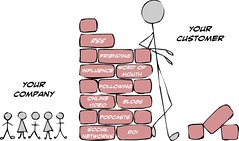
Customers are Ignoring YouImage by ronploof via FlickrYou and your team have a great idea. … When you finally bring it to market, no one is interested. Unfortunately you were so in love with your idea you never took the time to find out if anyone else cared enough to pay money for it. …

… Do the market research up front. … Talk to potential customers, at least a dozen of them. … If enough people say "yes" go ahead and build it. Better yet, sell the product at pre-release prices. Fund it in advance. If you don't get a good response, go on to the next idea.

3. Equal partnerships
Suppose you are the world's greatest salesman, but you need an operations guy to run things back at the office. Or you are a technical genius, but you need someone to find the customers. Or maybe you and a friend start the company together.

In each case, you and your new partner split the company 50/50. That seems fine and fair right now, but as your personal and professional interests diverge, it is a sure recipe for disaster. Either party's veto power can stall the growth and development of your company, and neither holds enough votes to change the situation.
Almost as bad is ownership split evenly among a larger number of partners, or worse, friends. … No one has the final say, every little decision becomes a debate, and things bog down quickly.

President Harry Truman with Image via WikipediaTo paraphrase Harry Truman, the buck has to stop somewhere. Someone has to be in charge. Make that person CEO and give them the largest ownership stake, even if it's only a little more. 51/49 works much better than 50/50. If you and your partner must have total equality, give a one percent share to an outside advisor who becomes your tie-breaker.

4. Low prices
Some entrepreneurs think they can be the low price player in their market and make huge profits on the volume. Would you work for low wages? Why do you want to sell at low prices? … Remember, low margins = no profits = no future. So the grosser the better.

Set your prices as high as your market will bear. Even if you can sell more units and generate greater dollar volume at the lower price (which is not always the case) you may not be better off. … Figure all your incremental costs. Figure in the extra stress as well. For service companies, low price is almost never a good idea. How do you decide how high? Raise prices. Then raise them again. When customers or clients stop buying, you've gone too far.

5. Not enough capital
… Regardless of the cause, many businesses are simply undercapitalized. Even mature companies often do not have the cash reserves to weather a downturn.

Be conservative in all your projections. Make sure you have at least as much capital as you need to make it through the sales cycle, or until the next planned round of funding. Or lower your burn rate so that you do.

6. Out of Focus
… [Many] entrepreneurs - hungry for cash and thinking more is always better - feel the need to seize every piece of business dangled in front of them, instead of focusing on their core product, service, market, distribution channel. Spreading yourself too thin results in sub-par performance.

Concentrating your attention in a limited area leads to better-than-average results, almost always surpassing the profits generated from diversification. …

… Don't spread yourself thin. Get known in your niche for the thing you do best, and do that exceedingly well.

English: Los Angeles Times building in downtow...Image via Wikipedia7. First class and infrastructure crazy
Many a startup dies an untimely death from excessive overhead. … Your management team should earn the bulk of their compensation when the profits roll in, not before.

… Spend all the money really necessary to achieve your objectives. Ask the question, will there be a sufficient return on this expenditure? Everything else is overhead.

8. Perfectionitis
… Finishing the last 20 percent of the last 20 percent could cost you more than you spent on the rest of the project. When it comes to product development, Zeno's paradox rules. Perfection is unattainable and very costly at that.

Plus, while you're getting it right, the market is changing right out from under you. On top of that, your customers put off purchasing your existing products waiting for the next new thing to roll out your doors.

… Focus on creating a market-beating product within the allotted time. … Know when you have to stop development to make a delivery date. When your time's up, it's up. Release your product.

English: Return on Investment analysis graphImage via Wikipedia9. No clear return on investment
Can you articulate the return which comes from purchasing your product or service? … You say it's too hard to quantify? … If it's too difficult for you to figure, what do you expect your prospect to do?

… Talk to your customers, create case studies. Come up with ways to quantify the benefits. … If you can demonstrate the great return on investment your product provides, sales are a slam dunk.

10. Not admitting your mistakes.
… At some point you realize the awful truth: you have made a mistake. Admit it quick. Redress the situation. … Sometimes this is hard, but, believe me, bankruptcy is harder.


Assume your costs are sunk. Your money is lost. There is good news: your basis is zero. From this perspective, would you invest fresh money in this idea? If the answer is no, walk away. Change course. Whatever. But do not throw any more good money after bad.
OK, everybody makes mistakes. Just try to catch them quickly, before they kill your company.

***
Paul Lemberg helps small business owners become wealthy. Since 1995, Paul has helped hundreds of small business owners achieve outstanding success. He has written three books, including Faster Than the Speed of Change, Earn Twice As Much with Half The Stress (co-authored with Tom Matzen), and his latest, the business best seller, Be Unreasonable. On television, Paul has appeared on Good Morning America, CNN, Financial News Network, and dozens of national radio programs. His work has been featured in over eighty magazines and publications including the New York Times and the Los Angeles Times, as well as the world's largest circulation newsletter, Bottom Line Personal. You can learn more about Paul at http://www.paullemberg.com/.

Enhanced by Zemanta

Tuesday, November 15, 2011

Richard Branson on How to Avoid Common Startup Mistakes

Image representing Richard Branson as depicted...Image via CrunchBase

Entrepreneur.com
BY Richard Branson

Editor's Note: Entrepreneur Richard Branson regularly shares his business experience and advice with readers. What follows is the latest edited round of insightful responses. …

Q: What are some of the most common mistakes entrepreneurs make when starting out? -- John Gachiri

A: Making mistakes is part of the process of building a company; quickly recovering from them is what's most important. …

But your way forward is not entirely uncharted: When you notice an opportunity that has never occurred to anyone else, there are certain steps to turning your vision into reality. You must formulate an innovative business plan, find funding, hire the right people to carry out the plan, and then step back from your role in the business at exactly the right moment.

Step 1: Stay on Target
A mistake often associated with the first step is signaled by an entrepreneur's inability to clearly and concisely convey his idea. You have to be able to generate buy-in from investors, partners and potential employees, so nail down your "elevator speech" -- what you would say if you ran into an important potential investor in an elevator. Try using a Twitter-like template to refine the essence of your concept into just 140 characters. Once you've done that, expand your message to a maximum of 500 characters. Remember, the shorter your pitch is, the clearer it will be.

An associated error is lack of focus. ... Clearly define your goals and strategies, then establish a timeline. Don't let the other possibilities or hazy dreams distract you from achieving your goal.
Getting too far ahead of yourself is also dangerous. If your product or service is still on the drawing board, don't get sidetracked by plans for future versions. As a general guideline, looking two or three years ahead is best, but the nature of your business and feedback from your investors will help you determine just how far ahead you should plan.

Be flexible, because just as lack of planning can be a problem, adhering blindly to your plan is a surefire way to steer your company off a cliff. A successful entrepreneur will constantly adjust course without losing sight of the final destination.

Step 2: Be Realistic About Costs
Don't shortchange your start-up when estimating the funds you will require -- you'll just diminish your chances of success. Keeping your expenses under control is vital, but don't confuse capitalization with costs. …

Step 3: Hire the People You Need, Not the People You Like
As tempting as it may be to staff your new business with friends and relatives, this is likely to be a serious mistake. If they don't work out, asking them to leave will be very tough.

When Virgin starts any new business, we always hire a core team of smart people who already know the industry and its inherent risks. … One of your goals should be to find a manager who truly shares your vision, and to whom you can someday confidently hand the reins so that you can carry out the next step.

Step 4: Know When to Say Goodbye
A great entrepreneur knows when the time has come to leave the CEO role. It's seldom easy, but it has to be done: few entrepreneurs make great managers. …

Stepping back doesn't mean turning your back on your business. …

Image representing Google as depicted in Crunc...Image via CrunchBaseImage representing Larry Page as depicted in C...Image via CrunchBaseFounders shouldn't hesitate to re-insert themselves into their businesses when necessary -- look at Larry Page, who temporarily returned to the CEO role at Google in April. That said, I had to laugh when I heard this news, wondering how many managers at Virgin businesses had thought, "Wow, I hope this doesn't give Richard any ideas."
Enhanced by Zemanta

FAQ: What the new U.S. crowdfunding bill means for entrepreneurs

Image representing LinkedIn as depicted in Cru...
Image via CrunchBase


Scott Edward Walker is the founder and CEO of Walker Corporate Law Group, PLLC, a law firm specializing in the representation of entrepreneurs.

Last week, the U.S. House of Representatives passed a crowdfunding bill that will allow startups to offer and sell securities via crowdfunding sites and social networks. If passed by the Senate and signed off by the President, the bill will become a law, giving entrepreneurs new options for raising money for their companies. …
What is crowdfunding?
As the term suggests, crowdfunding is funding from a crowd of people; that is, many people provide small amounts of money to finance something. Crowdfunding has its roots in charitable causes, including the advent of microfinancing …
Can startups use crowdfunding now?
Under current laws, startups may not sell stock or other securities through crowdfunding sites or social networks… They may, however, accept donations.
This is because of applicable federal securities laws ... The laws include the following:
  • A prohibition against “general solicitation” — which means that a company may not offer or sell securities unless there is a substantive, pre-existing relationship between the company (or a person acting on its behalf) and the prospective investor. (See “Can I Raise Money For My Startup Via Twitter?”)
  • Disclosure and state law compliance requirements if the investors are not “accredited investors” — which usually makes the offering too costly and onerous. (See “Ask the attorney — securities laws.”)
  • A requirement that any intermediaries (including websites) must be registered with the SEC as a “broker-dealer” in order to legally accept any transaction-based compensation in connection with the sale of securities. (See “Finder keepers could be losers, weepers”).
What will the new crowdfunding bill do?
Basically, if this new crowdfunding bill becomes a law, all of the foregoing prohibitions and requirements will be lifted, and a startup will be able to sell securities through crowdfunding sites like Kickstarter, or social networks like Twitter or Facebook, so long as the company (and its intermediary, if applicable) comply with the bill. According to the bill, the company will have to meet these key provisions:
  • The company may only raise a maximum of $1 million, or $2 million if the company provides potential investors with audited financial statements.
  • Each investor is limited to investing an amount equal to the lesser of (i) $10,000 or (ii) 10% of his or her annual income.
  • The issuer or the intermediary, if applicable, must take a number of steps to limit the risk to investors, including (i) warning them of the speculative nature of the investment and the limitations on resale, (ii) requiring them to answer questions demonstrating their understanding of the risks, and (iii) providing notice to the SEC of the offering, including certain prescribed information.
Are there any downsides to crowdfunding for startups?
Yes, there are several key downsides that you need to be aware of before jumping into crowdfunding.
First, startups must understand that minority stockholders have certain significant rights under state law, including voting rights, the right to inspect the company’s books and records, the right to bring a derivative claim on behalf of the company, and certain protections against oppression by the controlling stockholders. …
Second, having hundreds of stockholders is an administrative nightmare and will be time-consuming and costly. …
Third, startups will likely have difficulty raising funds from VCs and other sophisticated investors if they have hundreds of unsophisticated stockholders. …
What’s next?
Now we wait for the U.S. Senate, … The White House supports the House bill, so upon reconciliation, it will be signed into law. Then entrepreneurs will have a new option to consider when raising money for their startup.

About the Author, Scott Edward Walker

Scott Edward Walker is the founder and CEO of Walker Corporate Law Group, PLLC, a boutique corporate law firm specializing in the representation of entrepreneurs. Scott has 15+ years of broad corporate law experience, including nearly eight years at two prominent New York City law firms. He has built a strong team of lawyers, with offices in Los Angeles, San Francisco and Washington, D.C. You can follow him on Twitter as @ScottEdWalker or check out his blog.
Enhanced by Zemanta

Tuesday, September 6, 2011

The No. 1 Predictor of Startup Failure: Premature Scaling

 PEHub
Posted on: September 5th, 2011
Joanna Glasner

…The Startup Genome Project … published last week, crunches data from a set of more than 3,200 companies, seeking to identify the qualities that make startups most likely to either succeed or fail.
… The most consistent predictor of failure, …was a startup’s propensity to engage in premature scaling.

What is premature scaling? The authors define it as “focusing on one dimension of the business and advancing it out of sync with the rest of the operation.” For example, a startup may overspend too early on customer acquisition, hire too many employees, or focus too much on engineering at the expense of customer development. …

Researchers at the Startup Genome project, an eight-month-old effort supported by a collection of startup industry insiders and academics, also churned out some other interesting findings related to startup success. Insights include:

Pivoters do better: Switching a core facet of one’s business model, or pivoting, is sometimes the only way a startup can stay competitive in a fast-changing market. …

Diagram of the typical financing cycle for a s...Image via Wikipedia… Researchers found startups that pivot once or twice raise 2.5 times more money, have 3.6 times better user growth, and are 52% less likely to scale prematurely than startups that pivot more than two times or not at all.

Co-founders scale faster: Researchers found solo founders take 3.6 times longer to reach scale stage compared to a founding team of two, and they are 2.3 times less likely to pivot.

Business and Technical Partners Outperform: Teams with one business and one technical founder raise 30% more money, have 2.9 times more user growth, and are 19% less likely to scale prematurely than technical or business-heavy founding teams.

Founders are ridiculously over-optimistic: Researchers found that startups need two to three times longer to validate their [market] than most founders expect. Startups that haven’t raised money, meanwhile, tend to over-estimate their prospective market size as 100 times bigger than it actually is.

Interestingly, while premature scaling is quite common, its opposite, which the authors call dysfunctional scaling, is quite rare. … Curious to see if you’re committing any of these startup sins? The Startup Genome Project has a tool for companies to test whether they are scaling prematurely.
Enhanced by Zemanta

Wednesday, August 24, 2011

Cautious optimism: Startups will come out ahead


August 23, 2011 | Adeo Ressi

It’s hard to not get a sinking feeling in my stomach when I watch the stock market drop and hear smart people talk about a 25 percent correction. …

However, if you look closely, there is a new reality today. There are reasons to be cautiously optimistic.

The Start-up StageImage via WikipediaFirst, let’s start by looking at the modern angel investor. … [Many] of today’s angels work in startups and have pulled money off the table through a sale, IPO or, more likely, the secondary markets. They are skeptical of public markets after the debacles of 2000 and 2008. Therefore, while a 16 percent decline in the public markets may drop the aggregate amount of angel investments, modern angels will continue to invest in what they know: startups.

Diagram of venture capital fund structure for ...Image via WikipediaSecond, let’s look at the limited partners (investors in venture capital funds). Long before this correction, many of them had already fled the venture capital asset class, and they are not coming back. … Smarter VCs have adjusted by tapping sovereign wealth funds and other alternative capital sources, including the wealth of the partners themselves. …

Third, the VCs themselves have already been doing fewer and fewer deals since the end of 2008. … Entrepreneurs have already adjusted to a world where venture capital is a scarce source of capital (AngelList, for example), so a change in deal volume should not significantly change startup financing.

Finally, the mergers and acquisitions market is better positioned than it has been in the past. Large corporations are sitting on enormous cash reserves, and it is only a matter of time before we see a greater number of acquisitions. The thousands of angel-backed startups being launched each year represent attractive acquisition targets. …

Even if the correction continues and startup financing shrinks, we’re not facing a post-party “sober-up” stage similar what happened to 2000 and 2008. The reality is that creating meaningful and enduring technology companies is not a zero sum game. In a world of nearly seven billion people with 30 percent internet penetration and nearly two thirds of the global population using cell phones, there is room for thousands of new technology companies each year. And, if everything does go to hell again, the true entrepreneurs make their own luck.

I for one maintain a healthy dose of cautious optimism: Startups will come out ahead.
Image representing Founder Institute as depict...
Image via CrunchBase
photo of Adeo Ressi, Founder's Institute
Adeo Ressi is the founder of the Founder Institute, a global network of startups and mentors that launches hundreds of technology companies per year across four continents. Applications are now open in over 10 cities worldwide. Follow the Founder Institute on Twitter at @founding.
Adeo will also be one of the “sages” appearing onstage at DEMO Fall 2011, a conference co-produced by VentureBeat. It’s happening in Silicon Valley Sept. 12-14.Register Today and take advantage of our special VentureBeat Partner rate of $995.00.
[Image via Olena T./Shutterstock]
Enhanced by Zemanta

Thursday, June 23, 2011

A new option if you want to invest in startups |


 Just a decade ago, if you wanted to invest in a startup you had to know someone. Today, it’s a lot easier to become an angel investor, due to crowd funding, micro lending and investment sites like MicroVenture Marketplace Inc., which is opening doors to those looking to invest $1,000 to $10,000 or more.

Diagram of the typical financing cycle for a s...Image via WikipediaThe way to win at angel investing, of course, is to invest in the right startups. To get there, you need:
  1. 1) Good deal flow from which to spot potential winners.
  2. 2) The ability to invest in multiple deals so you gain experience.
  3. 3) A knack for spotting companies, and more importantly people, who will succeed.
Enhanced by Zemanta