Pages

Showing posts with label Philanthropy. Show all posts

Friday, December 30, 2011

The Power of the Post-Recession Consumer

An analysis of attitudes and spending reveals a return to traditional values, driven by consumers searching for quality, affordability, and connection.

strategy+business magazine
February 22, 2011 / Spring 2011 / Issue 62
by John Gerzema and Michael D'Antonio
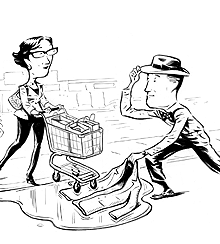
Illustration by Lars Leetaru

English: The financial crisis affectes the rea...Image via WikipediaThe wave of hyper-consumerism that propelled the U.S. economy through the last decades of the 20th century and into the first years of the 21st century has passed. …Consumer spending patterns are changing as part of a trend that has been quietly gathering strength over the past 10 years. …People are returning to old-fashioned values to build new lives of purpose and connection. They also realize that how they spend their money is a form of power, and are moving from mindless consumption to mindful consumption, increasingly taking care to purchase goods and services from sellers that meet their standards and reflect their values.

This change in consumer attitudes … is …, in part, a reaction to economic hard times. But it is also closely related to the civic dissatisfaction that is rocking the political establishment, and additionally has some roots in environmental awareness and changing aspirations. That is why this Spend Shift movement, as we call it, is here to stay. It will create opportunities for businesses that heed its message, and penalize those that do not. (For another perspective, see “Values vs. Value,” by Timothy Devinney, Pat Auger, and Giana M. Eckhardt, s+b, Spring 2011.)

Our view of the Spend Shift is based on two years of gathering and analyzing data, and traveling around the U.S. to discover how the recession has affected people’s lives. We started with Young & Rubicam’s BrandAsset Valuator (BAV), which is a poll of consumer values, attitudes, and shopping behaviors that goes back nearly 20 years. …

The BAV data revealed that even before the recession took hold in mid-2008, there were dramatic shifts in what people expected in the consumer marketplace and how they defined and pursued what they considered the good life. … More recently, the BAV surveys show sharp increases in the number of consumers who want positive relationships with marketplace vendors and who focus more on corporate behavior. Between 2005 and 2009, a growing number of people rejected status-driven values such as snobbishness and exclusivity, and embraced attributes related to bringing people closer together or making the world a better place. Among the once-prized brand attributes that declined in this period were: “exclusive” (down 60 percent), “arrogant” (down 41 percent), “sensuous” (down 30 percent), and “daring” (down 20 percent). On the opposite side of the scale, the brand attributes Americans found more important as they began to sense the impending recession and then suffered through the crisis were: “kindness and empathy” (up 391 percent), “friendly” (up 148 percent), “high quality” (up 124 percent), and “socially responsible” (up 63 percent).

… Between 2005 and 2009, U.S. consumers expressed a nearly fourfold increase in their preference for companies, brands, and products that show kindness in both their operations and their encounters with customers. This desire for companies to be more empathetic toward consumers is the biggest shift in any attitude that we have ever seen during the BAV survey’s two-decade history. …
1. United by Change
The Spend Shift is a far-reaching and inclusive phenomenon that can’t be defined by any particular demographic. According to our data, 55 percent of all Americans are part of this movement; in addition, about one-quarter of the U.S. adult population embraces many of the Spend Shift attitudes and characteristics (we call them Fast Followers). Although the word values tends to polarize U.S. citizens, the Spend Shift is blind to geography, education, age, and income. …

What unites all these Spend Shifters is a common sense of optimism and newfound purpose. As the shock of economic loss wears off for many people, they are redefining what it means to be successful and happy. They are living with less and yet feeling greater satisfaction. …
2. The New Thrift
…Consumer spending will no longer be able to grow faster than personal income, as it did during the 30 years leading up to the crisis. … If you look at historical savings rates in the U.S., people have on average saved 10 percent of their income going back as far as six decades. It was only in the mid-1980s that … ordinary people [ere encouraged] to get out over their skis. In only 20 years, average American households swung from being net savers to being net borrowers. Now, however, consumers are returning to traditional values that have long defined the U.S. ideal.

English: Weight Watchers Center, Newton Highla...Image via Wikipedia… In the post-recession economy, resourcefulness and self-sufficiency are viewed as virtues, and excessive consumption as a sign of weakness. … We examined the 2009 performance of a basket of “retooling” companies — those that are in the top 10 percent of our data on being “helpful,” “reliable,” “educational,” and “durable,” such as LeapFrog, Weight Watchers, Craftsman, and DeWalt, because they help people help themselves. The performance of these companies against all others is notable: They performed 249 percent better than other companies when respondents were asked whether they would recommend these brands to a friend, 234 percent better when respondents were asked if they used the products regularly, and 210 percent better on whether the products were worth a premium price.

…[Many] people, … are seeking ways to experience a sense of competence, self-sufficiency, and accomplishment. … If you have an idea for helping people learn new skills and connect with others, your business has a good chance of success.
3. Transparency Breeds Trust
… Companies serving these customers, who know more and expect more, will need to continuously listen, respond, and innovate. They are in for a challenge: Our data shows that confidence in all types of big organizations, including big government and big business, has declined by nearly 50 percent in the past two years. …

Wary consumers are going beyond just reading labels to get the best products and the best deals. The most tech-savvy are using online services as they stand in the supermarket aisle to get instant access to information on prices and on a company’s social or environmental record. …

… Today, however, customers have equal (and sometimes superior) access to data. As a result, transparency becomes all the more crucial. Today’s stakeholders … crave a true, authentic story. They will be interested in how a company thinks and how it makes decisions. …
4. Companies That Care
… The ability of a company to identify with its customers is now a prerequisite for any brand in the post-crisis age. Today, openness, humility, and understanding are critical. Generosity binds a company to its community and its stakeholders.

The rising importance of generosity reflects the fact that the post-crisis era will be defined by inclusion rather than exclusion. … Spend Shifters are buying artisanal food because they trust companies that reveal how their food is produced and handled. They patronize cooperative small businesses because such businesses use their profits to build up their local regions. Passionate customer groups will also band together to fund niche offerings that speak directly to the areas about which they feel most strongly. Because 71 percent of U.S. consumers are now aligning their spending with their values, businesses that practice in a new way will find a vibrant marketplace. Instead of selling shoes, such businesses sell empathy and respect. … Instead of serving food, companies create communities of hope. Instead of making cars, they promise fairness, openness, and shared discourse.

Consumers will be looking for signs that companies care about their impact on communities and are investing in making things better. … The vanguard companies understand that showing kindness and humanity is now a competitive advantage.

Microsoft is a telling example. … In our BAV survey, Microsoft always scores high on measures of its reputation, exceeding Apple by a wide margin. … Despite its massive size, Microsoft is still widely associated with the single personality of its founder, Bill Gates. He gives Microsoft a human face and, more important, his philanthropy gives the company a heart. …

When we talked to Akhtar Badshah, Microsoft’s senior director of global community affairs, he told us that in its response to the recession, Microsoft pursued three main areas of focus: education, innovation, and jobs and economic opportunity. … The key point is that Microsoft uses both its money and its true areas of expertise to maximize the good it can do as a citizen corporation, showing how a company can be charitable by redeploying its existing assets and infrastructure as tools for social and economic development.
The Consumer Connection
… Although the growth of consumer spending appears to be slowing, we believe that people are simply reallocating the way they spend — looking for a connection to the creator of the product; banding together to get better deals; and pushing service and product creators to do more, price better, and connect more deeply to their wants and needs.

English: A graph illustrating numbers of net j...Image via WikipediaEven as people find themselves less rich, they are deploying their dollars in a more calculated and strategic way to influence institutions such as corporations and government. …

The most successful companies will respond to this shift by adopting a business model in which all three parties — the business, the customer, and the community — win in every transaction. Although the Spend Shift will dampen domestic demand for some products, the market for values-oriented goods and services offers opportunities for growth in what might otherwise be considered mature categories. We examined the performance of a group of companies and brands that scored in the top 20 percent in the BAV survey on the values we had noted were becoming increasingly important — self-reliance, adaptability, honesty, quality, and community. And we found that in aggregate they enjoyed nearly three times as much usage and preference as brands that did not represent these values.

We believe that the future face of capitalism will be defined by delivering value and values. Those that embrace this reality and adapt will find extraordinary opportunities. Those that ignore it will do so at their peril.

Reprint No. 11107

Author Profile:

Enhanced by Zemanta

Thursday, January 14, 2010

Five attributes of enduring family businesses

The keys to long-term success are professional management and keeping the family committed to and capable of carrying on as the owner.
McKinsey Quarterly
JANUARY 2010 • Christian Caspar, Ana Karina Dias, and Heinz-Peter Elstrodt
Family businesses are an often overlooked form of ownership. Yet they are all around us—from neighborhood mom-and-pop stores and the millions of small and midsize companies that underpin many economies to household names such as BMW, Samsung, and Wal-Mart Stores. One-third of all companies in the S&P 500 index and 40 percent of the 250 largest companies in France and Germany are defined as family businesses, meaning that a family owns a significant share and can influence important decisions, particularly the election of the chairman and CEO.
As family businesses expand from their entrepreneurial beginnings, they face unique performance and governance challenges. … Indeed, less than 30 percent of family businesses survive into the third generation of family ownership. Those that do, however, tend to perform well over time compared with their corporate peers, according to recent McKinsey research. …
To be successful as both the company and the family grow, a family business must meet two intertwined challenges: achieving strong business performance and keeping the family committed to and capable of carrying on as the owner. Five dimensions of activity must work well and in synchrony: harmonious relations within the family and an understanding of how it should be involved with the business, an ownership structure that provides sufficient capital for growth while allowing the family to control key parts of the business, strong governance of the company and a dynamic business portfolio, professional management of the family’s wealth, and charitable foundations to promote family values across generations (Exhibit 1).


  • Exhibit 1: For a family business to be successful, five dimensions of activity must be working well and in synchrony.


    • Family

      Family businesses can go under for many reasons, including family conflicts over money, nepotism leading to poor management, and infighting over the succession of power from one generation to the next. Regulating the family’s roles as shareholders, board members, and managers is essential because it can help avoid these pitfalls.
      Large family businesses that survive for many generations make sure to permeate their ethos of ownership with a strong sense of purpose. Over decades, they develop oral and written agreements that address issues such as the composition and election of the company’s board, the key board decisions that require a consensus or a qualified majority, the appointment of the CEO, the conditions in which family members can (and can’t) work in the business, and some of the boundaries for corporate and financial strategy. …
      Long-term survivors usually share a meritocratic approach to management. There’s no single rule for all, however—policies depend partly on the size of the family, its values, the education of its members, and the industries in which the business competes. …
      As families grow and ownership fragments, family institutions play an important role in making continued ownership meaningful by nurturing family values and giving new generations a sense of pride in the company’s contribution to society. Family offices … can bring together family members who want to pursue common interests, such as social work, often through large charity organizations linked to the family. … It can also keep the family happy by providing investment, tax, and even concierge services to its members.

      Ownership

      Maintaining family control or influence while raising fresh capital for the business and satisfying the family’s cash needs is an equation that must be addressed, since it’s a major source of potential conflict, particularly in the transition of power from one generation to the next. Enduring family businesses regulate ownership issues—for example, how shares can (and cannot) be traded inside and outside the family—through carefully designed shareholders’ agreements that usually last for 15 to 20 years.
      Many of these family businesses are privately held holding companies with reasonably independent subsidiaries that might be publicly owned, though in general the family holding company fully controls the more important ones. … Many family businesses pay relatively low dividends because reinvesting profits is a good way to expand without diluting ownership by issuing new stock or assuming big debts. …
      To keep control, many family businesses restrict the trading of shares. Family shareholders who want to sell must offer their siblings and then their cousins the right of first refusal. In addition, the holding often buys back shares from exiting family members. Payout policies are usually long term to avoid decapitalizing the business.
      Because exit is restricted and dividends are comparatively low, some family businesses have resorted to “generational liquidity events” to satisfy the family’s cash needs. … One chairman said of his company, “Every generation has a major liquidity event, and then we can go on with the business.”

      Governance and the business portfolio

      With clear rules and guidelines as an anchor, family enterprises can get on with their business strategies. Two success factors show up frequently: strong boards and a long-term view coupled with a prudent but dynamic portfolio strategy.
      Strong boards
      Large and durable family businesses tend to have strong governance. … On average, 39 percent of the board members of family businesses are inside directors (including 20 percent who belong to the family), compared with 23 percent in nonfamily companies, according to an analysis of the S&P 500.1
      Of course, it’s important to complement the family’s knowledge with the fresh strategic perspectives of qualified outsiders. Even when a family holds all of the equity in a company, its board will most likely include a significant proportion of outside directors. One family has a rule that half of the seats on the board should be occupied by outside CEOs who run businesses at least three times larger than the family one.
      Procedures for all nominations to the board—insiders as well as outsiders—differ from company to company. …
      Family businesses, like their nonfamily peers, face the challenge of attracting and retaining world-class talent to the board and to key executive positions. In this respect, they have a handicap because nonfamily executives might fear that family members make important decisions informally and that a glass ceiling limits the career opportunities of outsiders. Still, family businesses often emphasize caring and loyalty, which some talented people may see as values above and beyond what nonfamily corporations offer.
      A long-term portfolio view
      Successful family companies usually seek steady long-term growth and performance to avoid risking the family’s wealth and control of the business. This approach tends to shield them from the temptation—which has recently brought many corporations to their knees—of pursuing maximum short-term performance at the expense of long-term company health. A longer-term planning horizon and more moderate risk taking serve the interests of debt holders too, so family businesses tend to have not only lower levels of financial leverage but also a lower cost of debt than their corporate peers do (Exhibit 2).


    • Exhibit 2: Family businesses tend to have lower levels of financial leverage and a lower cost of debt than their corporate peers do.


      • The longer perspective may make family businesses less successful during booms but increases their chances of staying alive in periods of crisis and of achieving healthy returns over time. In fact, despite the unique challenges facing family-influenced businesses, from 1997 to 2009 a broad index of publicly traded ones in the United States and Western Europe achieved total returns to shareholders two to three percentage points higher than those of the MSCI World, the S&P 500, and the MSCI Europe indexes (Exhibit 3). It is difficult to provide statistical proof that the family influence was the main driver. The results were surprisingly stable across geographies and industries, however, and indicate that family businesses have performed at least in line with the market—a finding corroborated by academic research.2


      • Exhibit 3: Publicly traded family-influenced companies often have higher total returns to shareholders than do leading indexes such as MCSI Europe, MSCI World, and S&P 500.


        • This long-term focus implies relatively conservative portfolio strategies based on competencies built over time, coupled with moderate diversification around the core businesses and, in many cases, a natural preference for organic growth. Family-influenced businesses tend to … [make] smaller but more value-creating deals than their corporate counterparts do … . The average deal of family businesses was 15 percent smaller, but the total value added through it—measured by market capitalization after the announcement—was 10.5 percentage points, compared with 6.3 points for their nonfamily counterparts.3
          Nonetheless, too much prudence can be dangerous. … Excessive risk aversion might, for example, unduly limit investments to maintain and build competitive advantage and to diversify the family’s wealth. Diversification is important not only for overall long-term performance but also for control because it helps make it unnecessary for family members to take money out of the business and diversify their assets themselves.
          That’s why most large, successful family-influenced survivors are multibusiness companies that renew their portfolios over time. … In general, family businesses seek a mix: companies with stable cash flows and others with higher risk and returns. …The idea is to renew the portfolio constantly so that the family holding can preserve a good mix of investments by shifting gradually from mature to growth sectors.

          Wealth management

          Beyond the core holdings, families need strong capabilities for managing their wealth, usually held in liquid assets, semiliquid ones (such as investments in hedge funds or private-equity funds), and stakes in other companies. By diversifying risk and providing a source of cash to the family in conjunction with liquidity events, successful wealth management helps preserve harmony. …
          [Recent events] highlight the importance of a professional organization with strong, consolidated, and rigorous risk management to oversee the wealth family businesses generate. For large fortunes, the best solution is a wealth-management office serving a single family…. A wealth-management office that serves a group of unconnected families is an option when individual ones don’t have the scale to justify the cost of a single-family office. …

          Foundations

          Charity is an important element in keeping families committed to the business, by providing meaningful jobs for family members who don’t work in it and by promoting family values as the generations come and go. Sharing wealth in an act of social responsibility also generates good will toward the business. …
          Money alone does not guarantee a high social impact. In addition to the financial and operational issues facing any charitable activity, families must cope with the critical challenge of nurturing a consensus on the direction of their philanthropic activities from one generation to the next. …
          Almost all companies start out as family businesses, but only those that master the challenges intrinsic to this form of ownership endure and prosper over the generations. The work involved is complex, extensive, and never-ending, but the evidence suggests that it is worth the effort for the family, the business, and society at large.


          About the Authors

          Christian Caspar is a director in McKinsey’s Zurich office; Ana Karina Dias is an associate principal in the São Paulo office, where Heinz-Peter Elstrodt is a director.
          The authors wish to acknowledge the contributions of Andres Maldonado, an alumnus of McKinsey’s São Paulo office.

          Notes

          1 Ronald C. Anderson and David M. Reeb, “Founding-family ownership and firm performance: Evidence from the S&P 500,” The Journal of Finance, 2003, Volume 58, Number 3, pp. 1301–27.
          2 See Ronald C. Anderson; David M. Reeb, “Founding-family ownership and firm performance: Evidence from the S&P 500,” The Journal of Finance, 2003, Volume 58, Number 3, pp. 1301–27; and also Roberto Barontini and Lorenzo Caprio, “The effect of family control on firm value and performance: Evidence from continental Europe,” EFA 2005 Moscow Meetings paper, 2005.
          3 The sample includes 78 deals for family-owned businesses and 494 deals for businesses not owned by families. The acquirers (both kinds of companies) were constituents of the US S&P 500, the German HDAX, or the French SBF 120 (Société des Bourses Françaises 120 Index) stock indexes. Value added through the deal is defined as the change in market capitalization, adjusted for market movements, from two days prior to two days after the announcement. The analysis includes all deals completed from 2005 to late 2009 with a value of over $500 million in which the acquirers’ ownership went from nothing to 100 percent.

          Thursday, January 29, 2009

          Preparing The Floodgates

          Private Wealth Magazine

          By Gary S. Shunk , Megan Wells

          ... People who find themselves overwhelmed by a sudden liquidity event express a ... mix of emotions: disbelief, elation and bewilderment—even grief, depending on their relationship with the person who left them the money. But people do not come out of this experience the same way and the outcome is not always positive. We’ve seen some clients careen off course before righting themselves and attempting a rational investment of what remains....

          A Flood ... As new wealth floods in, a person’s identity and old ideas of self are suddenly tested. They are faced with numerous questions. “Will this new money change who I am?” “Will it change how I behave?” “Do I trust myself to remain true to my values or will I be tempted to pursue a lifestyle I previously disdained?” “How will my relationships change?”

          No matter how stable and composed a client may seem, the new money will have a psychological impact. And the intensity of the emotional response is not entirely determined by the amount of wealth received. ... For some, new money brings exciting possibilities. For others, new money brings a downpour of disruption. ...

          Trust And Fear The stress created by a big financial gain can be difficult. Change can be frightening. Certainly it can be uncomfortable. ... Sometimes money is imagined to carry the qualities of the person who bequeathed it. ... Consequently, the heirs might start furiously spending their inheritance—because they’re trying to be rid of it. ...

          Curiosity And Resistance ... Studies show that people with curiosity respond to change better. On the flip side, a person resistant to change may shut down. Just waiting for wealth can trigger purposelessness. ... Their lives are “on hold” until the money comes. When it does finally arrive, the new wealth can stun their identity and derail their calling, as well as alter their character or cause it to disintegrate. ...

          Gary Shunk is a consultant to families of wealth and the advisors who serve them. His primary mission is to help integrate wealth, character and calling. He is based in Chicago. His Web site is www.wealth-psychology.com.

          Megan Wells is a writer and communications expert. She uses writing and storytelling for leadership, creativity and innovation. She works in Chicago. Her Web site is www.meganwells.com.

          Wednesday, January 21, 2009

          Rejecting the Turnstile Relationship

          Instead, invest more in your best customers.

          destinationCRM.com

          By Scott Hornstein, consultant, Hornstein Associates

          Posted Dec 1, 2008

          ...I’m a customer of many companies, and the concept of CRM, from my customer perspective, feels really good. Put simply, the implied contract says that if I invest my trust and respect, it will be reciprocated. I concentrate my business with that company, and the company and I both benefit. ...

          [An] example concerns a friend’s grown kids. A week before my friend’s birthday, they decided to get him an Apple iPhone, so off they went to the AT&T store. Mind you, every member of this family has been an AT&T customer for years. The response from the salesperson, and the supervisors, was “Sorry—your contract isn’t up for renewal. You can either pay twice the price or wait.” ... And yet, if my friend’s kids had been new customers who walked in off the street, they’d have been helped, right? ...

          Click here to learn more! This is corporate America’s complete focus on short-term sales. ... We are creating turnstile relationships with drive-by value. If a customer loses patience, she’ll simply opt out.

          The reflexive response to widespread panic is to redouble our short-term efforts. I am strongly suggesting that we balance that investment by creating the long-term value that causes customers to opt in. Here’s how:

          • Invest more in your best customer relationships. Right now, we invest the same in everyone, or we max out on prospecting. ... That’s crazy—they’re the 20 percent that are responsible for 80 percent of our revenue.
          • Let me tell you a story—...: A small manufacturer I know woke up one morning to find an ad from a new competitor, cutting the bottom out of his pricing—lower than cost, in fact. His first response was to talk to his best customers. He asked, “Have you seen the ad? What do you think?” They said, “It’s interesting, no doubt—but you know the intricacies of our business. You watch our back. You’re a member of our team.”
          • The bellwether is your customers’ satisfaction, which we too frequently see as a cost to be driven down instead of an opportunity to be seized. Yet it’s the most compelling competitive differentiator in a world gone flat. ... It’s messy and uncomfortable to us, but in the customer’s eyes, it’s simple—either you’re delivering on your promises or you’re not. ...

          Consider this quote from hockey legend Wayne Gretzky—recently referenced by Warren Buffett, a businessman some might consider mildly successful: “I skate to where the puck is going to be, not where it has been.” It’s time to get serious about CRM—as perceived by the customer—and to lay the foundation for tomorrow’s business. ...

          Happier customers stay longer and buy more.

          Scott Hornstein is principal at Hornstein Associates, a direct marketing consultancy in Redding, Conn., and co-author of Opt-In Marketing. He can be reached at scott@hornsteinassociates.com.

          Monday, January 12, 2009

          4 Overlooked Strategies to Grow Your Service Business

          Small Business Trends Posted using ShareThis January 12, 2009 By Matt Rodela ... How can you stay above water when it seems all external forces are working against you? Now is not the time for business as usual. It’s time to get creative and think outside-of-the-box for ways to increase profit. It’s always a good idea to tweak the services you offer to keep them fresh and competitive. Lets go over a few techniques that I am using to diversify my computer consulting business that can easily be translated to your own service business. 1. Provide Optional Add-ons for Existing Products or Services ... Take a look at your primary product or service and brainstorm ways you can add low-cost options. For me, I’m doing this by offering the “Go Green” service, for a small fee, as an add-on to my primary computer support services. Customers who choose the “Go-Green” option will receive a personal eco-consultation from me. ... Options such as this are important to business growth. You are showing your customers that you’re willing to take the time to go above and beyond what the “big boys” are offering in personal service. Pricing will vary, but make sure the add-on services are around 10-30% of what customers will be paying for your primary services, that way they’ll be more enticed to spend the extra money. 2. Partner with Other Small Businesses Collaboration , ... if you can find a business that is not a direct competitor of yours, it may be in your best interest to team up and pool your resources and your customers. ... 3. Package Deals ... Bundling your products together is a great strategy to get others to consider certain offerings that they may not have considered otherwise. ... You should still offer all of your regular stand-alone services alongside the bundles. This way your customers can really see the value of the package versus the a la carte stuff. By combining your services together, you save time and resources, and the customer saves money. This is a win-win situation! 4. Volunteer This may not seem like the most obvious way to gain more customers, but there’s no better way to get your name out to the community in a positive light than volunteering your services for a charity or local organization. ... Four or 8 hours a week should be enough to make a lasting impression on your community. It’s also a great opportunity for you to hone your skills and practice new service strategies. Make sure you highlight some of your volunteer work on your website or in your advertising as well. When times are tough, think outside of the box for options that your customers will care about. The results will be more business, higher esteem, and increased revenue. ... * * * * * About the Author: Matt Rodela, aka Your Friendly Neighborhood Computer Guy, writes about his experiences running a part-time computer consulting business on his blog, http://www.yfncg.com.

          Sunday, December 14, 2008

          Give Til It Hurts

          Private Wealth

          By Hannah Shaw Grove , Russ Alan Prince - 10/3/2008

          Despite the wide appeal of philanthropy, most of the wealthy don’t capture the benefits of planned charitable gifts.

          ... In an effort to understand how actively the wealthy are involved in the stages of the giving process, we surveyed 446 individuals with a net worth of $5 million or more and a history of giving at least $50,000 a year to non-profit organizations.

          One of the first issues that surfaced in our study was how much authority and control affluent givers want in the selection of the charities they support and, then, how the contributions are used. Almost three-quarters of survey respondents characterized themselves as wanting a high degree of both—we refer to them as high-influence givers. By contrast, the remaining quarter were less interested in participating in the process—low-influence givers (Exhibit 1).

          Typically, most charitable gifts—regardless of the total wealth of the donor—can be considered “checkbook philanthropy,” meaning monetary gifts made in response to fundraising requests or one-off situations such as benefit events and auctions. While this form of giving is no less important, it often occurs without much advance thinking or planning and may not allow either the donor or the charitable organization to benefit as much as possible.

          To ensure maximum effect, many wealthy individuals have begun planned giving to structure their philanthropic activities. More than half of our survey participants had already established a planned gift, but there was a greater disparity when viewed by segment. About two-thirds, or 62%, of the high-influence individuals had established a planned gift, while just 39% of low-influence givers had done so (Exhibit 2). ...

          The opportunity to proactively reduce taxes was of material importance for 87% of high-influence givers, but far less significant to low-influence givers. Just 35% of that group cited tax implications as one of the major drivers in their decision to establish a planned gift (Exhibit 3).

          A large portion of both segments, however, cited a broader planning effort as playing a principal role in their decision to create a planned gift. Of high-influence givers, 97% said the planned giving process was part of a broader effort that focused on financial planning, estate planning or both, as did 90% of low-influence givers (Exhibit 4). ...

          ... The most popular vehicle for high-influence givers was the charitable remainder trust, with 60% having established one. The second most frequently used structures were private foundations and supporting organizations, used by 34% of high-influence respondents. By contrast, almost three-quarters of low-influence givers used a simple will bequest as the way to structure their charitable gifts.

          Donor-advised funds were the second most frequently used vehicle, established by 29% of the low-influence segment (Exhibit 5). ...

          About half of the 247 wealthy individuals that have established planned gifts have additional planned giving needs. A much larger percentage of high-influence givers, 58 percent, expect to enhance their existing gifts or established additional gifts as compared to just 19% of the low-influence givers (Exhibit 6).

          While high-influence givers cited the same gifting vehicles—private foundations, charitable remainder trusts and charitable lead trusts ... The vehicle of greatest interest to the low-influence group was a private foundation, as cited by 52% of the segment. After that, interest in other giving structures dropped off considerably with just 13% identifying the donor advised fund as a product of interest (Exhibit 7).

          ... The planned giving process can help all types of donors get the maximum benefit from their gifts as it provides a forum to have a dialogue with selected charities, creates opportunities to involve family members, and can ensure tax codes are interpreted and leveraged to the greatest degree possible. Still, many affluent givers continue to make contributions without any advance planning and, as a result, may be sacrificing some substantial benefits.

          Hannah Shaw Grove

          Ms. Grove is a respected author, columnist and speaker and a leading authority on the mindset, behavior, concerns, preferences and finances of high-net-worth individuals. She is the executive editor of Private Wealth, the first and only magazine for professionals with ultra-affluent clients, and Cultivating the Affluent, a practice management newsletter for financial professionals.

          View all articles by Hannah Shaw Grove

          Russ Alan Prince

          Russ is an editor of Private Wealth magazine and the president of Prince & Associates, Inc., the leading market research firm specializing in private wealth. He is a highly sought consultant to the ultra-high-net-worth and elite advisors and originated the use of high-net-worth psychology in the financial services sector. He is the author of more than 40 books on private wealth and is frequently cited as an expert in the national and international press.

          View all articles by Russ Alan Prince