Pages

Showing posts with label Mergers and acquisitions. Show all posts

Tuesday, August 27, 2013

The Secret to a Successful Divestiture

When you are selling part of your company, don’t just offer buyers a potential asset; give them the capabilities to gain value from it.

strategy+business magazine:
... Business strategy is always intertwined with capabilities. A capability is the combination of processes, tools, knowledge, skills, and organizational design needed to deliver a specified outcome. Thus, although most M&A departments spend much more time thinking about the sale price, attention to capabilities can make a major difference in a deal’s outcome.
For example, when you sell major assets, you can often maximize the deal price by identifying buyers with capabilities systems of their own that are a good fit. ... They are often willing to pay big premiums to complete the deal—and with good reason. Deals that leverage a buyer’s existing capabilities typically fare well (see “The Capabilities Premium in M&A,” by Gerald Adolph, Cesare Mainardi, and J. Neely, s+b, Spring 2012).
But maximizing price is only one of four major goals in a divestiture. The others are minimizing any disruptions to your retained businesses, keeping capabilities away from particularly strong competitors (which might mean turning down a deal that is favorable in other respects), and handing the buyer something that can be operated successfully from Day One. Your motive is not altruistic; in M&A, it is generally in a seller’s interest to minimize the length of entanglement, and to establish a reputation as a good partner for making deals.
... The leaders of any company divesting assets must deal smartly with capabilities issues or risk having the deal fall short.

Differentiating Divestiture

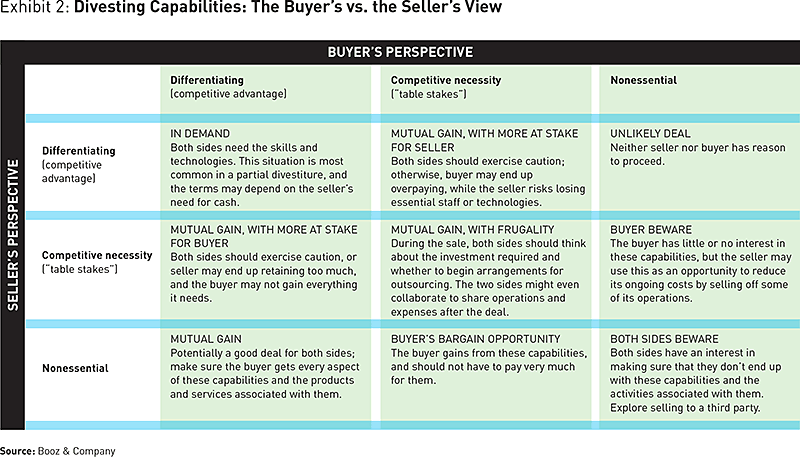
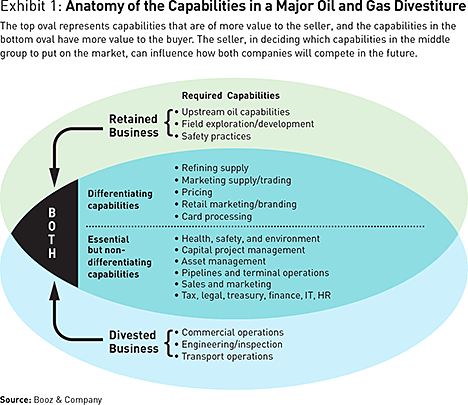
As a seller, you should begin your divestiture process by identifying the desired end state for the important capabilities involved: those you will still need after the deal is done, those you won’t need, and most importantly, those that both you and the buyer will need (see Exhibit 1). In each group, some capabilities are “table stakes”—every company in the industry needs them—whereas others are truly differentiating. The latter can distinguish your company in the market and give you an advantage over competitors. These capabilities require the most attention during a divestment, and you should seek to keep them intact while enabling the buyer to benefit from the deal in every other way (see Exhibit 2).
In practice, most sellers, facing the pressure of time, end up having to choose which capabilities to focus on. Your goal is to keep the process moving without sacrificing the quality of your decision making or jeopardizing the outcome.
There are certainly divestitures in which the buyer is known from the beginning, but it is not uncommon for a company to decide to divest something just because it no longer fits strategically, announce this plan publicly, and then search for a buyer. In these cases, major portions of a divestment plan must be executed before a buyer has been identified, and certainly before the transaction has taken place. This adds to the challenge.
There are also partial divestitures ..., in which only some assets of a given business or parts of an asset are sold. A partial divestiture is often more complicated from the standpoint of capabilities, because of the seller’s need to hold on to some people, processes, and technologies that it could let go of if it were selling an entire business or product line.
To make the process of divestiture more manageable, we recommend five steps. Each step gains its power from how it builds on previous steps, helping sellers during the critical period—usually lasting up to 18 months—when they are readying assets for sale. Note that these steps focus only on the analyses and business process changes that are relevant to managing the capabilities you are divesting. ...

Step 1: Capability Scoping

In the first step, you set the overall strategy for the divestment—including the assets you want to sell, when you want to sell them, and to whom. This takes place through an exercise called “capability scoping,” in which you take stock of the most important capabilities associated with the assets you are putting on the block. Often what’s up for sale is not a stand-alone business unit but ... a product, service, or asset that sits within that business unit. It likely draws on capabilities that are centralized within the company or that are used by other parts of the business unit (and therefore can’t be offered as part of the deal). This step usually precedes the identification of a buyer and should be done before any transaction-related activity, such as planning an auction. ...
Often, the seller realizes there isn't time to address every capability on its list, and it must set some priorities. ...
Undoubtedly there is a set of analogous activities at your company, drawing on people and technologies that are dispersed throughout the organization. A scoping exercise in and of itself isn't a plan for divesting assets—it doesn't answer the question of how to ensure the integrity of differentiating capabilities. But it does lead to a hypothesis of what will have to be accounted for, and either added to or carved out of an asset, in the months leading up to a divestiture.

Step 2: Baseline Analysis

This step involves understanding the components of key capabilities and how they come together to enable products and services to be successful. The idea is to break down those activities into their constituent parts—
English: Business Process Reengineering Cycle
English: Business Process Reengineering Cycle (Photo credit: Wikipedia)
what the activities consist of, who performs them, where in the company they are performed, how long they take, what technologies make them possible, and what problems are associated with them.
The baseline analysis identifies exactly what you can let go of and what you need to keep—and illuminates where a new owner might be left with a gap.
Not all buyers have gaps. Some may have capabilities systems that are a better fit for the assets you’re selling than your own capabilities are. In other cases, the ability of your activities to fill the buyer’s gaps becomes a point of negotiation in the deal—factoring into the price, the time to completion, or the transition services that you must provide. If no buyer has yet been identified, this is your chance to formulate a clear picture of the value that your divested assets might hold for someone else.
Completing a baseline analysis of your capabilities is more difficult than it might seem. The problem is that most people in a company—even, and sometimes especially, those with special talents or important functional roles—have a narrow view of what underpins a business’s success. The salespeople will describe the differentiating capabilities in one way, the marketing people in another, and the product development people in a third. From up close, and amid the competing perspectives, it can be hard to tell which activities truly make a difference. You may need to weigh all these inputs dispassionately—and pull back to get a wider perspective.

Step 3: Option Analysis

In this step, having identified one or more potential buyers, you look closely at the buyer’s capabilities needs and how your assets can help fill those gaps. This enables you to maximize the value of the deal. ...
The information uncovered during this step may prompt you to revisit a previous step. ...

Step 4: Transition Planning

Having identified the gaps and decided how to fill them, you as the seller now must start carving out the asset and making sure it has the capabilities it will need. This involves the creation of detailed project plans—perhaps one for each of the major capabilities involved—and of work teams.
Where to begin? At this stage, there is still no guarantee of who the buyer will be. Focus on activities that need to be conducted for any buyer. This forces you to tend to the known things first, as opposed to doing what comes more naturally and tending to the biggest things first. This approach can speed a sale once a buyer has been identified—and even if you don’t sell the asset, in the end, you won’t regret the planning effort. ...

Step 5: Buyer Engagement

Once you have a definite buyer and a signed contract, you can flip the switch on all the plans you have been making in Steps 1 through 4. Begin by sharing your thinking with the buyer, including which capabilities you see as most important and what your plans are for transferring them. Describe how you will deliver a fully functioning business to the buyer. The buyer has its own market strategy, quite possibly different from yours, and may have a different view of which capabilities are important. These differences sometimes lead the buyer to ask for something you don’t expect. That’s another reason not to start on this stage prematurely: That early work might have to be discarded. ...

Preparation, Skills, and Pride

Divestitures can be some of your company’s most complex transactions. They require strategic thinking, a massive amount of contingency planning, and—once a certain point is reached—the simultaneous management of multiple work streams and projects. You will need to be flexible and ready for the unexpected. This checklist can help you get ready for the process:
  1. Do you have a clear sense of what you’d like to sell, what you think it’s worth, and what capabilities might be involved?
  2. Do you know when you’d like to complete a transaction, and do you have a rough sense of the time line leading up to that?
  3. Do you have a list—if not by name, then by type of company—of who might be interested in your assets?
  4. Do you have a clear sense of how the sale will affect capabilities you’ll need for your retained businesses or assets?
  5. Do you have a dedicated transaction team, and if so, does the team have a clear set of priorities?
  6. Do you have measures in place to track your progress? Do you have clear measurements for the success or failure of the transaction?
The skills you develop during this process aren't relevant just to divestitures. They can also be used to reduce risk; create value; and improve the outcomes of acquisitions, spin-offs, and portfolio restructurings. Your work on divestitures can span organizational boundaries, geographies, business units, and functions, and thus help you develop the structures and communications links you need for other complex initiatives. The focus on capabilities involves accounting for factors that are often overlooked. It can help you avoid the tunnel vision that often accompanies a singular focus on financial matters during major transactions—and that can keep you from seeing the broader strategic impact of your decisions in general.
Many companies pride themselves on their ability to use acquisitions to drive inorganic growth. It’s far more rare to find a company that prides itself on the way it divests a business or asset. That’s understandable; by their nature, divestitures focus on businesses or assets that once seemed promising but no longer fit with where the seller is heading. It isn't surprising that there would be a mind-set of “the sooner, the better” and a narrow focus on the price. If you use the filter of capabilities, the divestiture might take a little longer, but it can leave your company better off in the ways that matter most. 
Reprint No. 00208

AUTHOR PROFILES:

  • Eduardo Alvarez is a Booz & Company partner based in Chicago. He leads the firm’s global operations practice and is an expert in business process transformation and technology-enabled transformation.
  • Steven Waller is a Booz & Company principal based in Chicago. He specializes in technology strategy and the development of new operating models for energy and financial-services companies.
  • Ahmad Filsoof is a Booz & Company senior associate based in Chicago. His focus is on operations, business process transformation, and technology-enabled transformation in the energy industry.
  • Also contributing to this article was consulting writer Robert Hertzberg.

'via Blog this'
Enhanced by Zemanta

Tuesday, August 6, 2013

How Private Equity Is Driving Value


A new study finds that financial-sponsor-backed companies are outperforming their publicly held peers.
CFO.com:
Vincent Ryan      Follow on Google 

... From 2006 to 2012, E&Y found in its recent study of North American PE deals, PE-backed firms spawned a return of more than five-fold that of investor returns on publicly held companies. 
English: Diagram of private equity fund struct...
English: Diagram of private equity fund structure for Private equity, Private equity fund, Private equity firm (Photo credit: Wikipedia)
About half of that return (realized when the PE firm sold its ownership interest) came from strategic and operational improvements. For the most part, E&Y found, it was growth in EBITDA (earnings before interest, taxes, depreciation and amortization) that created this value for PE firms’ acquisitions -- in particular, growth of the organic variety. 
English: Diagram of private equity co-investme...
English: Diagram of private equity co-investment structure for Equity co-investment (Photo credit: Wikipedia)
At companies that exited their PE owners in 2010-2012, for example, organic-revenue increases accounted for 45 percent of EBITDA growth, up from 39 percent pre-recession (2006-2007). (Click here for an interactive chart.) 
Diagram of leveraged buyout transaction struct...
Diagram of leveraged buyout transaction structure for Private equity, Leveraged buyout (Photo credit: Wikipedia)
E&Y says the results stem from PE firms changing the business models of the companies they own. ... 
“In the 1990s and the 2000s, if PE firms bought at the right time and then held the investment, they made money based on the multiples expansion in the public markets,” says Jeffrey Bunder, global private equity leader at Ernst & Young. Now, however, PE firms are concentrating on driving earnings growth, he says. 
English: Different methods to assess value on ...
English: Different methods to assess value on the secondary market (Photo credit: Wikipedia)
In almost all of the PE deals E&Y studied, for instance, once the PE firm acquired the company, the financial sponsors had a 100-day plan to either enhance revenue (52 percent) or generate cash (32 percent). “It’s more of an operating model: getting the right management team in place, driving business expansion into different geographies, adding products and expanding through acquisition,” Bunder says.
But it would be wrong to suggest that the old value creators for private-equity firms no longer contribute. Higher stock market returns still drove 17 percent of PE-owned companies’ overall returns, and the additional leverage PE-backed companies took on accounted for 25 percent of overall returns. In addition, cost reduction at acquired businesses still drove 26 percent of EBITDA growth for the deals PE firms existed during 2006 to 2012.
Healthy equity markets have also enabled successful exits of private-equity-backed firms through initial public offerings. And even the multiple-expansion effect has returned. “Multiples, which compressed significantly during the post-crisis years and negatively impacted performance, have rebounded in the recovery period and accounted for 30 percent of overall PE returns,” the E&Y report says.
PE firms indeed are holding companies longer — an average of 5.1 years in the study’s deal population in 2012, up from 3.4 in 2006. While the Great Recession certainly had something to do with that, “longer hold periods … also point to increased engagement by PE owners in the businesses they back,” said the E&Y report.
For the study, Bunder’s team analyzed deals that PE firms exited during 2006 to 2012. They chose acquisitions that had an initial value of $150 million or higher.
'via Blog this'
Enhanced by Zemanta

Friday, February 22, 2013

Business Valuation: Key Questions to Ask


By some estimates, roughly 80% of a typical small business owner’s net worth is tied up in her company. Yet, according to experts, most entrepreneurs have not taken the time to formally value their companies.


Financial Planning:

BY: ANN MARSH
FINANCIAL PLANNING
THURSDAY, FEBRUARY 21, 2013

“The value is the amount your business would be worth if you were to sell it to a third party,” says Mark Tepper, the president of Strategic Wealth Partners in Seven Hills, Ohio. Tepper, who specializes in working with small business owners, has devised a multi-step process for doing back-of-the-envelope valuations for his clients.“We put the valuations together as part of our wealth management package,” he says.

English: Figure 13: Break even of costs and re...
English: Figure 13: Break even of costs and revenues; new investment. Belongs to The Organic Business Guide. (Photo credit: Wikipedia)
Given that certified valuations cost between $5,000 and $20,000, Tepper says, many of his clients prefer to use his process at first before making the larger investment. Although he warns that his line of questioning offers only a rough number, he says it can still give clients a preliminary way of thinking about their assets' value. “These are not certified valuations,” he cautions. “You can’t take these to IRS court and challenge a gift tax or estate tax ruling. But we can turn [them ]into a certified valuation in roughly a week’s time” if necessary, he adds.

As part of the process, he says, he asks his clients the following eight questions:

1. Can the company stand on its own two feet and operate independently of the owner?
“A good litmus test is if you don’t have the ability to take a month-long vacation from the business, and shut down email and phone communication for that month, then the business is not independent of you,” according to Tepper. “No acquiring buyer is interested in buying a job. They want to buy an investment.”

2. Does the company have a stable and motivated management team?
“Those are really the biggest assets in an acquisition,” Tepper says. “We want to make sure [the management team] will stick around post sale." To ensure this happens, he says, owners should have some sort of non-qualified deferred compensation in place: Valuable team members "should want to continue working so that their account will vest every single year,” he explains.

3. Are there operating systems in place that can improve the sustainability of cash flows?
To make sure a company is a well-oiled machine, Tepper says, there should be a how-to manual -- so that when somebody acquires the venture, they don’t have to learn everything from scratch. “This also helps to protect you when employees leave,” he says, “even if it’s just a receptionist.”

4. Is there a diversified customer base?
“You don’t want to generate 70% of your revenues from one big company,” he says, “because if they leave, you are out of business.”

5. Are there recurring revenues?
“The greater percentage of your revenues that are recurring, the greater the multiple that you will attract” when selling the firm, Tepper says. Firms are typically sold as a multiple of revenues, such as 10 times earnings or total revenues. “This would be something like a cell phone contract,” he says, “not like buying toothpaste. You want sales on a subscription or contractual basis. The acquiring owner would expect those revenues to continue.”

6. Are the financial statements easy to understand?
Buyers want to make sure your client is not running a lot of lifestyle expenses  -- such as cars, vacations or country club memberships -- through the company. Those would make the company’s tax profile look better than it is in reality, Tepper says.

7. Is the appearance of the facility consistent with the asking price?
There can’t be broken windows or unkempt grounds at  $10 million asking price, Tepper says.

8. Is the cash flow not only good, but improving?
A buyer wants to know he is getting an asset that promises to increase in value, he adds.

'via Blog this'
Enhanced by Zemanta

Thursday, February 21, 2013

Getting more value from divestitures


Companies often struggle to capture the full value of a separation. Here’s how to do better.


McKinsey Quarterly:


Getting more value from divestitures article, how to profitably part ways with a business, Corporate Finance
Most divestitures start with a strategic decision that a company is no longer the best owner of one of its businesses. ... Indeed, past McKinsey research has shown that companies that more frequently reallocate capital generate higher returns than their peers.1
But once a company decides to sell, problems can arise. Managers devote their attention to finding a buyer but seldom scope deals from a potential buyer’s point of view, even as they struggle to figure out exactly what should be included in the sale, apart from the productive assets that are its centerpiece. ... Management and the board can get so caught up in the sale that the core business begins to suffer from neglect. All in all, divestiture turns out to be no panacea: sellers can take up to three years to recover from the experience (exhibit). Indeed, some companies are so wary of these pitfalls that they decide to muddle through with businesses of which they are not the natural owners—another unsatisfactory result, as research suggests that these sales can produce significant returns for both the parent company and the divested or spun-off business.2
In our experience, even highly complex divestitures can work well, provided companies follow proven practices, especially in three areas: scoping the deal in detail, addressing the so-called stranded costs left behind when the revenue-generating assets are sold, and managing the expectations and concerns of employees.
... Getting started on these activities quickly, in parallel with the search for a buyer, can unlock enormous value for buyer and seller alike.
Taking the buyer’s point of view
... Admittedly, it’s a bit impractical to define exact deal boundaries before the identity of the buyer and its preferences are known.
To get around that problem, smart sellers define a number of different deal packages—of assets, people, and services—configured to attract interest from a broad spectrum of buyers. These packages not only broaden the field of potential buyers, often in ways that companies cannot envision at the outset, but also help the company cope with the tough questions that buyers inevitably have about what’s in scope, how to separate, the transitional services they can count on, and the financials of the business. ...
English: Diagram of private equity fund struct...
English: Diagram of private equity fund structure for Private equity, Private equity fund, Private equity firm (Photo credit: Wikipedia)
Sellers can construct sale packages for a range of buyers. Each buyer is unique and will have more or less need for infrastructure, capabilities, and a geographic presence where the assets for sale are located. To prepare for the wide range of needs, most sellers will want to develop basic packages for at least three types of bidder: a strategic buyer with a local presence, a strategic buyer from another region, and a private-equity firm seeking a stand-alone entity. ...
... And there may also be buyers interested in cherry-picking parts of the core business instead of taking all of it—which, while probably not ideal, should not be discounted out of hand. Sale packages include pro forma financial statements tailored to represent the package being offered to each buyer or class of buyer that highlight the true value of the business, separation and transition plans, and details on proposed management and talent assignments.
When a large industrial company was looking to divest one of its business units in the late 2000s, its managers’ first instinct was to sell to a large strategic buyer. But by conducting a form of due diligence on its prospective buyers ...—including some private-equity firms—the company was able to understand all the potential synergies each would gain by buying the business. That enabled managers to design a specific value proposition for each potential buyer. Eventually, they were able to attract—and sell the business to—a much smaller player ... . Even better, the company got a price 20 percent higher than first expected. In fact, ... the final list of bidders included a private-equity consortium and a few other unanticipated interests.
Rooting out stranded costs
One of the most challenging aspects of a major divestiture is that even sellers that control expenses well are inevitably left with some corporate costs associated with the business but not sold with it. ... Stranded costs essentially can be any type of cost that does not automatically disappear with the transaction, ... . Some of these are fixed, such as the IT system, and cannot be readily reduced regardless of the size of the divestiture. Others are more variable and can contract, for example, with a lower head count—but they can still take years to unwind unless explicitly planned as part of the divestiture. ...
We see three strong practices to reduce overhead. First, ... defining the precise boundaries of potential deal packages early in the deal brings to light the full extent of the subsidiary’s sales, general, and administrative costs. The parent company can make a better attribution of resources to the parent and the subsidiary. That benefits both companies.
Second, successful sellers often use the momentum generated by the divestiture as a catalyst to reduce stranded costs—and to improve the performance of any bloated or inefficient corporate-center activities revealed by the divestiture. (This mirrors a similar effect of transformational acquisitions, in which buyers take advantage of the circumstances of an acquisition as a catalyst to restructure costs more broadly.3) ...
Rooting out stranded costs takes a separation manager with the foresight to rethink the parent company’s cost base and the authority to make it happen—the third good practice. ...
Companies of this size often face a special problem in rooting out stranded costs. For many large multinational companies organized by matrix, the only pragmatic method is for senior management to lead a cross-functional initiative to tackle cross-cutting opportunities such as shared-service and outsourcing operations, as well as the change programs required to support the cost transformations.
Managing employee expectations
The challenges of talent management in a divestiture start at the moment companies begin defining the boundaries of different sale packages and continue right through to the close of the deal. First and foremost, managers struggle to figure out what to say to the people involved. ...  Sometimes company leaders will choose to keep plans for the deal confidential up until signing— as one global CEO and seasoned divestiture veteran told us, “I just deny everything until the deal is signed. It’s easier that way.” This may be true, but it creates a communication challenge. Many employees inevitably will know about the deal because of the massive preparation work that is impossible to conceal. But if management officially denies the reports, it becomes very difficult to put in place communication plans and other measures to minimize the concerns that always arise in such situations—all employees want to know, “What happens to me?”
Some form of short announcement is essential. Once managers make an announcement, they should clearly define and communicate the selection process to keep employees motivated while they wait for news of their fate. ... Ideally, the communication plan should be part of a compelling story that shows not only employees but also investors, analysts, and customers why the divestiture will leave both buyer and seller better off.
Once the word is out, other challenges begin. ... Given the role the exiting managers will play in communicating the business’s value to potential buyers, delay in informing them is undesirable. But once they are informed, they immediately become another party at the negotiating table, bargaining for the talent, assets, and contracts they feel they’ll need to be successful and trying to avoid the ones they don’t want.
Failing to manage the tension between the two groups can be damaging. When a global industrial company divested a multibillion-dollar division, for example, it began to receive a lot of applications for transfers from the entity to be divested back into the parent company—so many, ... that the company was at risk of visibly depleting the divested company ... potentially affecting its value. To discourage the transfers, it aligned the incentives of people in the departing unit to the characteristics of the sale. It decided to reward managers based on earnings before interest, taxes, depreciation, and amortization (EBITDA)—a critical negotiating point with the private-equity firm that ultimately bought it. The emphasis on EBITDA motivated exiting managers to minimize the overhead they took with them; it also reduced transfer requests.
This approach did leave more overhead for parent-company managers to deal with, ... But they made a conscious choice to accept this, believing that the right way to deal with broader cost issues was, ... as part of a thorough change process in the wake of the divestiture. Parent-company managers often lack the incentives that would compel them to take care of the departing entity. ... In our experience, it is important to define and implement a set of performance measures and rewards aligned with value maximization, and to use these with all key people involved in the divestiture process. The most obvious rewards are monetary, but research shows that other incentives (such as recognition and promotions) can be equally if not more important determinants of performance.
Negotiations over talent are particularly sensitive. The first inclination of parent-company managers is to keep the best performers and send the rest with the divested business. That’s not practical, ... the divestor has a moral ... and ... legal [obligation] to make sure the business is a going concern. ... At the same time, the parent company must retain critical resources, and quite often, the exiting managers have the very skills they need. Thus, successful divestors will address the issue of talent early in the process and start building or acquiring the skills needed in both the parent organization and the business to be sold.
Much of the value of a divestiture depends on the effectiveness of the separation process. Defining the right deal, managing talent uncertainty, and rooting out stranded costs can make the difference between a deal that succeeds and one that destroys value. And skill in divestiture is comparatively rare; doing it well can help companies get a competitive edge.

About the Authors
David Fubini is a partner in McKinsey’s Boston office, Michael Park is a partner in the New York office, and Kim Thomas is a senior expert in the Copenhagen office.
Notes
1 Stephen Hall, Dan Lovallo, and Reinier Musters, “How to put your money where your strategy is,” mckinseyquarterly.com, March 2012.
2 Bill Huyett and Tim Koller, “Finding the courage to shrink,” mckinseyquarterly.com, August 2011.
3 Marc Goedhart, Tim Koller, and David Wessels, “The five types of successful acquisitions,” mckinseyquarterly.com, July 2010.

'via Blog this'
Enhanced by Zemanta

Tuesday, May 29, 2012

Get Paid More with a Seller Note

Corporate Finance Associates Newsletter Q2 2012

By John Hammett, Managing Director
Minneapolis Office, Corporate Finance Associates
cash paid from selling company
Private company owners are always interested in maximizing the value of their company when they sell. … Sellers naturally focus on the nominal valuation of the company. But the value to the seller isn’t just in the price that is negotiated, but also in the terms of the deal. Experienced dealmakers know that the terms of the deal can drive the total valuation from the buyer’s perspective.

The natural inclination of sellers is to favor an "all-cash" deal: …However, this perspective overlooks an alternative that can increase the total value of the deal by 10% to 20%.

This alternative is a "seller note". The seller note means that the seller finances part of the buyers purchase with a promissory note or a loan back to the company. The seller agrees that a portion of the purchase price will be paid three to five years down the road, and he will receive interest payments on the face value of the note. Private Equity firms (financial buyers) have a strong preference for including seller notes as part of their deal terms.

Example
The example of this is shown in the attached chart (FIG 1). The example assumes that the company has EBITDA (Earnings Before Interest, Taxes, Depreciation, Amortization) of $2 million and that it would be valued in an all-cash deal at 5 times EBITDA for an Enterprise Value of $10 million (left column). It shows an alternative where the seller finances 20% of the Enterprise Value with a seller note at 9% interest (center column) and the difference in cash to the seller (right column).

Buyer’s Perspective
The immediate difference is that the value multiple for the deal with the seller note is 0.5 times … higher than the Typical deal. … There are two reasons why the buyer will pay a higher multiple for a deal with a seller note.


English: Diagram of DuPont analysis of return ...
English: Diagram of DuPont analysis of return on equity. ‪Norsk (bokmÃ¥l)‬: Diagram over DuPont-analyse av kapitalrentabilitet. (Photo credit: Wikipedia)
The first reason is simple math. The buyer’s balance sheet (FIG 2) is composed of bank debt, the buyer’s equity, and sometime, a seller note. Each tranche of capital has a different cost related to it. Bank debt is relatively cheap, with Prime Rate at 3¼% and commercial loans at 6%. At the other end of the spectrum, financial buyers target a rate of return of greater than 25% on their equity investment. The seller note lets the buyer put in less equity … so the deal is more leveraged but still delivers the target rate of return on the equity. This works because seller note carries a relatively high 9% interest rate, but that is still lower than the equity that it replaces. The math works out so that the equity investor gets an even higher rate of return, even though the price paid is higher.

There is a subjective reason why buyers pay more for a deal with a seller note: comfort. … The seller who is willing to leave a seller note invested in the company gives the buyer great comfort that there are no hidden issues that might show up after the deal is closed. This is reflected in a higher price to the seller.

Seller’s Perspective
In this example, the seller gets a 10% higher enterprise value on the company with the seller note. Just as important, the seller gets an opportunity to invest 20% of the proceeds in a high-yield fixed income investment. … The seller note becomes the fixed income allocation of the portfolio. Its performance should certainly beat the returns from most publicly-traded debt securities.

Bottom Line
The seller is making a wise move by selling a private company that is a concentrated , risky, and illiquid asset, and re-investing the proceeds in a portfolio of other investments to provide for future living expenses and to preserve wealth. The seller note should be managed as a core part of that portfolio.
Enhanced by Zemanta

Wednesday, May 9, 2012

M&A Madness: It's Not A Game

 
CRN Magazine
By Steven Burke, CRN March 23, 2012

Solution providers staying pat during the current M&A frenzy could find themselves left standing in what is turning out to be the business equivalent of musical chairs.

This M&A madness is anything but a child’s game. It’s all about making an almost unimaginable business transformation to a world where businesses are buying IT as a service. …


Cover via Amazon
Nicholas Carr, the IT futurist, had it right in his book “The Big Switch,” which compared the current IT-as-a-Service phenomenon to the move by companies 100 years ago to stop building their own power sources and instead move to the electric grid. Today’s transformation, however, does not mean that every business will move outright to the IT-as-a-Service model. There will be plenty that maintain a hybrid model, building their own private clouds and relying on the public cloud for some services. But the economic forces that are reshaping the solution provider marketplace are moving at a breakneck pace.

Solution providers are looking closely at whether they have the right business model and technical talent to make it in this new world. …


Diagram showing three main types of cloud comp...
Diagram showing three main types of cloud computing (public/external, hybrid, private/internal) (Photo credit: Wikipedia)
For my money, the more interesting deals are those aimed at cloud computing IT services superiority. GreenPages, for example, which began making big cloud computing investments long before it was fashionable, recently acquired cloud MSP LogicsOne. The deal comes as GreenPages is set to shake up the market with an enterprise hybrid cloud management offering.


Breakdown of Cloud Computing Services
Breakdown of Cloud Computing Services (Photo credit: Wikipedia)
 
“Everything we do is around infrastructure transformation, turning internal IT into a service platform, getting apps and data cloud-ready so customers can move to a new paradigm,” said GreenPages CEO Ron Dupler. “Everything we do is around the cloud.” Even without LogicsOne, GreenPages’ cloud services business is growing at a 30 percent clip. Add LogicsOne to the party and it takes the GreenPages cloud services story to another level. …


Cloud Computing visual diagram
Cloud Computing visual diagram (Photo credit: Wikipedia)
These type of scale-up deals bringing together best-of-breed cloud computing service providers should worry companies that are staying pat. The IT services phenomenon means that solution providers need to, in one way or another, go big or go home.

BACKTALK: Are you going big? Reach out to Steven Burke via e-mail at steven.burke@ubm.com
Enhanced by Zemanta

Monday, April 30, 2012

Ready to Sell Your Business and Retire?

WSJ.com:


The wealth of many boomers is tied up in businesses they own. And that can be a problem when it comes time to retire.
Advance planning for the sale of a business is more important than ever, ... Even when families transfer ownership to the next generation without a sale, the tax consequences can be huge without proper planning.


Too many owners aren't prepared for the day when they'll need to cash out. Some haven't done their homework to figure out what the business is really worth. Others undermine their company's value with their inability to let go.
Below, financial advisers and exit-planning specialists weigh in on some of the most common mistakes business owners make when they're ready to retire, and how those mistakes can be avoided:
[EXIT_illo]Gary Hovland

The Mistake: Creating a Business That's Too Dependent on the Owner
One of Paul Pagnato's boomer clients spent decades building his company. When he decided to retire, he was not only chief executive, he was handling all key decisions in marketing, sales and client service, despite having hired executives to handle those functions.
WASHINGTON, DC - FEBRUARY 21:  Chairman, Presi...
WASHINGTON, DC - FEBRUARY 21: Chairman, President, and CEO of the Boeing Company W. James McNerney, Jr . (Image credit: Getty Images via @daylife)
"He was the business," says Mr. Pagnato, a Washington, D.C.-based adviser who works exclusively with entrepreneurs. But Mr. Pagnato says having a business too dependent on the owner or a handful of major customers can dramatically hinder the company's sale price, as buyers are likely to perceive more risk. Indeed, Mr. Pagnato's client ended up selling his business for less than he originally planned and was required to stay on longer to insure a smooth transition.
The Fix: Mr. Pagnato says it's important to delegate responsibility well before the sale to help insure a smoother transition and diversify the company's customer base.

The Mistake: Ignoring the Tax Benefits of Planning Ahead
Adam von Poblitz had a client whose 10-year-old business was valued at $20 million two years ago. The owner had always planned to transfer an interest to her son, says the New York City-based estate-planning attorney. But the client procrastinated. Today, the client is ready to transfer a 50% interest in the company to her son, but the company is now valued at $40 million. As a result, she will pay gift tax on a much larger taxable gift.
The Fix: Had the client transferred the half interest two years ago, she would have paid gift tax on only $10 million rather than on $20 million, thus avoiding the tax on the post-gift appreciation attributable to her son's half interest.
Mr. von Poblitz says that if an owner anticipates transferring ownership in the next five years, it may make sense doing it sooner at a lower valuation.

The Mistake: Incorrectly Valuing the Business
Unfinished Business Is it a folly? or has some...
Unfinished Business Is it a folly? or has someone run out of money or fallen foul of the planning people? (Photo credit: Wikipedia)
Richard Jackim worked with a client who was the founder of a small but successful consulting firm. The client calculated he'd need to sell his business for $6.25 million to maintain his lifestyle in retirement, says the Chicago-based exit-planning adviser, and figured his business would be worth that much. He was wildly optimistic, however. All too often, owners base retirement plans on faulty valuations, causing drastic overhauls in retirement plans, not to mention blows to self-esteem, says Mr. Jackim.
The Fix: Well in advance of retiring, business owners should get a realistic appraisal of their business, to see if it will fetch what they'll need to retire. If it won't, the owner needs to adjust his or her retirement plans, or come up with a financial strategy to boost their income.
Mr. Jackim says a mergers-and-acquisition adviser can help determine what a business actually might sell for.
Also essential: understanding if there is a market for the company, how liquid the market is for lending and equity, what buyers are paying for similar companies and how they are structuring the deals.

The Mistake: Rushing to Accept a Rich Number
Understanding Financial Leverage
Understanding Financial Leverage (Photo credit: Wikipedia)
Sellers often jump at what appears to be the highest bidder, ignoring other bids, says Fentress Seagroves, an Atlanta-based transaction-services principal. ... The seller doesn't take into account the due diligence that the buyer is undertaking, and how that could change the final number. The seller also ignores other crucial elements of the bid, such as how employees will be treated, or how the buyer will finance the deal. In the end, the seller may have ignored what would have been truly the best deal.
The Fix: Don't fixate on what is superficially the richest offer, Mr. Seagroves says. ...Try to anticipate how the due diligence the buyer is undertaking could change his or her offer at the close. Consider all aspects of the transaction, not just the nominal price.

The Mistake: Hiring Your Brother-in-Law to Do the Deal
Thomas Bonney had a client whose legal counsel's expertise was in general legal matters for small businesses. The lawyer also happened to be the husband of the company's controller, says the Philadelphia-based exit-planning adviser. The lawyer's lack of expertise with merger-and-acquisition transactions and lack of understanding about the time-sensitive nature of the deal resulted in the family's missing the opportunity to sell the business in a strong deal market.
The Fix: Too many family businesses keep everything in the family—including legal services. That can be ... foolhardy when looking to sell. Mr. Bonney advises clients who are considering selling their business to interview three to five separate firms early in the process. He says they should ask the lawyers how they would structure the deal, how they can help with negotiations and ultimately, make a quick close. This process will not only allow the owner to see how an attorney works with them, but they will also have an opportunity to get some good ideas on both legal and personal issues—such as what should a compensation package look like for a family member who wants to continue to work in the business.

The Mistake: Underestimating the Emotional Impact of Selling a Business
John Leonetti, a certified business-exit consultant based in Canton, Mass., has seen all manner of crises erupt when a business owner prepares to sell, causing disastrous moves that wound up hurting the sale and the seller's personal life. ...


Because owners' sense of self and purpose is often wrapped up in their business, letting go is often more difficult then they realize and sometimes causes them to act irrationally, he says.
The Fix: Mr. Leonetti says owners can make their exit easier by mapping out their post-exit lifestyle before the sale. He advises clients to get a calendar and fill in how they are going to spend each day for the six to 12 months after the deal goes through. He's also seen clients do consulting work or start a scaled-down version of their former business, allowing them to stay in the business they love and adjust to a new schedule.
Ms. Dagher is a reporter for Dow Jones Newswires in New York.
She can be reached at veronica.dagher@dowjones.com.
A version of this article appeared April 30, 2012, on page R3 in some U.S. editions of The Wall Street Journal, with the headline: Preparing to Leave.
Enhanced by Zemanta