
What are the factors that determine which C. E. O.'s succeed and which fail? Even in the high-tech world, the laws of the jungle still rule.
strategy+business magazine
By Edward F. Tuck and Timothy Earle
{The authors of this article are an early-stage venture seed capitalist and an anthropologist who specializes in leadership.}
… Why do these otherwise successful, competent, well-trained people fail? Why, in the face of good advice, do they do things that bring their ruin? Why, after they fail, can people of less training, skill and intelligence turn their failures into successes?
…We have examined the most common ways that C.E.O.'s fail by applying the findings and techniques of anthropology to business organizations. We have found that the cause of these systematic failures is not the C.E.O.'s lack of skill, nor even his psychology; it is the changing institutional context in which he must perform.
C.E.O.'s fail most often in these three situations:
… Something changes when a company reaches a certain size that makes it somehow different to manage; also, running an independent company is different from running a division of a large company. In short, small-company C.E.O.'s fail in large companies, large-company C.E.O.'s fail in small companies and C.E.O.'s who have risen through the ranks can't work with their boards.
- He or she has moved to a much smaller company, either as an entrepreneur or to take over a start-up or early-stage company;
- The C.E.O.'s small company has grown to middle size;
- The C.E.O. has been a successful vice president or chief operating officer and has been promoted to chief executive, or has been recruited as chief executive for another company.
Camp, Corporation and Community: The View from Anthropology
… In a company, as in any polity, each person behaves according to his or her rules about behavior in groups. …[Half] of them, according to recent research,(1) are inherited. … When we try to succeed in a group, we unconsciously call on those primitive patterns of behavior …; and the structure of our groups comes from the way we behave together.Image via WikipediaEvery company is a polity: a "politically organized community." …[Each] director, officer, manager and employee of a company is a functioning member of the polity.
Anthropologists study people, their cultures and their polities. … When anthropologists find basic similarities across polities with no historical relationship, they believe that these similarities may come from behavior of biologically similar humans adjusting to the same organizational problems.
We have found patterns in these "primitive," isolated human polities that will help C.E.O.'s understand and solve difficulties in their relationships with their boards and their employees. …[Boards] are organizationally different from the corporations to which they are attached. We learned that the founder who is ruined by his company's success, the captain of industry who cannot run a small company and the seasoned executive who cannot be promoted are all victims of the same simple and ancient effect, and we propose a reason for that effect.
First, let's compare organizations.
There are three primitive organizations that have counterparts in modern companies: the working group, the camp and the hierarchy.
The Working Group
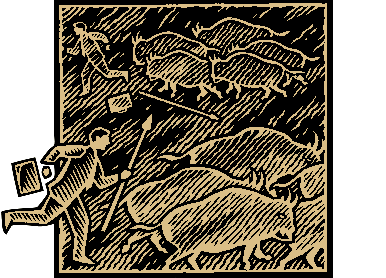
When a hierarchical organization like a corporation or an army sets up a working group, a leader is named by the hierarchy ("chairman" or "squad leader"), although the real leader of the group emerges informally. … [Usually], the leader arises without any special action as the work progresses, and leadership passes from one person to another smoothly as the nature of the work changes. … When the problem is solved or abandoned, the group disbands.Image via WikipediaA "working group" is found in all cultures.(2),(3) It is a temporary association of two to six people with useful skills, and it has a specific purpose: to hunt, to lay a section of railroad track, to right an overturned car, to catch a criminal. … They exist only for the purpose at hand, and they are organized quickly and informally.
The result of the group's work has a strong effect on the mood of its members. If the work is successful, they are elated and often celebrate. If the work is a failure, its members are depressed and uncommunicative for a time. Working parties are short-lived, have only a few members and are re-formed as needed.
The Camp
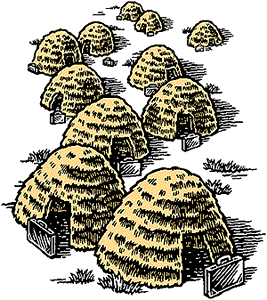
Hunting and gathering "camps" usually comprise about 30 people, from up to six families. The business of the camp -- hunting, gathering, cooking, building -- is done by temporary working groups as defined above. …[Today’s] hunter may be tomorrow's gatherer or hut-builder, although special skills such as stone tool making are recognized by all.
The hunting-gathering camp does not admit to having a leader; in fact, members of the camp will deny there is a leader. They will say, "We're all leaders." Nonetheless, a member of a nearby camp will say, "That's Joe's camp."
The camp thus does have a person who facilitates decisions. He or she does not command, but is respected because of knowledge, judgment and skill in organizing opinion. He or she does not give orders,(4) but focuses the decision-making process. Decision-making in a camp is a political, deliberative, consensual process. The camp's elders are expected to choose courses of action that are acceptable to the camp, and to accept suggestions from everyone. The whole camp behaves in a consensual manner and there is strong social pressure to conform. (In functioning camps, all members are interested in the facts, are fully informed of them, continuously discuss them and are aware of the various alternatives being considered.) …
Where a consensus is not found and distrust and disagreement linger, the usual solution is for the smaller faction to leave, striking off on its own. …The faction that takes off risks its very survival if a new camp receptive to it cannot be found.
When a camp grows to about 50 people, it becomes unstable and splits into two or more camps. This pattern of size-related instability is repeated in organizations of all kinds across human society.
The Hierarchy
The tribe, which may encompass several camp-sized groups, is a hierarchy. Hierarchical organizations have a clearly defined leader, and often many strata of authority. …The tribal hierarchy made it possible for more than 50 people to live and work together, at the cost of personal and group autonomy.
Simple tribes are organized into local groups of a few hundred, each with its own leadership. More complex tribes are organized into regional chiefdoms of several thousands, each with a hierarchy of leaders.
The State
In the archaic world, states eventually evolved to organize much larger populations, often living together in cities and relying on market exchange. It was at this time that real bureaucracies emerged, both to solve efficiently the problems of large groups and to control those groups for the will of dictatorial rulers.
With industrialization and cheap transportation, people began to live together in even larger groups. … At first, these were outright dictatorships, but improvements in communication, education and the economy led to a revision of societal values so that now all members of hierarchical societies have some voice. …
Size Determines Structure
…It appears that six or seven is the largest number of relationships that one person can deal with continuously. We need the hierarchy, with its well-defined roles and patterns of behavior, to allow large numbers of people to work together without overload.
An important study(5) has shown that decision-making performance in egalitarian groups falls off rapidly as the group size grows beyond six. This is a result of a well-studied limitation of the human brain, which cannot simultaneously retain and process more than about seven "information chunks" at once. (One such study by the Bell System set the size of local telephone numbers at seven digits.)
To make larger groups work while still retaining their egalitarian nature, six or seven groups form a "sequential hierarchy." …The largest stable group in which this process has been observed contains about 100 people, and involves three levels of consensus; the usual maximum is about 50 people (7 times 7), and uses two levels of consensus.(6)
Two points to hold in mind are: 1) As group size changes, so must its organizational structure. … 2) Within a single social system, groups of different scale exist and require different organizational structures. A major dysfunction occurs when an organizational structure appropriate for one scale is used for groups of other sizes.
The Camp in the Hierarchy
At the top of every stable hierarchy there is a camp-like consensual group. Even in outright dictatorships there must be an egalitarian council, as Machiavelli advised 500 years ago:
"A prudent prince must ... [choose] for his council wise men ... he must ask them about everything and hear their opinion, and afterwards deliberate by himself and in his own way, and in these councils and with each of these men comport himself so that every one may see that the more freely he speaks, the more he will be acceptable."(7)
The Modern Organization
Thus, four types of organization have arisen when people live together and try to do something in common: the working group, the camp, the general hierarchy and the state bureaucracy.
The most primitive of these is the working group, up to six people. It is also the one that elicits the most profound emotional response. The camp, up to 30 to 50 people, is the next most primitive, and is a very old structure. Camp-like groups are found among non-human primates, and in all human societies.
The most modern organizations, and therefore the ones for which we are by nature least adapted, are the hierarchy and the bureaucracy. Behavior in a tribe, a company or a nation is not innate: it is learned, in contrast to behavior in camps and working groups, much of which is innate. An individual's success in a hierarchy depends on how well he or she has learned its rules, and to what extent his or her innate behavior allows that person to conform to those rules. {emphasis added}
The Modern Corporation
A modern corporation employing more than 100 people is a hierarchy; a company of more than 1,000 is a bureaucracy. A camp-like board of directors is at the top, to offer guidance by diverse experience and to provide intercorporate information. The corporation's best work is done by working groups.
The advantages and satisfactions of recognizing the egalitarian…
How Boards Behave
Since boards are like camps, a successful C.E.O. must remember how camps behave.
A board is not a working party. It cannot solve problems, it can only approve or disapprove courses of action proposed by its leader. If it is forced to choose between alternatives, a crisis of leadership often arises.
The C.E.O.'s leadership role is not openly acknowledged by outside board members, who strongly assert their equality. The C.E.O. thus must reach consensus among board members before proposing important issues. This process is called "keeping in touch."
The C.E.O. is the natural leader of the board. … If the chief executive refuses to lead, then the C.E.O. and board will flounder or another individual member will assume leadership. In either case, the C.E.O. must be replaced. This is because the surrogate leader cannot lead well unless he or she assumes the C.E.O.'s role inside the organization as well as on the board.
Board members expect the C.E.O. to be their leader and will treat him or her as such until they decide to fire the person. … If an act or utterance of the C.E.O. is unreasonable in this leadership context, the other members will believe at a deep level that he or she is incompetent or insane. Since in either of these cases the C.E.O. must be replaced, an extremely unpleasant and difficult task, a member will sometimes opt for denial by assuming that a chief executive who exhibits such behavior is manipulative or evil, either of which is a disquieting but acceptable alternative.
The Ways C.E.O.'s Fail
We can now examine C.E.O. failure modes by comparing modern companies with polities in primitive cultures, and by recognizing that much of our behavior is genetically determined and will be similar when working within groups of the same size. Our understanding of the short-term development of companies can thus be aided by knowing the long-term evolution of human society.
These comparisons confirm anecdotal evidence that successful management techniques are fundamentally different for companies above and below a critical size, and that techniques which succeed in a company above the critical size will fail below it, and vice versa.
The comparisons also explain why C.E.O.'s who are successful as division or subsidiary managers in large companies are unable to run independent companies. These failures are related to their inability to deal with their camp-like boards of directors.
Consider the following scenarios:
Problems With the Board: The New C.E.O.'s Surprise
Those few extraordinary individuals who succeed by climbing to the top of a hierarchy are surprised and sometimes quickly fail when faced with the need to immediately lead the board. …
The result is that the C.E.O. often arrives at his position as head of the board without realizing that his role has fundamentally changed. He assumes that he simply has an organization like his old division or function to command.
If his whole experience has been in hierarchies, he may define himself as one who gives and receives orders… . If he has had no experience with boards of directors, he may make the fatal error of regarding his board as his new boss, as a working group to solve his company's problems or as a part of his organization that he must supervise. If he is told that he must lead the board but not command it, and that he must work by consensus, he finds this incomprehensible. …
If, in fact, the C.E.O. does not lead the board, the board's other members, … are confused and become unruly. The C.E.O. and sometimes the organization itself then fail. …
Problems With Becoming Big: The Faltering Founder
Unless he has access to an enormous amount of money, the founder of a company must first found a camp. In a camp, as we have seen, there is little specialization; in a new company, it is common to hear, "I wear a lot of hats." It is also common to operate by consensus: members marvel at the speed with which decisions are made, and at their feeling of mutual support, clear objectives and clean, unambiguous communication. Employees at all levels speak as though they know what is going on throughout the company. Most of the company's people work far more hours than a normal workday; they enjoy their work.
If the company succeeds, it grows….
The appropriate action is to assemble a hierarchy, using experienced people, when the company's staff numbers more than 20. … The C.E.O. must gradually abandon his role as consensus leader and take on the role of chief.(8)
This is a difficult transition even for C.E.O.'s who understand the problem. Often, a founder has chosen his role because of difficulties in a hierarchy; he sees the transformation of his company to a hierarchy as a personal failure. At best, he must deal with alienation and feelings of betrayal in people with whom he has worked closely, and with whom he shared the bonding and elation of a successful working party. Sometimes, even if his company succeeds, he is unhappy and unfulfilled.
Problems With Going Small: A Chief Without a Tribe
The opposite occurs when a C.E.O. is recruited from a large company to run a young one. Such people often have no experience with consensus-based groups.
…There is no hierarchical organization; it is a camp. He cannot delegate; he must work by consensus.
Conclusion
The literature and techniques of anthropology and cultural evolution can be used to understand business organizations at different scales. We have explained three familiar failure modes of chief executive officers, derived from studies of primitive societies and their leadership. We have shown that these failure modes can be avoided if the C.E.O. and the company's employees understand and conform to the deep structure of their organization.
We have also shown that the board of directors of a modern corporation is a more primitive and intrinsically different structure from the organization it serves, and that C.E.O.'s must use fundamentally different techniques to work with their boards and with their companies.
Many failures of companies and their C.E.O.'s can be avoided by supplementing graduate business training, … The goal is for the new C.E.O. to have the training to understand the differences between the organization he is entering and the one he is leaving.
In the absence of knowledge, people do the things that have worked for them in the past, and when they fail to work, simply do the same things more intensively, like a tourist in a foreign country who just shouts louder if he is not understood. …
Venture capitalists, executive recruiters and board members of young companies who have a stake in the success of the people they fund or recruit can reduce their risks considerably by discussing consensual organizations with their candidates. …
© 1989, 1990, 1996 Edward F. Tuck and Timothy Earle
(1) L.J. Eaves, H.J. Eysenck and N.G. Martin, "Genes, Culture and Personality: An Empirical Approach" (Academic Press, 1989).
(2) Allen W. Johnson and Timothy Earle, "The Evolution of Human Societies" (Stanford University Press, 1987). This work includes observations on the structure and leadership of primitive polities; insights from this book and the following monograph are used throughout the remainder of this article without specific reference.
(3) Timothy Earle, "Chiefdoms in Archaeological and Ethnohistorical Perspective," from the "Annual Review of Anthropology" (Annual Reviews Inc., 1987).
(4) Andrew Bard Schmookler, "The Parable of the Tribes" (University of California Press, 1984), p. 92. This work, subtitled "The Problem of Power in Social Evolution," contains many strong parallels to modern corporate behavior.
(5) Gregory A. Johnson, "Organizational Structure and Scalar Stress," from "Theory and Explanation in Archaeology," edited by C.A. Renfrew, M.J. Rowlend and D.A. Segraves (Academic Press, 1982), pp. 389-421.
(6) Gregory A. Johnson, op. cit. p. 402.
(7) Niccolò Machiavelli, "The Prince," translated by Luigi Ricci (The New American Library, 1952), p. 116.
(8) Eric Flamholtz, "How to Make the Transition From Entrepreneurship to a Professionally Managed Firm" (Jossey-Bass, 1986).
Illustrations by Bryan Wiggins
Reprint No. 96402




 Posts
Posts


