How to design a mix of formal and informal factors to advance your company’s strategy.
strategy-business.com:
Published: May 20, 2013
by Ashok Divakaran, Gary L. Neilson, and Jaya Pandrangi
Sometimes epiphanies come by email—or, in this case, three emails. It was Saturday at 5:17 a.m., and Joanna was already at her laptop. As the new CEO of the Seabright Publishing Company, just four months into the job, she had returned the night before from a 90-day “listening tour” of the company’s operations. ...
A recognized turnaround expert, Joanna had been hired by a board looking for organizational change. Seabright had a new strategy. It was shifting from print-based books and magazines for professionals to global digital information products. Everyone agreed this was the right direction for the company. Yet the former CEO, despite making a major push for restructuring and change, hadn’t gotten much traction or support. That failure had cost him his job.
Joanna had concluded that the strategy itself was sound, and Seabright’s people seemed to both understand the need for a turnaround and value the shift to digital media. But they couldn’t execute it, especially when they had to work across company boundaries. The first few digital products were struggling to gain a foothold. When pressed, even the digital product managers grumbled that they’d be foolish to change too rapidly; their bonuses were linked to last year’s metrics. The organization’s culture also seemed to be holding them back. On the listening tour, when Joanna asked people what needed to be fixed, they pointed fingers at one another.
So, ... Joanna woke before sunrise to plot a course of action. First, she checked her email. At the top of the queue was a note from Seabright’s senior vice president of production:
About that R&D project—I think we’re looking at about $13 million. How soon could we seek budget committee approval?
That was followed by one from the head of marketing and consumer insight:
As I mentioned last week, I know that the app will deliver. Only remaining question is costs. I got an estimate today of ~$12-15m. Can we talk further?
The third was from her head of sales:
The new digital tool will address a lot of the issues we had with the numbers last quarter. Expect it’ll be $10 million-plus to develop. How rich are we feeling these days?
Here was a perfect illustration of the problem. Three departments, with similarly sized propositions, that clearly weren’t talking to one another. ... This was more than a communication issue. The company’s
organizational design, which had evolved in an
ad hoc fashion over its 80-year history, was out of sync with its strategy. Each business leader had good intentions, but the company had too many initiatives under way, all projecting hockey-stick growth and rosy
return on invested capital. The reality was underperformance, confusion, conflict, and spiraling costs.
The organizational structure was simply too fragmented to meet the challenges the company faced. As long as that structure remained in place, getting Seabright to execute in the digital realm would be like entering a minivan into the Indy 500.
 |
| Galbraith's Star Model of organizational design (Photo credit: Wikipedia) |
The Case for a New Organization
The Seabright story that unfolds in this article is a composite, derived from several actual cases in various industries. It is written to illustrate how to design a more effective alignment between your strategy and your business structure: how to gain a consistent advantage, or a “right to win” in the marketplace, through the way you are organized. To succeed consistently in the marketplace, a company must have a clear and differentiated way of creating value for its customers, supported by well-defined capabilities—things it does exceptionally well that are central to its ability to perform, and hard to replicate. All this should be reflected in its portfolio of products and services. But those elements will only lead to sustainable success if the company has the right organizational design, one that enables it to execute its strategy.
Every company’s situation is unique, and therefore the right design for one company will probably not work for others, even within the same industry. But the symptoms of ad hoc organizational design are regrettably common. They include business units and functions that protect their own domain’s priorities to the detriment of the overall business, hoarded or wasted resources, strategic goals without follow-through, and a culture that dismisses or ignores accountability. These problems are not just a matter of personal ill will, incompetence, external pressure, or cultural resistance. They exist because organizational design determines behavior. When a company’s organizational forms are inconsistent with the broader objectives of the business, that misalignment affects the day-to-day actions of individual employees. It leads perfectly competent people to chronically underperform. Conversely, companies with a strong link between their strategy and their organizational structure can, like an engine firing on thousands of cylinders instead of a few, generate energy and creativity at all levels.
Even when leaders recognize that their problems are organizational, they try to solve them in ineffective ways, by making rapid, reactive changes to the organizational structure. They shift the “lines and boxes” of the org chart, or divide up responsibilities differently. They may also force a few recalcitrant leaders to resign, sending an implicit message to current executives: “If you can’t deliver, I’ll get someone who will.” But these fixes don’t address the actual cause of underperformance: a misaligned organizational design.
At Seabright, Joanna was able to diagnose the problem because she had seen it at other companies. By making a few major changes to the organizational design, she could enable the new strategy to deliver. Given a job this big, the main question was where to start.
Designing for Strategic Fit
 |
| English: Capabilities value contribution to strategy (Photo credit: Wikipedia) |
How do you translate a business strategy into an organizational design? How can you connect the dots between company-wide objectives and the concrete details of reporting relationships, information flows, decision rights, and social networks? ... Figuring it out requires a new way of thinking about organization: what might be called organizing for essential advantage. “Essential advantage,” in this context, refers to the creation of meaningful, lasting value for customers. Although mission statements and lists of business objectives are plentiful, it’s rare to find a statement that explains precisely how a company creates value. As described in several recent books—notably,
The Essential Advantage: How to Win with a Capabilities-Driven Strategy, by Paul Leinwand and Cesare Mainardi (Harvard Business Review Press, 2011)—these statements can be distilled down to two elements: a “way to play” and a system of differentiating capabilities. The way to play is how a company engages with the market, its fundamental value proposition. For example, some companies choose to distinguish themselves as innovators, continually introducing new products and service, whereas others are value providers, offering their products or services at an attractive price point. Capabilities are cross-functional combinations of technology, processes, skills, and mind-sets that work together synergistically. Differentiating capabilities are the few (typically, three to six) capabilities that enable a company to stand out from competitors and consistently provide value for its chosen customers that no one else can match.
A successful company doesn’t gain its way to play and capabilities system by accident. Like an athlete picking a game he or she can win, and then honing skills to play that game more successfully, the company seeking a strategy looks to build on both its strengths and its prospective market opportunities by choosing the path that encompasses both. Inevitably, this means choosing not to pursue some directions. That’s a difficult decision for many companies, particularly those in rapidly evolving sectors, where there are many opportunities and few certainties. Nonetheless, being clear and consistent about where to play and where not to play is a necessary step toward building a coherent strategy, where everything the company does fits well together.
A coherent strategy also provides the necessary starting point for the organizational design process. Without clarity about the “what” (the way the company creates value), one can’t possibly define the “how” (the way to organize to create value).
Take our fictional company Seabright. Historically, its way to play had been as a premium producer; it provided targeted information to business professionals in several industries. It had a well-known brand name and strong customer retention; leaders in some industries could not function without it. But in recent years, as the value of print publishing faded relative to the value of the Internet, the company had lost its identity. On any given day, it was hard to tell whether it wanted to be a reputation player (building, like many other media companies, from a long-established brand name), a digital innovator, or a value player offering inexpensive data through online platforms.
Much of Seabright’s reputation had come from its mastery of rapid print distribution. It could outpace rivals with its network of printing plants and other facilities, optimized to reduce costs and speed up delivery. Unfortunately, that capability was rapidly becoming obsolete. But another was more relevant than ever. Over the years, through its loyal subscriber base, Seabright had refined its ability to measure and understand customer insights. It also had a strong innovation capability, with the skills to tailor new products to meet customer expectations.
The existing organizational design, in formal and informal ways, tended to favor the print-related capabilities over those with more digital relevance. Joanna had already known, coming in, that she would have to reorient the company’s strategy. Now she saw that she would also need to rapidly shift the organization to support that change.
Eight Building Blocks, One Design
Two weeks after her email epiphany, Joanna convened one of the most critical meetings of her tenure at Seabright. Gathered around the conference table were the heads of several business units and functions, along with two promising midlevel executives, Jill and Sanjay. Jill was a talented operations manager with a decade of experience in manufacturing. Sanjay had run finance at two digital media startups. Both were well respected in the organization and had a knack for delivering unpleasant truths with a minimum of drama.
“Effective today,” Joanna said, “you two have a new assignment: Develop a fresh organizational design and bring back your high-level recommendations to this group in a month. At that point, we’ll see how it fits with our company strategy, and I’ll make the call on whether to detail out the new design and how to adopt it. This is the top item on my agenda.”
Jill and Sanjay exchanged a glance. Joanna could tell, in that moment, that they appreciated this rare fast-track opportunity, but they also saw the risks. One major reshuffling effort had gone down in flames just two years before.
“I know,” Joanna continued. “It sounds like a big, unwieldy job, but it boils down to deliverables. First, I want a diagnostic of our organizational problems: critical bottlenecks, pain points, and areas where we’re stepping on ourselves or replicating efforts.
“OK,” Sanjay said quietly.
“Second,” Joanna said, “I want a plan to rectify those issues. That means a new org design for the company.”
“From scratch?” Jill asked.
“Not entirely from scratch,” Joanna said. “We’re a decades-old company, with more than 15,000 employees. We can’t—and wouldn’t want to—just rip up all our institutional heritage. But you should be bold in your proposal, and especially clear about how it will explicitly support our digital growth strategy.”
“Anything else we should know?” Sanjay asked.
“Yes. Don’t limit yourselves to the org chart. We can all agree the last redesign was a bust, and that’s one reason for it. You can’t simply shift people around and expect to truly change the way they work. You have to look at the other mechanisms that influence the way people make decisions—including their attitudes and our culture. Finally, let’s be clear: If you succeed, the company succeeds. And if you fail…” She let the thought hang in the air before continuing. “One other thing: Don’t assume any individuals belong in any specific boxes. Once we figure out the overall design, we’ll sort out who does what.”
“Where do we start?” Sanjay asked.
Joanna slid a printout across the table. “Start here.”
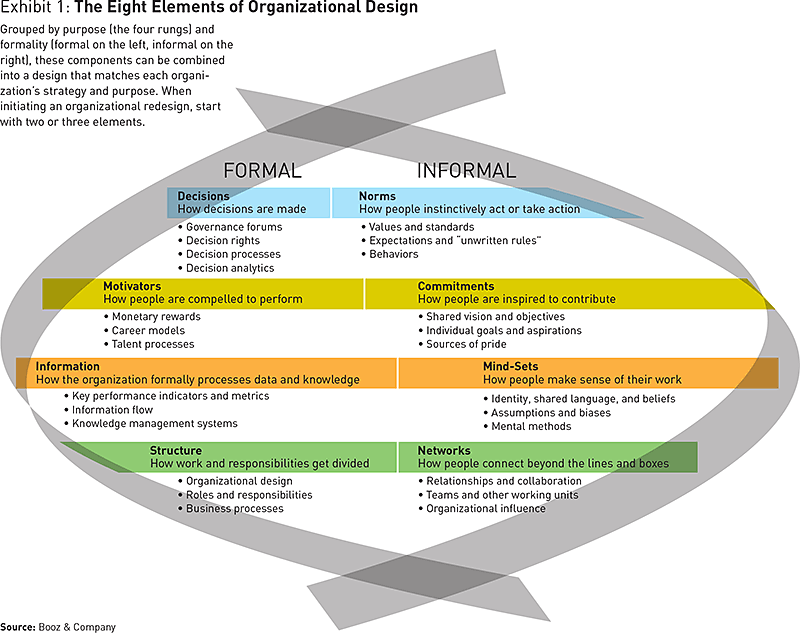
The printout contained a diagram, taken from an article that Joanna had used before in other companies, a blueprint for effective organizational design. It showed eight fundamental levers—vehicles for change—divided into two groups: formal and informal. Formal levers are factors that a company can precisely articulate, codify, and measure. These include the structure of the organization chart, along with incentives, decision rights, and rules that are fairly well defined. By contrast, the informal levers are factors embedded in culture, personal relationships, and behavior. They cannot be precisely codified, but they have a profound impact on an organization’s effectiveness and efficiency, because they represent the everyday habits of its people. In the same way that good product engineering must incorporate both software and hardware, good organizational design must incorporate informal elements along with formal rules and structures (see Exhibit 1).
Like the elements of a string of DNA, the elements of organizational design can be divided into four “rungs” in a ladder. The first rung is related to authority and the governance of behavior. On the formal side are decisions—the statements, often set into rules, bylaws, or policies, that describe the underlying mechanics by which decisions get made, including how and by whom. They include aspects such as governance policies, approval processes (for everything from product launches to expenses), guidelines for delegation, and the creation of advisory panels.
At Seabright, Sanjay knew, there was a reasonably clear approval process for financial transactions. However, the approval process for new product development needed major changes. Ideas sprang up from multiple places, and they tended to get funding as a result of internal lobbying. Innovations in digital media were particularly prone to being overlooked. To rectify this, Jill and Sanjay proposed a cross-business-unit process that could collect, analyze, and prioritize competing projects—and that would give preference to digital products, especially those which analyzed user requests, profiled their likely interests, and customized information accordingly.
The informal counterparts of decisions are norms—the unwritten shared values and standards of behavior that lead people to expect others to act in certain ways. A norm is typically expressed in statements like, “We rise to challenges. We never say ‘We can’t do it’ unless there’s no alternative.” Norms are often learned through apprenticeship, or passed down from mentors. They describe what separates the people who “belong here” from the people who don’t.
For example, at Seabright, people tended to discuss problems only when they could propose a workable solution. This led people to routinely understate challenges and propose small measures that tended to wither away without effect. Jill and Sanjay knew this component would have to change as well.
The next rung addresses the way the company governs behaviors. The formal elements, motivators, are traditional mechanisms for reward, promotion, and recognition. They include performance objectives and incentives such as bonuses and promotions. Motivators can be immensely influential.
Seabright had a strong incentive program; as much as 30 percent of a typical manager’s compensation came through end-of-year bonuses, but the bonuses were pegged to the margins of each business unit. This structure inadvertently devalued the new digital products, where the margins would likely take a hit for the first year or so.
The informal components, commitments, are unwritten aspirations that, when fulfilled, become part of a company’s identity and sources of pride for its employees. One classic example of a commitment was FedEx’s early slogan, “When it absolutely, positively has to be there overnight.” The company was proud to be held to that promise. Seabright had its own long-standing commitment: “We deliver must-read information.” In many industries, its publications were the first thing that executives read each morning. For commitments to be meaningful and sustainable, they must be backed by distinctive capabilities that allow the organization to deliver. This was a bedrock element for Seabright: Jill and Sanjay knew they could build on it.
The next rung involves flows of knowledge and insight. Its formal element,information, encompasses the measurement of performance (through key performance indicators and other metrics); the coordination of activities; and the flow of explicit, codified knowledge.
The informal component is mind-sets. These deeply held attitudes and beliefs affect how employees engage with customers, design and make products, and solve problems. For example, some companies collectively believe that they must serve a social purpose in addition to their commercial interests; others have a mind-set that superlative products require superb product design. This element often separates great companies from also-rans.
The remaining rung is traditionally aligned with the concept of organizational design. On the formal side is structure—the “lines and boxes” of the organization chart, defining critical roles, responsibilities, and formal relationships. Structure is especially important for large, global companies, which must carefully design the lines and boxes, no matter who occupies the various roles. Smaller firms can more easily compensate for a flawed structure with processes and talent. For this reason, and because the chart is so closely linked to traditional thinking about organizational design, many large-company redesigns start with the org chart and, all too often, stop there as well. Although a good structural design can be important, it is never sufficient by itself. It needs to be aligned with changes in other formal and informal elements. It should generally be the capstone, not the cornerstone, of a design effort.
Although Seabright had already gone through a redesign, its structure still had significant problems—but it also had some strengths. For example, a new chief digital officer (CDO) position had been created, and that executive was well placed to bring new products to market. But the current CDO lacked authority and accountability, and had only a few direct reports.
The informal counterpart of structure is networks: connections among employees that transcend the lines and boxes of the formal organization. Networks can be organized deliberately; many centers of expertise are designed to bring together individuals with shared interests and skills. Other networks emerge on their own, as groups of individuals who consult one another because of shared interests or business needs. In general, networks provide a necessary complement to the formal structure, and they can also reveal difficulties with the overall design. If a group with a mandate for influencing performance is systematically bypassed in daily decision making, that’s a clear problem.
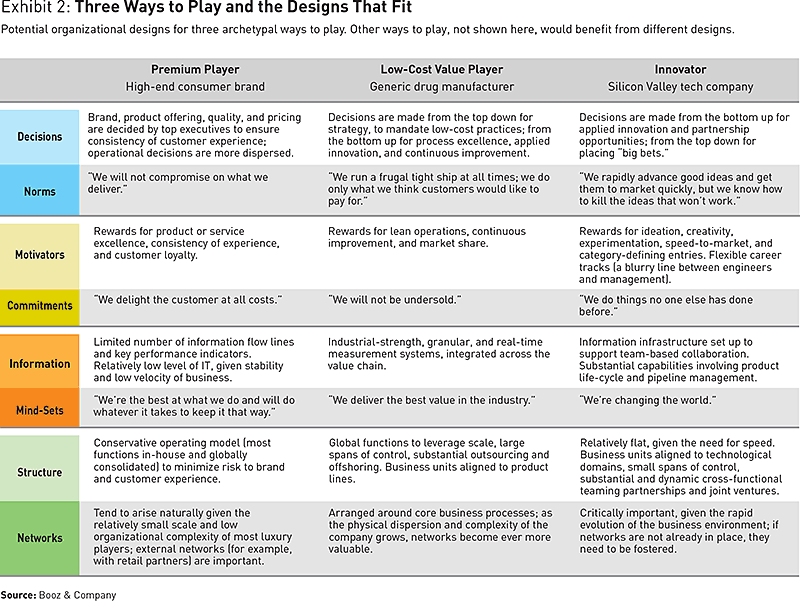
In putting together these eight elements, the formal and informal versions of the four rungs of the ladder, your objective as senior management is to define a single strategically aligned organization. Rather than starting with the eight elements, you begin with your way to play and capabilities system. What are the essential shared attributes of an organization that would best serve the strategy you have already defined (see Exhibit 2)?
The purpose of this exercise is to lay a foundation that should guide the rest of the detailed design. As you move through the organization to specify the elements of particular functions and departments, some variation from the overall design is inevitable. For example, an overall blueprint for a premium auto manufacturer like BMW, Audi, or Mercedes-Benz may not identify frugality as a central tenet. But even luxury carmakers keep a watchful eye on the efficiency of their operations. The organizational design for such a company might specify incentives related to efficiency and norms of frugality for its operations group, but not for marketing and sales.
The New Organizational Design
One month after the initial meeting at Seabright, Jill and Sanjay presented their findings to Joanna and an expanded executive team, including chief functional officers for finance, operations, marketing, and R&D. Sanjay began. “We’ve made a lot of progress,” he said. “We started with our way to play as an innovative value provider—using digital technology to cut prices while being more relevant than ever. This requires an organization that can continually improve print while making the transition to digital. We focused on the areas we need to improve most: the formal controls of decision rights and motivators, and the informal leverage of commitments and networks.”
“What about the other elements?” Joanna asked. She already knew the answer, but this was a small test.
“Well, we can’t tackle all eight at once,” said Jill. “We need some clear priorities. We already have a strong commitment to excellence, and although our organizational restructuring was painful, the resulting structure could actually serve us well—if we bring the other elements up to par.”
“That sounds right,” Joanna said. “So what’s first?”
Sanjay explained how they would strengthen the CDO’s role and expand that leader’s jurisdiction; Jill then talked about motivators. “Right now,” she said, “business unit evaluations are based on individual performance. So everyone’s working hard, but they’re not working together. We want to adjust the bonuses, linking them to the new behaviors we want in addition to margin performance.
“Next,” she continued, “we need to build our information capabilities. We have access to a lot of customer data—the salespeople are fantastic in maintaining those relationships—but we don’t have the capability yet to synthesize that data from multiple places, make sense of it, and translate it into the products and apps that we need.”
“I thought we were already building this,” said the senior vice president for production.
“We are,” replied Sanjay. “That’s the problem. We have five different groups working on aspects of it, but they don’t know what the others are doing. We need to be innovative in a more systematic way, but without more structural constraints. Eventually, we will have to upgrade our information infrastructure, but the first step is to get people collaborating across boundaries. So we’re setting up long weekly lunches among the five groups. We’re also asking everyone to make a common commitment to customers—to raise our game further, giving them the information they need faster than anyone else does. To help pull that off, we’re setting up some dialogues between our content generation staff and our leading customers.”
Joanna sat back in her chair. They’d said the right things so far. “I know I pushed you hard to turn this around quickly,” she said. ”Are you convinced it will get us aligned?”
Sanjay and Jill both nodded. “It’ll at least point the ship in the right direction,” Jill said.
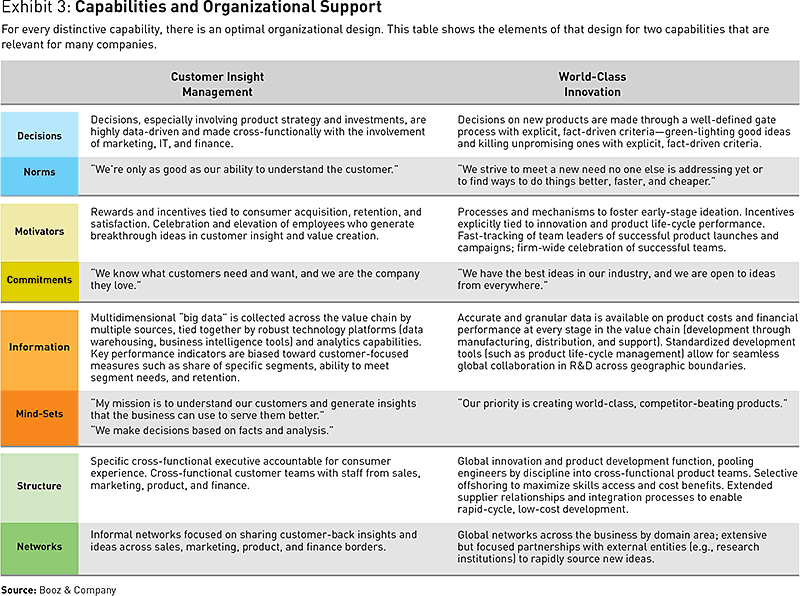
“And,” said Joanna, “how will these recommendations help us strengthen the critical capabilities that we need?”
Jill and Sanjay both smiled. Jill reached into a folder in front of her. “Already done,” she said, passing out a sheet of paper to the people in the room (see Exhibit 3).
Closing the Gap
It took several months to close the gap between the organization that Seabright had and the design that it needed. The first challenge was the board of directors. Because the previous restructuring had been so difficult, Joanna had to persuade them (along with some top executives) that this redesign would be different. Next, she set up a handful of working teams—on product development, on customer acquisition and retention, and on information infrastructure—to lay out the details of the new organizational design. Each working team had a sponsor from the top team, ensuring that the most senior leaders would get involved.
Joanna worked directly with the global HR head to revamp the bonus system. She took pains to ensure that all employees understood the new system and what it would mean for them. The formulas were posted on Seabright’s intranet, along with collective scores by business unit and geographic market.
By her one-year anniversary at Seabright, Joanna was able to demonstrate results to the board. Thanks to the efforts of the newly empowered chief digital officer, several new products had sailed through beta testing. Several follow-on initiatives were in the works—all informed by consumer insights and all with a clear strategic justification. It was too early to tell for sure, but the results seemed promising; customer response and retention were favorable, and metrics on employee engagement were trending in the right direction.
Seabright’s organizational blueprint would not fit the needs of any other company. But a process like this one can help any company, ensuring that its strategy, capabilities, and organization are all aligned to support each other.
That quality is often overlooked in organizational design, but it is probably the most important factor of all: a critical enabler of your company’s ability to deliver on its strategy.

AUTHOR PROFILES:
- Ashok Divakaran is a partner with Booz & Company based in Chicago. He specializes in strategy-driven transformation for product- and innovation-based companies.
- Gary L. Neilson is a senior partner with Booz & Company based in Chicago. He focuses on operating models and organizational transformation.
- Jaya Pandrangi is a partner with Booz & Company in Cleveland. Her work focuses on growth and cost fitness strategy as well as sales and marketing effectiveness for consumer products and retail companies.
'via Blog this'




 Posts
Posts


