Pages

Showing posts with label Strategic planning. Show all posts

Tuesday, September 24, 2013

Seven Ways to Make Your Strategic Planning Relevant

strategy+business magazine
Matthew Siegel

One of the most important shifts in many companies today is the move toward a capabilities-driven strategy. Companies that define a “way to play,” lined up with a handful of key differentiating capabilities that deliver on that value proposition, have a definite competitive advantage. Your own company may have redesigned your strategy accordingly. Now it’s time to execute.
English: Capabilities value contribution to st...
English: Capabilities value contribution to strategy (Photo credit: Wikipedia)
Undoubtedly, you already have a planning and performance management system—otherwise known as a strategic plan and corporate budget. This is a group of deeply ingrained methods for allocating costs and tracking. ... They tend to foster silo-based thinking and to spread investments across all activities. That makes them irrelevant to your strategy—at best. At worst, they will undermine the development of key capabilities. ...
A truly relevant planning and performance management system will help you instill the discipline and accountability to make hard choices. It will make it easier, not harder, to assign the lion’s share of investment to your differentiating capabilities. And it will keep things on track with clearly articulated objectives and performance metrics. Here are seven guiding principles that will help you put such a system into place:
1. Emphasize key capabilities in your strategic plan. Look beyond short-term marketplace opportunities and challenges. Articulate what you need to do, different from what any other company can do, to deliver on the company’s unique value proposition. Tie strategic objectives to those capabilities. ...
English: A diagram of the (strategic) planning...
English: A diagram of the (strategic) planning cycle showing the key stages in the loop (Photo credit: Wikipedia)
2. Spell out capability-building initiatives in the plan. Design roadmaps for developing and steadily upgrading specific capabilities over time. Then, in each annual plan thereafter, spell out how you can further advance these capability-building initiatives. ...
3. Manage discretionary and non-discretionary spending separately. A successful strategy concentrates investment dollars where they are needed most: the company’s distinctive capabilities. Traditional budgeting can undermine this goal by allowing individual units to spend discretionary dollars as they see fit—often favoring pet projects, even if they have no strategic relevance. To prevent this, use zero-based budgeting to determine the amount of non-discretionary expenditures needed to “keep the lights on” throughout the company. The rest of your spending should go through a management process, connected directly to the strategic plan.
4. Use cross-functional governance to balance company priorities against the priorities of individual business areas. Governance forums should use a set of clearly defined decision rights on a regular basis to steer the business. ...
5. Create guidelines for evaluating investment demands. Your company is subject to a range of investment demands with varying degrees of relevance to strategic priorities. Detailed investment guidelines will help assess these requests, especially when you’re balancing “apples and oranges” demands (such as regulatory compliance expenditures versus capital spending proposals). ...
6. Give leaders cross-functional authority to build capabilities and hold them accountable. Capability-building efforts fail when nobody has the authority to carry them out. Help individual leaders build capability systems across functional lines by making sure others can see that they have the requisite decision rights and position. ...
7. Measure and reward progress. Building a strategic capability can often take months or years. Explain clearly how each initiative bolsters a critical capability. Establish objectives and milestones for each initiative. Use these benchmarks to measure and reward progress toward the ultimate goal: a market-leading capability.
A more relevant planning and performance management system yields significant long-term benefits, because it continuously evaluates your company’s performance against strategic goals. The performance benchmarks tell you where and how external changes are affecting your progress. This provides a real-time snapshot of your capabilities at work in the marketplace. Strengths and weaknesses become clear, informing your investment decisions for the next strategic planning cycle. After a few years, this virtuous feedback loop can become second nature, paving the way for real collective mastery of the capabilities that distinguish your company.
Matthew Siegel is a principal with the organizational change and leadership practice at Booz & Company in New York. 

'via Blog this'
Enhanced by Zemanta

Friday, August 30, 2013

New Strategies Around Strategy


The financial crisis turned traditional budgeting and strategic planning on its head. Now companies allow for more flexibility in drafting their plans.
CFO.com:
Russ Banham   


Strategic Planning Meeeting
Strategic Planning Meeeting (Photo credit: michaelcardus)
Along with the traditional annual budget, the five-year strategic plan is a staple of business, a rou­tine exercise with scant thought given its continu­ing utility. Most every company performs the ritual, consuming count­less hours of management time in the process, as if predicting the tortuous turns of markets, tech­nologies, political machi­nations and consumer preferences were a simple affair.
The financial crisis and subsequent recession turned these efforts on their head, rendering almost every five-year plan into worthless scraps of paper. ... “For most of us, the financial crisis and its aftermath was a truly dynamic event that we had not experienced in our lifetimes before,” explains Ken Esch, partner in PwC’s private company service practice.

Strategic Planning Meeeting
Strategic Planning Meeeting (Photo credit: michaelcardus)
We’d never seen such change happen with such velocity, and we’d never realized just how connect­ed we were to the global economy,” he adds. “It tested our ability to plan for the future.”
Yet, as Steve Player, North America program director for the Beyond Budget­ing Roundtable, points out, despite the constant winds of change, all organizations still must develop and act upon a strategic plan. “You have to have some idea of where you’re going,” Player asserts. “You need to establish what markets you’re going to compete in, which products you will produce, which services you will provide, and then posit out your strategy for winning.”
Both planning experts agree that the key to plan­ning is keeping the plan flexible, nimbly adjust­ing it based on dynamic forecasts that suggest changes ahead, if not already afoot. As Player puts it, “You plan for what you think will happen, but then constantly subject the plan to scenario tests based on your changing assumptions.”
These assumptions might be the price of a bar­rel of oil, the risk of an extreme weather event, the impact
English: Created for the WMF strategic plannin...
English: Created for the WMF strategic planning process (Photo credit: Wikipedia)
of potential currency fluctuations or the shifting economic conditions in Italy. In each case, a contingency plan is developed and kept at hand—just in case. The organizations that best assess these possibilities and expeditiously address them arguably are in a better competitive posi­tion than their peers.
Not all companies are tak­ing such actions, however. “Businesses seem to be diverging on their ap­proach to planning,” Esch says. “One camp continues to be uncertain as to what they ought to do in light of all these events occurring around the globe, and how they will impact their companies. They seem to be afraid to make com­mitments and big bets.”
The other camp has accepted that these dynamic events and changing times are the new normal. “They’re constantly figuring out how they’re go­ing to operate in this new environment, placing bets on a different market or new product,” he adds. “Their planning is agile.”
As always, information is vital to the planning exercise. In many cases, such business intelligence is not hard to come by. “Companies that have been around for awhile already have a repository of historical data indicat­ing what happened to the business the last time the economic cycle shifted or some unforeseen event occurred,” Esch notes. “Perhaps one part of the business suffered, but another part performed even better. That tells you something about where to allocate resources.”
Like Player, Esch does not advocate gutting the strategic five-year plan. Rather, he agrees that companies must write these plans not in ink, but in pencil. Keep an eraser handy.

'via Blog this'
Enhanced by Zemanta

Tuesday, August 27, 2013

The Secret to a Successful Divestiture

When you are selling part of your company, don’t just offer buyers a potential asset; give them the capabilities to gain value from it.

strategy+business magazine:

... Business strategy is always intertwined with capabilities. A capability is the combination of processes, tools, knowledge, skills, and organizational design needed to deliver a specified outcome. Thus, although most M&A departments spend much more time thinking about the sale price, attention to capabilities can make a major difference in a deal’s outcome.
For example, when you sell major assets, you can often maximize the deal price by identifying buyers with capabilities systems of their own that are a good fit. ... They are often willing to pay big premiums to complete the deal—and with good reason. Deals that leverage a buyer’s existing capabilities typically fare well (see “The Capabilities Premium in M&A,” by Gerald Adolph, Cesare Mainardi, and J. Neely, s+b, Spring 2012).
But maximizing price is only one of four major goals in a divestiture. The others are minimizing any disruptions to your retained businesses, keeping capabilities away from particularly strong competitors (which might mean turning down a deal that is favorable in other respects), and handing the buyer something that can be operated successfully from Day One. Your motive is not altruistic; in M&A, it is generally in a seller’s interest to minimize the length of entanglement, and to establish a reputation as a good partner for making deals.
... The leaders of any company divesting assets must deal smartly with capabilities issues or risk having the deal fall short.

Differentiating Divestiture

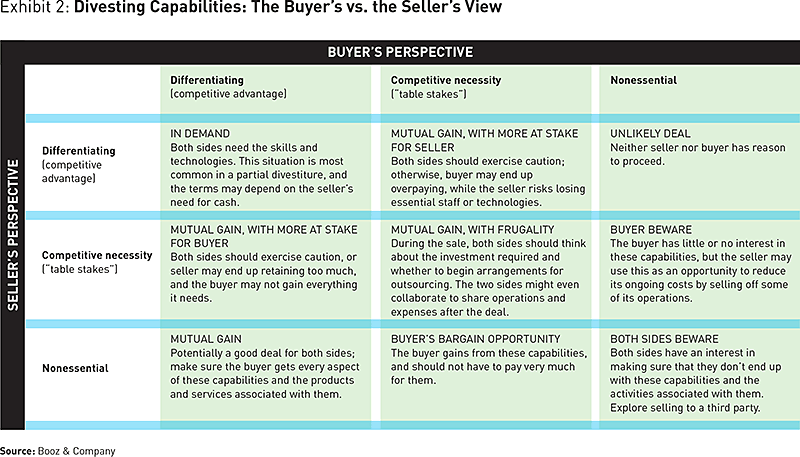
As a seller, you should begin your divestiture process by identifying the desired end state for the important capabilities involved: those you will still need after the deal is done, those you won’t need, and most importantly, those that both you and the buyer will need (see Exhibit 1). In each group, some capabilities are “table stakes”—every company in the industry needs them—whereas others are truly differentiating. The latter can distinguish your company in the market and give you an advantage over competitors. These capabilities require the most attention during a divestment, and you should seek to keep them intact while enabling the buyer to benefit from the deal in every other way (see Exhibit 2).
In practice, most sellers, facing the pressure of time, end up having to choose which capabilities to focus on. Your goal is to keep the process moving without sacrificing the quality of your decision making or jeopardizing the outcome.
There are certainly divestitures in which the buyer is known from the beginning, but it is not uncommon for a company to decide to divest something just because it no longer fits strategically, announce this plan publicly, and then search for a buyer. In these cases, major portions of a divestment plan must be executed before a buyer has been identified, and certainly before the transaction has taken place. This adds to the challenge.
There are also partial divestitures ..., in which only some assets of a given business or parts of an asset are sold. A partial divestiture is often more complicated from the standpoint of capabilities, because of the seller’s need to hold on to some people, processes, and technologies that it could let go of if it were selling an entire business or product line.
To make the process of divestiture more manageable, we recommend five steps. Each step gains its power from how it builds on previous steps, helping sellers during the critical period—usually lasting up to 18 months—when they are readying assets for sale. Note that these steps focus only on the analyses and business process changes that are relevant to managing the capabilities you are divesting. ...

Step 1: Capability Scoping

In the first step, you set the overall strategy for the divestment—including the assets you want to sell, when you want to sell them, and to whom. This takes place through an exercise called “capability scoping,” in which you take stock of the most important capabilities associated with the assets you are putting on the block. Often what’s up for sale is not a stand-alone business unit but ... a product, service, or asset that sits within that business unit. It likely draws on capabilities that are centralized within the company or that are used by other parts of the business unit (and therefore can’t be offered as part of the deal). This step usually precedes the identification of a buyer and should be done before any transaction-related activity, such as planning an auction. ...
Often, the seller realizes there isn't time to address every capability on its list, and it must set some priorities. ...
Undoubtedly there is a set of analogous activities at your company, drawing on people and technologies that are dispersed throughout the organization. A scoping exercise in and of itself isn't a plan for divesting assets—it doesn't answer the question of how to ensure the integrity of differentiating capabilities. But it does lead to a hypothesis of what will have to be accounted for, and either added to or carved out of an asset, in the months leading up to a divestiture.

Step 2: Baseline Analysis

This step involves understanding the components of key capabilities and how they come together to enable products and services to be successful. The idea is to break down those activities into their constituent parts—
English: Business Process Reengineering Cycle
English: Business Process Reengineering Cycle (Photo credit: Wikipedia)
what the activities consist of, who performs them, where in the company they are performed, how long they take, what technologies make them possible, and what problems are associated with them.
The baseline analysis identifies exactly what you can let go of and what you need to keep—and illuminates where a new owner might be left with a gap.
Not all buyers have gaps. Some may have capabilities systems that are a better fit for the assets you’re selling than your own capabilities are. In other cases, the ability of your activities to fill the buyer’s gaps becomes a point of negotiation in the deal—factoring into the price, the time to completion, or the transition services that you must provide. If no buyer has yet been identified, this is your chance to formulate a clear picture of the value that your divested assets might hold for someone else.
Completing a baseline analysis of your capabilities is more difficult than it might seem. The problem is that most people in a company—even, and sometimes especially, those with special talents or important functional roles—have a narrow view of what underpins a business’s success. The salespeople will describe the differentiating capabilities in one way, the marketing people in another, and the product development people in a third. From up close, and amid the competing perspectives, it can be hard to tell which activities truly make a difference. You may need to weigh all these inputs dispassionately—and pull back to get a wider perspective.

Step 3: Option Analysis

In this step, having identified one or more potential buyers, you look closely at the buyer’s capabilities needs and how your assets can help fill those gaps. This enables you to maximize the value of the deal. ...
The information uncovered during this step may prompt you to revisit a previous step. ...

Step 4: Transition Planning

Having identified the gaps and decided how to fill them, you as the seller now must start carving out the asset and making sure it has the capabilities it will need. This involves the creation of detailed project plans—perhaps one for each of the major capabilities involved—and of work teams.
Where to begin? At this stage, there is still no guarantee of who the buyer will be. Focus on activities that need to be conducted for any buyer. This forces you to tend to the known things first, as opposed to doing what comes more naturally and tending to the biggest things first. This approach can speed a sale once a buyer has been identified—and even if you don’t sell the asset, in the end, you won’t regret the planning effort. ...

Step 5: Buyer Engagement

Once you have a definite buyer and a signed contract, you can flip the switch on all the plans you have been making in Steps 1 through 4. Begin by sharing your thinking with the buyer, including which capabilities you see as most important and what your plans are for transferring them. Describe how you will deliver a fully functioning business to the buyer. The buyer has its own market strategy, quite possibly different from yours, and may have a different view of which capabilities are important. These differences sometimes lead the buyer to ask for something you don’t expect. That’s another reason not to start on this stage prematurely: That early work might have to be discarded. ...

Preparation, Skills, and Pride

Divestitures can be some of your company’s most complex transactions. They require strategic thinking, a massive amount of contingency planning, and—once a certain point is reached—the simultaneous management of multiple work streams and projects. You will need to be flexible and ready for the unexpected. This checklist can help you get ready for the process:
  1. Do you have a clear sense of what you’d like to sell, what you think it’s worth, and what capabilities might be involved?
  2. Do you know when you’d like to complete a transaction, and do you have a rough sense of the time line leading up to that?
  3. Do you have a list—if not by name, then by type of company—of who might be interested in your assets?
  4. Do you have a clear sense of how the sale will affect capabilities you’ll need for your retained businesses or assets?
  5. Do you have a dedicated transaction team, and if so, does the team have a clear set of priorities?
  6. Do you have measures in place to track your progress? Do you have clear measurements for the success or failure of the transaction?
The skills you develop during this process aren't relevant just to divestitures. They can also be used to reduce risk; create value; and improve the outcomes of acquisitions, spin-offs, and portfolio restructurings. Your work on divestitures can span organizational boundaries, geographies, business units, and functions, and thus help you develop the structures and communications links you need for other complex initiatives. The focus on capabilities involves accounting for factors that are often overlooked. It can help you avoid the tunnel vision that often accompanies a singular focus on financial matters during major transactions—and that can keep you from seeing the broader strategic impact of your decisions in general.
Many companies pride themselves on their ability to use acquisitions to drive inorganic growth. It’s far more rare to find a company that prides itself on the way it divests a business or asset. That’s understandable; by their nature, divestitures focus on businesses or assets that once seemed promising but no longer fit with where the seller is heading. It isn't surprising that there would be a mind-set of “the sooner, the better” and a narrow focus on the price. If you use the filter of capabilities, the divestiture might take a little longer, but it can leave your company better off in the ways that matter most. 
Reprint No. 00208

AUTHOR PROFILES:

  • Eduardo Alvarez is a Booz & Company partner based in Chicago. He leads the firm’s global operations practice and is an expert in business process transformation and technology-enabled transformation.
  • Steven Waller is a Booz & Company principal based in Chicago. He specializes in technology strategy and the development of new operating models for energy and financial-services companies.
  • Ahmad Filsoof is a Booz & Company senior associate based in Chicago. His focus is on operations, business process transformation, and technology-enabled transformation in the energy industry.
  • Also contributing to this article was consulting writer Robert Hertzberg.

'via Blog this'
Enhanced by Zemanta

Tuesday, June 11, 2013

Building a Flywheel Business

By linking customers and capabilities, companies can generate the momentum for sustainable growth.

strategy-business.com:
Many growth opportunities look like bottle rockets. They start with an impressive flash but end with an explosion. Most often, this is caused by business leaders’ tendency to chase after the biggest customer segments or the ones with the highest margins—typically the same segments that everyone else chases. Other leaders get lost in their enthusiasm for a new product or in their desire to pursue the next market fad. They fail to consider whether they are attempting to solve a customer problem, and how much the solution is worth. Such strategies may result in fireworks, but they don’t create a business of increasing momentum that provides both the stability and the energy reserve to drive sustainable growth—in other words, one with a solid flywheel.
Companies that pursue a flywheel-business model focus on building the kind of long-term capabilities that allow them to prevail against rivals and capture new opportunities for growth. ... Along the way, they target the customers or customer segments that will help them develop these capabilities. It is similar to the flywheel concept from high school physics, typically demonstrated by a heavy disc that is difficult to start up, but that spins easily with limited effort once it reaches full speed. Over time, a simple innovative idea becomes a well-oiled machine, which translates into a predictable and profitable business.
Two case studies—Johnson Controls Inc.’s Automotive Experience group and Pulte Homes—show how company leaders embraced the flywheel concept to unlock strategic growth opportunities.

Collaborate with Suppliers

Johnson Controls, Inc. logo
Johnson Controls, Inc. logo (Photo credit: Wikipedia)
Revenues at Johnson Controls Inc. (JCI) in 2012 were US$42 billion, nearly half of which came from the largest of its three global business units, the Automotive Experience group. But this group is relatively new. ...
The Automotive Experience group began in the early 1980s as the Automotive Seating group. At that time, the automotive industry was embracing outsourcing ... From 1982 to 1984, leading seat frame and foam manufacturer Hoover Universal Inc. had built six seat assembly facilities to serve nearby customer vehicle assembly plants. JCI recognized the outsourcing trend and acquired the Automotive Seating group from Hoover, along with the Ferro Manufacturing Corporation, a seat mechanisms manufacturer, and continued to add plants capable of providing full seat systems to the Detroit Three.
Realizing that wage arbitrage offered no competitive advantage ... JCI sought to build a sustainable flywheel business. ... John Daly, the newly appointed vice chairman of JCI, ... challenged his managers to embrace Japanese manufacturing methods and targeted the Toyota Motor Corporation as a customer that could help the company achieve its goal.
In October 1985, Daly informed his Georgetown, Ky., plant workers that a team from Toyota would be visiting in three weeks. Although the plant was viewed as JCI’s best in terms of internal housekeeping ... it followed U.S. manufacturing performance standards, which did not match Japan’s. Die changes took four to eight hours, so an average production run lasted 20 days to amortize the setup cost. Inventory levels exceeded a month of supply, and equipment ran only 40 percent of the time. Despite making nascent efforts at statistical process control, the company remained focused on volume, leading to substantial rework.
In anticipation of the Toyota visit, the Georgetown plant manager sought to temporarily cut inventory by nearly 70 percent, to a mere 10-day supply. ...  Later, he visited a seat supplier in Japan and learned that even 10 days was excessive by Toyota standards: The supplier held so little inventory that it did not even require forklifts to move materials around.
...[Shortly] after the JCI plant visit, Toyota announced that it would build an assembly plant in Georgetown. Over the coming year, Toyota visited JCI regularly, and the Georgetown plant attempted to showcase new improvements every time. ... By the time Toyota production began ramping up in 1988, the dedicated Toyota seat assembly area within the Georgetown plant operated with a mere 7.5 days of inventory, and by 1989 at full scale it held less than a day’s worth.
... Equally important, the lessons of Georgetown had spread across other JCI Automotive Seating group plants ... At this moment, JCI had completed the first turn of the flywheel; it had developed the capabilities to be a world-class seating manufacturer in the emerging “just-in-time” environment.
The company then sought to become a full partner in design through delivery. Chrysler appeared to be the logical customer to fuel this second rotation of the flywheel. ... In 1989, JCI jumped at the chance to take responsibility for the entire seat system in Chrysler’s new Neon model. The innovative compact car designed under Lee Iacocca’s guiding hand proved to be a huge commercial success for Chrysler—and for JCI, which now had the momentum to build its design capability.
JCI’s next step was to establish deeper relationships with the Detroit Three and other automotive manufacturers by creating dedicated “customer business teams.” These new cross-functional groups sought to expand their scope of responsibilities for their respective automotive customers. ... While the individual teams focused on serving the specific needs of their respective OEMs, a common R&D group sought to leverage the company’s growing expertise across vehicle programs by designing materials and components that could be incorporated into many different designs.
In 1994, JCI opened a new research and development center capable of doing its own prototype testing, expanding its design capabilities even further. Independent of the OEMs, the company also began examining car customer views regarding seating. Through sophisticated conjoint analysis, JCI developed deep consumer insight into preferences among features, such as motorized versus manual adjustments and seat heaters. Rather than simply accepting design guidance from the customer’s vehicle program manager, the customer business teams came armed with data to help them make the inevitable design trade-offs that influenced the entire car. The second revolution of the flywheel was complete.
The third rotation began with JCI’s acquisition of Prince Automotive (which made auto interiors) in 1996. Now the company could leverage its growing capabilities across a larger proportion of the vehicle. It provided instrument display clusters, dashboards, sound-cushioning headliners, and trim, in addition to the safety and comfort-critical seat system. Having gained control of all the key aesthetics of a car’s interior, JCI opened a new technology center in 1998 complete with an “idea factory” and “comfort lab.” ... JCI could now help a program manager make the right decisions throughout the car interior.
JCI continued to increase the momentum of its flywheel by expanding its product and geographic scope. In 1998, it added to its portfolio an automotive interior part producer, the Becker Group, with 70 percent of its revenues in Europe, and the Italy-based Commerfin SpA, a maker of door systems. Taking another page out of the Japanese playbook, in 1999 JCI launched a keiretsu-like partnership with Genetex, Jabil, and Microchip Technology to develop integrated electronics for car interiors. And in 2000, it expanded into Japan by acquiring Nissan’s stake in Japanese seat manufacturer Ikeda Bussan. By 2005, JCI had renamed the business unit the Automotive Experience group. It was now a global flywheel business with annual revenues of nearly $19 billion.

Create Scale in New Markets

In 1950, unable to afford an architect, a startup contractor named Bill Pulte used a plan from the Detroit Times’  Home of the Week section to build his first house—which he sold for $10,000. ... Over the next decade, his company, which is today called PulteGroup Inc. (of which Pulte Homes is a subsidiary), operated like every other builder in the country. It built individual, custom-designed homes for a particular price niche in a local market—in Pulte’s case, the high-end home market of the Detroit suburbs.
Pulte Homes logo
Pulte Homes logo (Photo credit: Wikipedia)
But Pulte recognized an opportunity to create a flywheel business of national scale by offering his high-quality craftsmanship at more affordable prices through modular design and prebuilt components. In 1959, Pulte shared his vision for the future in the plans for Concord Green in Bloomfield Township, Mich., the company’s first subdivision project. He priced the homes at $29,000—well more than double the $12,000 median price in Michigan at a time when median family income ran less than $6,000—and tapped the aspirational dreams of a growing upper middle class.
Pulte created a superior alternative to the then dominant models of suburbia. From experience, he understood that the custom model incurred additional costs for the buyer and uncertainty for the seller beyond the true value of the finished product. He also saw the flaws of the mass-produced subdivision model pioneered by Abraham Levitt and his sons, William and Alfred. Launched in 1947 to target soldiers returning from World War II, the Levitts’ original planned community in New York consisted of 2,000 rental homes employing a common, single-floor house plan. The homes could be built at the astonishing rate of 30 per day. By 1949, they had expanded the quality of the homes and introduced a new “ranch-style” design for sale at $7,990, well below the statewide median of $10,152. It was offered in five models defined by only slight differences in window placement and exterior colors. By 1951, what had become known as Levittown encompassed more than 17,000 homes—organized in huge subdivisions full of nearly identical “boxes.”
At Concord Green, Pulte sought to achieve the scale economies of the low-end, mass-production approach while providing the variety demanded by the more discerning upper-middle-income customer. His modular designs eliminated the need for expensive architects but, unlike the Levitts’ homes, provided generous variation in design throughout the subdivision. The company also built design tools to allow homebuyers to customize where it mattered most, in the interior. Customers could choose from a wide range of paint colors, flooring, countertops, and lighting and plumbing fixtures. The unique capabilities Pulte developed for the Concord Green project powered the first rotation of Pulte’s flywheel, enabling the company to reach an underserved market.
... Pulte expanded to other markets: Washington, DC, in 1960, Chicago in 1961, and Atlanta in 1968. In this second turn of the flywheel, he broke the paradigm of construction as a local business. Under the old model, relevant scale occurred at the local level, through builders’ ability to get better pricing and scheduling preferences with local subcontractors and suppliers. The new paradigm of modular designs and selective customization applied across markets, making national scale in home building meaningful.
Pulte’s national expansion enabled him to invest in improving his company’s capabilities in developing design tools and customer understanding—building more houses with more options while increasing scale by using national building material suppliers, not just local distributors. He continued to innovate during the 1970s, turning his focus to the baby boomer market. For example, Pulte’s in-house architectural team introduced the “quadromin-ium,” a single structure made up of four two-bedroom units with separate entrances and garages priced at a mere $20,000 per unit (only slightly above the median home price in 1970), targeting first-time buyers with kids. These new capabilities provided the momentum for the third rotation of the flywheel, as Pulte built additional national scale across a wider range of price points and markets.
Bill Pulte also recognized a potential disadvantage his business model had in comparison with that of entrenched local builders, who could ensure quality through personal relationships with subcontractors for electrical work, plumbing, and the like. To offset this disadvantage, in 1980 the company created “Pulte University” near its headquarters in Bloomfield Hills, Mich., and began training construction workers from around the country. Over time, the university was expanded to include high-performing managers as well. By the end of the 1980s, Pulte was selling homes in 17 markets in 11 states at prices ranging from $50,000 to $600,000.
Continuing to bear in mind the now middle-aged baby boomers, in the 1990s Pulte developed communities in Arizona, California, Florida, Michigan, New Jersey, and Virginia, targeting “active adults” age 55 and older. (A merger in 2001 with Del Webb Corporation, a builder of retirement communities, solidified this market.) ... Along the way,Businessweek named it one of the 50 top-performing companies and Moneymagazine declared it a 30-year “super stock.”
Today Pulte operates in more than 65 markets in 29 states and the District of Columbia, generating $4.8 billion in annual revenue—roughly a third of its peak revenues in 2005 before the housing crash. Despite being hit hard by the collapse of the bubble, Pulte survived, while other builders did not, by continuing to look for new markets and honing its design tools. In 2009, the company acquired Centex Corporation, a leader in the entry-level home market. And in 2011, Pulte drew on consumer research to introduce its trademarked “Life-Tested” designs, which offer innovative features to meet the needs of modern families. That same year, Pulte ranked as the country’s largest home builder (in terms of revenue), and one poised to grow during the housing market recovery.

The Perpetual Motion Machine

Both JCI and Pulte created sustainable, multibillion-dollar businesses that have proven resilient despite the misfortunes of the automotive and construction industries. They built their flywheels in different ways, but still provide common lessons for other companies.
First, both recognized the stagnation inherent in the status quo, and sought to create a step change in customer value by questioning conventional wisdom or practices. JCI sought to become more than a simple contract manufacturer leveraging nonunion wage rates, and Pulte sought to break the trade-off between customization and cost that constrained other homebuilders.
Second, both companies identified key capabilities that would enable them to compete successfully, and targeted a customer or customer segment that could help them further develop those capabilities. Importantly, they targeted neither the largest customer segment nor the customer that could pay the most per unit. Rather, they sought out an underserved market that would help them learn and refine their alternative business model. In some cases, they added capabilities and market access through M&A: Both companies realized that a well-functioning flywheel is not only an engine for organic growth, but can also provide the strategic logic for acquisitions.
Third, JCI and Pulte both had a “big-picture vision” for their company’s growth, and simultaneously understood the need to work with a customer to learn the myriad small details that no amount of planning or conceptual thinking could uncover. Toyota helped teach JCI how to implement lean manufacturing, and Concord Green provided the opportunity for Pulte to interact with hundreds of customers to build the design tools needed to change the customization–cost paradigm.
Finally, for both companies, the entire picture might not have been clear from the beginning. But each had a line of sight to the next flywheel revolution—that sense that this could be bigger than a single-customer initiative. They leveraged their growth to fund further investment ahead of the competition. JCI used its scale to invest in consumer research and expand its interior portfolio, whereas Pulte used its consumer knowledge to capture purchasing scale and enhance its design tools. Each nurtured specific competitive advantages to add momentum to its flywheel.
These four characteristics—step change in value, clear target segment, scale in new capabilities, and line of sight to the next revolution—are also found in other familiar flywheel businesses. Consider Walmart, which spent its early years targeting towns that then dominant Kmart had concluded were too small. The company recognized the possibility of a step change in value in towns where the existing alternatives were high-priced local stores with limited merchandise or a suburban mall a dozen miles away. By growing for more than a decade under the radar screen, Walmart achieved the scale to develop the IT systems and logistics network for which the company is now famous. Did Sam Walton foresee Walmart’s becoming the largest company in the world (by revenue)? Probably not, but he certainly did sense that his “everyday low price” model and the efficient supply chain behind it offered innovations to better serve millions of people in the type of middle American towns that he understood so well.
There is great power in linking customers and capabilities this way to create a flywheel effect. But it is important to remember that flywheels can be deceptive, leading to false confidence and hubris. ...
Flywheel business models do not achieve perpetual motion, but instead require continued tending to maintain the momentum. Times change, and flywheels are by definition hard to adapt and difficult to control—leaving a business vulnerable to the entry of a disruptive technology. In times like these, it can be tempting to revert to old habits, pursuing bottle rockets. Our advice: Don’t even try to course correct. Even companies with well-oiled machines should continually look for the next flywheel business, always seeking step-function changes by linking a new set of capabilities and customers. The original flywheel inevitably winds down, but companies that have planned ahead will have a new one up and running to take its place. 
Reprint No. 00180

AUTHOR PROFILES:

  • Tim Laseter is a professor of practice at the University of Virginia’s Darden School and other leading business schools. He is the author or coauthor of four books, including The Portable MBA (Wiley, 2010). Formerly a partner with Booz & Company, he has more than 25 years of business strategy experience.
  • Jeff Bennett is the founder and managing partner of Amphora Consulting. Formerly a partner with Booz & Company, he is an expert at helping companies think strategically about growth opportunities. He has facilitated discussions on strategy and organization at university executive education programs and at more than three dozen leading corporations.

'via Blog this'
Enhanced by Zemanta

Tuesday, June 4, 2013

Organizing for Advantage

How to design a mix of formal and informal factors to advance your company’s strategy.

strategy-business.com:
Published: May 20, 2013
by Ashok Divakaran, Gary L. Neilson, and Jaya Pandrangi

Sometimes epiphanies come by email—or, in this case, three emails. It was Saturday at 5:17 a.m., and Joanna was already at her laptop. As the new CEO of the Seabright Publishing Company, just four months into the job, she had returned the night before from a 90-day “listening tour” of the company’s operations. ...
A recognized turnaround expert, Joanna had been hired by a board looking for organizational change. Seabright had a new strategy. It was shifting from print-based books and magazines for professionals to global digital information products. Everyone agreed this was the right direction for the company. Yet the former CEO, despite making a major push for restructuring and change, hadn’t gotten much traction or support. That failure had cost him his job.
Joanna had concluded that the strategy itself was sound, and Seabright’s people seemed to both understand the need for a turnaround and value the shift to digital media. But they couldn’t execute it, especially when they had to work across company boundaries. The first few digital products were struggling to gain a foothold. When pressed, even the digital product managers grumbled that they’d be foolish to change too rapidly; their bonuses were linked to last year’s metrics. The organization’s culture also seemed to be holding them back. On the listening tour, when Joanna asked people what needed to be fixed, they pointed fingers at one another.
So, ... Joanna woke before sunrise to plot a course of action. First, she checked her email. At the top of the queue was a note from Seabright’s senior vice president of production:
About that R&D project—I think we’re looking at about $13 million. How soon could we seek budget committee approval?
That was followed by one from the head of marketing and consumer insight:
As I mentioned last week, I know that the app will deliver. Only remaining question is costs. I got an estimate today of ~$12-15m. Can we talk further?
The third was from her head of sales:
The new digital tool will address a lot of the issues we had with the numbers last quarter. Expect it’ll be $10 million-plus to develop. How rich are we feeling these days?
Here was a perfect illustration of the problem. Three departments, with similarly sized propositions, that clearly weren’t talking to one another. ... This was more than a communication issue. The company’s organizational design, which had evolved in an ad hoc fashion over its 80-year history, was out of sync with its strategy. Each business leader had good intentions, but the company had too many initiatives under way, all projecting hockey-stick growth and rosy return on invested capital. The reality was underperformance, confusion, conflict, and spiraling costs.
The organizational structure was simply too fragmented to meet the challenges the company faced. As long as that structure remained in place, getting Seabright to execute in the digital realm would be like entering a minivan into the Indy 500.
Galbraith's Star Model of organizational design
Galbraith's Star Model of organizational design (Photo credit: Wikipedia)

The Case for a New Organization

The Seabright story that unfolds in this article is a composite, derived from several actual cases in various industries. It is written to illustrate how to design a more effective alignment between your strategy and your business structure: how to gain a consistent advantage, or a “right to win” in the marketplace, through the way you are organized. To succeed consistently in the marketplace, a company must have a clear and differentiated way of creating value for its customers, supported by well-defined capabilities—things it does exceptionally well that are central to its ability to perform, and hard to replicate. All this should be reflected in its portfolio of products and services. But those elements will only lead to sustainable success if the company has the right organizational design, one that enables it to execute its strategy.
Every company’s situation is unique, and therefore the right design for one company will probably not work for others, even within the same industry. But the symptoms of ad hoc organizational design are regrettably common. They include business units and functions that protect their own domain’s priorities to the detriment of the overall business, hoarded or wasted resources, strategic goals without follow-through, and a culture that dismisses or ignores accountability. These problems are not just a matter of personal ill will, incompetence, external pressure, or cultural resistance. They exist because organizational design determines behavior. When a company’s organizational forms are inconsistent with the broader objectives of the business, that misalignment affects the day-to-day actions of individual employees. It leads perfectly competent people to chronically underperform. Conversely, companies with a strong link between their strategy and their organizational structure can, like an engine firing on thousands of cylinders instead of a few, generate energy and creativity at all levels.
Even when leaders recognize that their problems are organizational, they try to solve them in ineffective ways, by making rapid, reactive changes to the organizational structure. They shift the “lines and boxes” of the org chart, or divide up responsibilities differently. They may also force a few recalcitrant leaders to resign, sending an implicit message to current executives: “If you can’t deliver, I’ll get someone who will.” But these fixes don’t address the actual cause of underperformance: a misaligned organizational design.
At Seabright, Joanna was able to diagnose the problem because she had seen it at other companies. By making a few major changes to the organizational design, she could enable the new strategy to deliver. Given a job this big, the main question was where to start.

Designing for Strategic Fit

English: Capabilities value contribution to st...
English: Capabilities value contribution to strategy (Photo credit: Wikipedia)
How do you translate a business strategy into an organizational design? How can you connect the dots between company-wide objectives and the concrete details of reporting relationships, information flows, decision rights, and social networks? ... Figuring it out requires a new way of thinking about organization: what might be called organizing for essential advantage. “Essential advantage,” in this context, refers to the creation of meaningful, lasting value for customers. Although mission statements and lists of business objectives are plentiful, it’s rare to find a statement that explains precisely how a company creates value. As described in several recent books—notably, The Essential Advantage: How to Win with a Capabilities-Driven Strategy, by Paul Leinwand and Cesare Mainardi (Harvard Business Review Press, 2011)—these statements can be distilled down to two elements: a “way to play” and a system of differentiating capabilities. The way to play is how a company engages with the market, its fundamental value proposition. For example, some companies choose to distinguish themselves as innovators, continually introducing new products and service, whereas others are value providers, offering their products or services at an attractive price point. Capabilities are cross-functional combinations of technology, processes, skills, and mind-sets that work together synergistically. Differentiating capabilities are the few (typically, three to six) capabilities that enable a company to stand out from competitors and consistently provide value for its chosen customers that no one else can match.
A successful company doesn’t gain its way to play and capabilities system by accident. Like an athlete picking a game he or she can win, and then honing skills to play that game more successfully, the company seeking a strategy looks to build on both its strengths and its prospective market opportunities by choosing the path that encompasses both. Inevitably, this means choosing not to pursue some directions. That’s a difficult decision for many companies, particularly those in rapidly evolving sectors, where there are many opportunities and few certainties. Nonetheless, being clear and consistent about where to play and where not to play is a necessary step toward building a coherent strategy, where everything the company does fits well together.
A coherent strategy also provides the necessary starting point for the organizational design process. Without clarity about the “what” (the way the company creates value), one can’t possibly define the “how” (the way to organize to create value).
Take our fictional company Seabright. Historically, its way to play had been as a premium producer; it provided targeted information to business professionals in several industries. It had a well-known brand name and strong customer retention; leaders in some industries could not function without it. But in recent years, as the value of print publishing faded relative to the value of the Internet, the company had lost its identity. On any given day, it was hard to tell whether it wanted to be a reputation player (building, like many other media companies, from a long-established brand name), a digital innovator, or a value player offering inexpensive data through online platforms.
Much of Seabright’s reputation had come from its mastery of rapid print distribution. It could outpace rivals with its network of printing plants and other facilities, optimized to reduce costs and speed up delivery. Unfortunately, that capability was rapidly becoming obsolete. But another was more relevant than ever. Over the years, through its loyal subscriber base, Seabright had refined its ability to measure and understand customer insights. It also had a strong innovation capability, with the skills to tailor new products to meet customer expectations.
The existing organizational design, in formal and informal ways, tended to favor the print-related capabilities over those with more digital relevance. Joanna had already known, coming in, that she would have to reorient the company’s strategy. Now she saw that she would also need to rapidly shift the organization to support that change.

Eight Building Blocks, One Design

Two weeks after her email epiphany, Joanna convened one of the most critical meetings of her tenure at Seabright. Gathered around the conference table were the heads of several business units and functions, along with two promising midlevel executives, Jill and Sanjay. Jill was a talented operations manager with a decade of experience in manufacturing. Sanjay had run finance at two digital media startups. Both were well respected in the organization and had a knack for delivering unpleasant truths with a minimum of drama.
“Effective today,” Joanna said, “you two have a new assignment: Develop a fresh organizational design and bring back your high-level recommendations to this group in a month. At that point, we’ll see how it fits with our company strategy, and I’ll make the call on whether to detail out the new design and how to adopt it. This is the top item on my agenda.”
Jill and Sanjay exchanged a glance. Joanna could tell, in that moment, that they appreciated this rare fast-track opportunity, but they also saw the risks. One major reshuffling effort had gone down in flames just two years before.
“I know,” Joanna continued. “It sounds like a big, unwieldy job, but it boils down to deliverables. First, I want a diagnostic of our organizational problems: critical bottlenecks, pain points, and areas where we’re stepping on ourselves or replicating efforts.
“OK,” Sanjay said quietly.
“Second,” Joanna said, “I want a plan to rectify those issues. That means a new org design for the company.”
“From scratch?” Jill asked.
“Not entirely from scratch,” Joanna said. “We’re a decades-old company, with more than 15,000 employees. We can’t—and wouldn’t want to—just rip up all our institutional heritage. But you should be bold in your proposal, and especially clear about how it will explicitly support our digital growth strategy.”
“Anything else we should know?” Sanjay asked.
“Yes. Don’t limit yourselves to the org chart. We can all agree the last redesign was a bust, and that’s one reason for it. You can’t simply shift people around and expect to truly change the way they work. You have to look at the other mechanisms that influence the way people make decisions—including their attitudes and our culture. Finally, let’s be clear: If you succeed, the company succeeds. And if you fail…” She let the thought hang in the air before continuing. “One other thing: Don’t assume any individuals belong in any specific boxes. Once we figure out the overall design, we’ll sort out who does what.”
“Where do we start?” Sanjay asked.
Joanna slid a printout across the table. “Start here.”
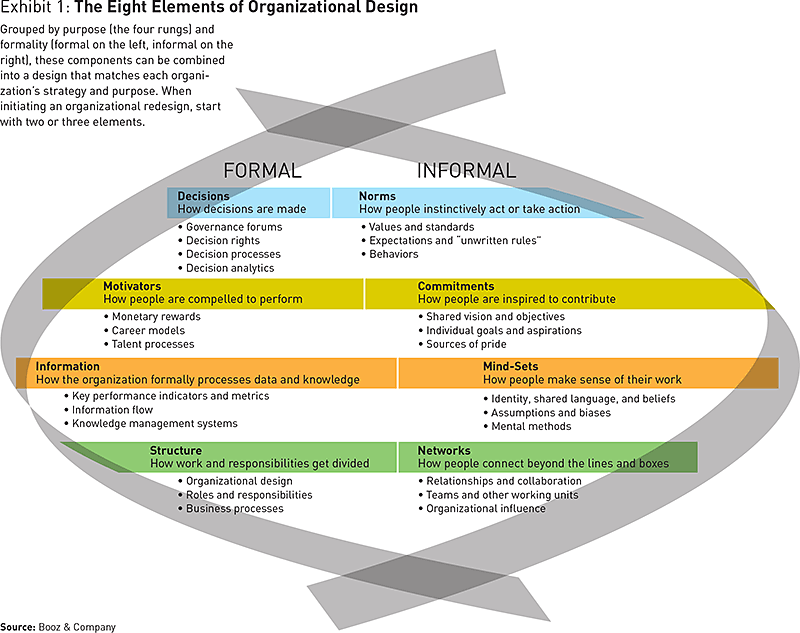
The printout contained a diagram, taken from an article that Joanna had used before in other companies, a blueprint for effective organizational design. It showed eight fundamental levers—vehicles for change—divided into two groups: formal and informal. Formal levers are factors that a company can precisely articulate, codify, and measure. These include the structure of the organization chart, along with incentives, decision rights, and rules that are fairly well defined. By contrast, the informal levers are factors embedded in culture, personal relationships, and behavior. They cannot be precisely codified, but they have a profound impact on an organization’s effectiveness and efficiency, because they represent the everyday habits of its people. In the same way that good product engineering must incorporate both software and hardware, good organizational design must incorporate informal elements along with formal rules and structures (see Exhibit 1).
Like the elements of a string of DNA, the elements of organizational design can be divided into four “rungs” in a ladder. The first rung is related to authority and the governance of behavior. On the formal side are decisions—the statements, often set into rules, bylaws, or policies, that describe the underlying mechanics by which decisions get made, including how and by whom. They include aspects such as governance policies, approval processes (for everything from product launches to expenses), guidelines for delegation, and the creation of advisory panels.
At Seabright, Sanjay knew, there was a reasonably clear approval process for financial transactions. However, the approval process for new product development needed major changes. Ideas sprang up from multiple places, and they tended to get funding as a result of internal lobbying. Innovations in digital media were particularly prone to being overlooked. To rectify this, Jill and Sanjay proposed a cross-business-unit process that could collect, analyze, and prioritize competing projects—and that would give preference to digital products, especially those which analyzed user requests, profiled their likely interests, and customized information accordingly.
The informal counterparts of decisions are norms—the unwritten shared values and standards of behavior that lead people to expect others to act in certain ways. A norm is typically expressed in statements like, “We rise to challenges. We never say ‘We can’t do it’ unless there’s no alternative.” Norms are often learned through apprenticeship, or passed down from mentors. They describe what separates the people who “belong here” from the people who don’t.
For example, at Seabright, people tended to discuss problems only when they could propose a workable solution. This led people to routinely understate challenges and propose small measures that tended to wither away without effect. Jill and Sanjay knew this component would have to change as well.
The next rung addresses the way the company governs behaviors. The formal elements, motivators, are traditional mechanisms for reward, promotion, and recognition. They include performance objectives and incentives such as bonuses and promotions. Motivators can be immensely influential.
Seabright had a strong incentive program; as much as 30 percent of a typical manager’s compensation came through end-of-year bonuses, but the bonuses were pegged to the margins of each business unit. This structure inadvertently devalued the new digital products, where the margins would likely take a hit for the first year or so.
The informal components, commitments, are unwritten aspirations that, when fulfilled, become part of a company’s identity and sources of pride for its employees. One classic example of a commitment was FedEx’s early slogan, “When it absolutely, positively has to be there overnight.”  The company was proud to be held to that promise. Seabright had its own long-standing commitment: “We deliver must-read information.” In many industries, its publications were the first thing that executives read each morning. For commitments to be meaningful and sustainable, they must be backed by distinctive capabilities that allow the organization to deliver. This was a bedrock element for Seabright: Jill and Sanjay knew they could build on it.
The next rung involves flows of knowledge and insight. Its formal element,information, encompasses the measurement of performance (through key performance indicators and other metrics); the coordination of activities; and the flow of explicit, codified knowledge.
The informal component is mind-sets. These deeply held attitudes and beliefs affect how employees engage with customers, design and make products, and solve problems. For example, some companies collectively believe that they must serve a social purpose in addition to their commercial interests; others have a mind-set that superlative products require superb product design. This element often separates great companies from also-rans.
The remaining rung is traditionally aligned with the concept of organizational design. On the formal side is structure—the “lines and boxes” of the organization chart, defining critical roles, responsibilities, and formal relationships. Structure is especially important for large, global companies, which must carefully design the lines and boxes, no matter who occupies the various roles. Smaller firms can more easily compensate for a flawed structure with processes and talent. For this reason, and because the chart is so closely linked to traditional thinking about organizational design, many large-company redesigns start with the org chart and, all too often, stop there as well. Although a good structural design can be important, it is never sufficient by itself. It needs to be aligned with changes in other formal and informal elements. It should generally be the capstone, not the cornerstone, of a design effort.
Although Seabright had already gone through a redesign, its structure still had significant problems—but it also had some strengths. For example, a new chief digital officer (CDO) position had been created, and that executive was well placed to bring new products to market. But the current CDO lacked authority and accountability, and had only a few direct reports.
The informal counterpart of structure is networks: connections among employees that transcend the lines and boxes of the formal organization. Networks can be organized deliberately; many centers of expertise are designed to bring together individuals with shared interests and skills. Other networks emerge on their own, as groups of individuals who consult one another because of shared interests or business needs. In general, networks provide a necessary complement to the formal structure, and they can also reveal difficulties with the overall design. If a group with a mandate for influencing performance is systematically bypassed in daily decision making, that’s a clear problem.
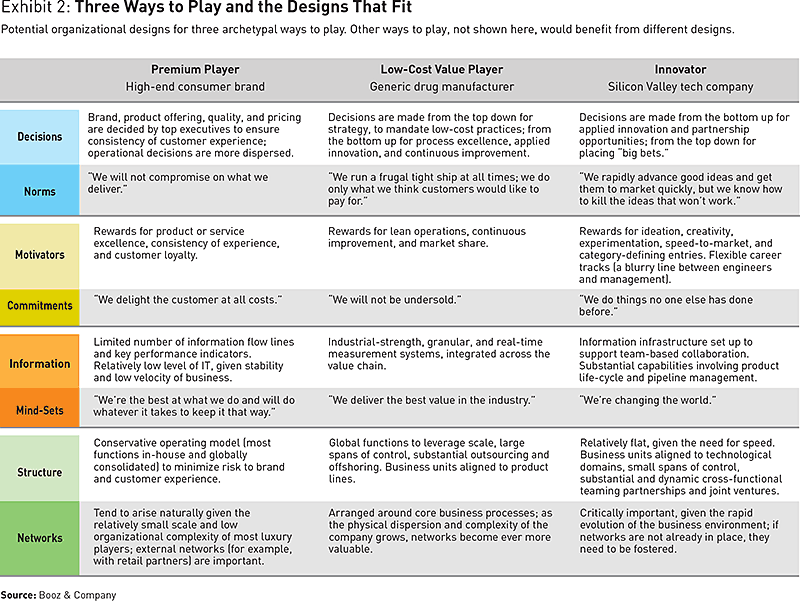
In putting together these eight elements, the formal and informal versions of the four rungs of the ladder, your objective as senior management is to define a single strategically aligned organization. Rather than starting with the eight elements, you begin with your way to play and capabilities system. What are the essential shared attributes of an organization that would best serve the strategy you have already defined (see Exhibit 2)?
The purpose of this exercise is to lay a foundation that should guide the rest of the detailed design. As you move through the organization to specify the elements of particular functions and departments, some variation from the overall design is inevitable. For example, an overall blueprint for a premium auto manufacturer like BMW, Audi, or Mercedes-Benz may not identify frugality as a central tenet. But even luxury carmakers keep a watchful eye on the efficiency of their operations. The organizational design for such a company might specify incentives related to efficiency and norms of frugality for its operations group, but not for marketing and sales.

The New Organizational Design

One month after the initial meeting at Seabright, Jill and Sanjay presented their findings to Joanna and an expanded executive team, including chief functional officers for finance, operations, marketing, and R&D. Sanjay began. “We’ve made a lot of progress,” he said. “We started with our way to play as an innovative value provider—using digital technology to cut prices while being more relevant than ever. This requires an organization that can continually improve print while making the transition to digital. We focused on the areas we need to improve most: the formal controls of decision rights and motivators, and the informal leverage of commitments and networks.”
“What about the other elements?” Joanna asked. She already knew the answer, but this was a small test.
“Well, we can’t tackle all eight at once,” said Jill. “We need some clear priorities. We already have a strong commitment to excellence, and although our organizational restructuring was painful, the resulting structure could actually serve us well—if we bring the other elements up to par.”
“That sounds right,” Joanna said. “So what’s first?”
Sanjay explained how they would strengthen the CDO’s role and expand that leader’s jurisdiction; Jill then talked about motivators. “Right now,” she said, “business unit evaluations are based on individual performance. So everyone’s working hard, but they’re not working together. We want to adjust the bonuses, linking them to the new behaviors we want in addition to margin performance.
“Next,” she continued, “we need to build our information capabilities. We have access to a lot of customer data—the salespeople are fantastic in maintaining those relationships—but we don’t have the capability yet to synthesize that data from multiple places, make sense of it, and translate it into the products and apps that we need.”
“I thought we were already building this,” said the senior vice president for production.
“We are,” replied Sanjay. “That’s the problem. We have five different groups working on aspects of it, but they don’t know what the others are doing. We need to be innovative in a more systematic way, but without more structural constraints. Eventually, we will have to upgrade our information infrastructure, but the first step is to get people collaborating across boundaries. So we’re setting up long weekly lunches among the five groups. We’re also asking everyone to make a common commitment to customers—to raise our game further, giving them the information they need faster than anyone else does. To help pull that off, we’re setting up some dialogues between our content generation staff and our leading customers.”
Joanna sat back in her chair. They’d said the right things so far. “I know I pushed you hard to turn this around quickly,” she said. ”Are you convinced it will get us aligned?”
Sanjay and Jill both nodded. “It’ll at least point the ship in the right direction,” Jill said.
“And,” said Joanna, “how will these recommendations help us strengthen the critical capabilities that we need?”
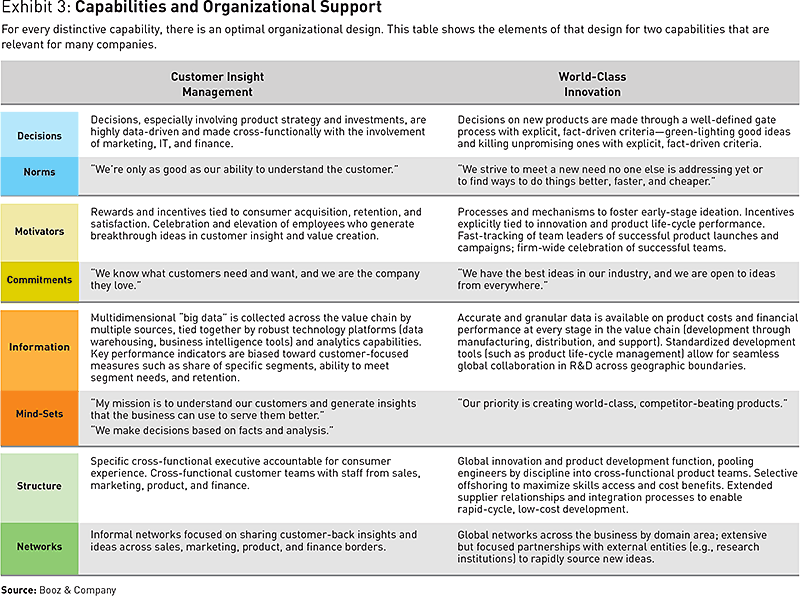
Jill and Sanjay both smiled. Jill reached into a folder in front of her. “Already done,” she said, passing out a sheet of paper to the people in the room (see Exhibit 3).

Closing the Gap

It took several months to close the gap between the organization that Seabright had and the design that it needed. The first challenge was the board of directors. Because the previous restructuring had been so difficult, Joanna had to persuade them (along with some top executives) that this redesign would be different. Next, she set up a handful of working teams—on product development, on customer acquisition and retention, and on information infrastructure—to lay out the details of the new organizational design. Each working team had a sponsor from the top team, ensuring that the most senior leaders would get involved.
Joanna worked directly with the global HR head to revamp the bonus system. She took pains to ensure that all employees understood the new system and what it would mean for them. The formulas were posted on Seabright’s intranet, along with collective scores by business unit and geographic market.
By her one-year anniversary at Seabright, Joanna was able to demonstrate results to the board. Thanks to the efforts of the newly empowered chief digital officer, several new products had sailed through beta testing. Several follow-on initiatives were in the works—all informed by consumer insights and all with a clear strategic justification. It was too early to tell for sure, but the results seemed promising; customer response and retention were favorable, and metrics on employee engagement were trending in the right direction.
Seabright’s organizational blueprint would not fit the needs of any other company. But a process like this one can help any company, ensuring that its strategy, capabilities, and organization are all aligned to support each other.
That quality is often overlooked in organizational design, but it is probably the most important factor of all: a critical enabler of your company’s ability to deliver on its strategy.

AUTHOR PROFILES:

  1. Ashok Divakaran is a partner with Booz & Company based in Chicago. He specializes in strategy-driven transformation for product- and innovation-based companies.
  2. Gary L. Neilson is a senior partner with Booz & Company based in Chicago. He focuses on operating models and organizational transformation.
  3. Jaya Pandrangi is a partner with Booz & Company in Cleveland. Her work focuses on growth and cost fitness strategy as well as sales and marketing effectiveness for consumer products and retail companies.
'via Blog this'
Enhanced by Zemanta