Pages

Showing posts with label Research and development. Show all posts

Friday, January 20, 2012

The Surprising Benefits of Solitude

Harvard Business Review

2:47 PM Thursday January 19, 2012
Andrew McAfee

Some recent reading crystallized two hypotheses that have been rattling around in my head for a while now:
Digital crowds work better than real-world ones For some things, nothing works except solitude
These formed after reading a great article by Susan Cain in the New York Times called "The Rise of the New Groupthink." The column is a preview of her new book Quiet: The Power of Introverts in a World that Can't Stop Talking

The book summarizes a lot of research about what actually happens when people work together in groups, and most of it ain't pretty. As Cain writes,
...decades of research show that individuals almost always perform better than groups in both quality and quantity, and group performance gets worse as group size increases. The "evidence from science suggests that business people must be insane to use brainstorming groups," wrote the organizational psychologist Adrian Furnham... 

The reasons brainstorming fails are instructive for other forms of group work, too. People in groups tend to sit back and let others do the work; they instinctively mimic others' opinions and lose sight of their own; and, often succumb to peer pressure
So it seems like we need to add brainstorming sessions to the scrap heap of plausible business techniques that actually don't work that well, along with focus groups and job interviews. …

There is one large exception to this rule: groups that come together digitally, rather than in the real world, are often very creative, innovative, and productive. … According to Cain:
The protection of the screen mitigates many problems of group work. This is why the Internet
Marcel Proust in 1900
Image via Wikipedia
has yielded such wondrous collective creations. Marcel Proust called reading a "miracle of communication in the midst of solitude," and that's what the Internet is, too. It's a place where we can be alone together -- and this is precisely what gives it power.
I love this idea, … because it provides a great counterargument to all the hand-wringing about the Net's isolating and society-corroding tendencies. Alone together has until now been a lament; it should also be a celebration.

The second hypothesis is that as powerful as the Net can be for generating and improving ideas, those of us who think for a living still need to be alone a lot to get good thinking done.

… It's usually a blast to digitally swap ideas; tweet, update, share, comment, 'like,' and multitask with multi-people. It's usually a drag to take yourself away from all that, sit down, disconnect, and start writing, sketching, coding, diagramming - in short, to start thinking.

If and when you get into a flow, solitary work becomes fantastic. But it rarely starts that way. It proceeds the way my marathoner friends tell me their winter training runs go: with a lot of initial discomfort and why-am-I-doing-this? followed eventually by enjoyment and accomplishment.

Getting over that initial hump is hard. And people might stop trying if they start believing that digitally facilitated ensemble work suffices. … It's absolutely necessary, but it's not enough when genuine novelty is the goal. We - YOU - also need to spend some time alone, just thinking. The poet Charles Bukowski got it
Charles Bukowski
Image via Wikipedia
 right: "Isolation is the gift."


Andrew McAfee
Andrew McAfee is principal research scientist at the Center for Digital Business in the
MIT Sloan School of Management
Image via Wikipedia
MIT Sloan School of Management. He is the author of Enterprise 2.0 and the co-author, with Erik Brynjolfsson, of Race Against The Machine.
Enhanced by Zemanta

Thursday, January 19, 2012

6 ways to fail your business


Logo of CBS News
Image via Wikipedia
 CBS News

By Jeff Haden
(flickr.com user The Doctr)
(MoneyWatch) 

Sure, businesses fail -- but are you failing your small business?

Here are six ways you could be failing your business:

Your eye has started to wander. You're bored with your business because, well, things have gotten a little stale. … You're thinking about forming other companies, or starting a side venture, and you pay less and less attention to your primary business. In the process results, relationships with customers and suppliers, and employee morale all suffer.

You focus on the wrong line. When revenue is down it's natural to focus on cutting costs, … Instead of focusing on the top line and growing sales, you cut and cut and cut until nothing is left. Sometimes it is impossible to save your way to profitability, and focusing on top-line growth is the only long-term answer.

You use "we" at the wrong times. You know there is no "I" in "team" so you try to say "we" -- but at the wrong times. … Use "I" whenever you personally make a mistake, and use "we" whenever you do something positive.

You network rather than sell. Networking is like sowing seeds. Selling is like harvesting crops. … Network some of the time -- sell all the time.

You're in it for glory. … You should serve your business. Your business should not serve you -- and especially not your ego.

You can't stop searching for that one big idea. … Most companies succeed through hard work, attention to detail, and consistent execution. Ignore ideas and small improvements while you search for that one incredible breakthrough and your company will fail. A big idea is unlikely to transform your business; executing lots of small ideas can build a great business.
© 2012 CBS Interactive Inc.. All Rights Reserved.
  • Jeff Haden Jeff Haden learned much of what he knows about business from managing a 250-employee book manufacturing plant. Everything else he picked up from ghostwriting books for some of the smartest CEOs and leaders in business. He has written more than 30 non-fiction books, including four Business and Investing titles that reached #1 on Amazon's bestseller list. Follow him on Twitter at @Jeff_Haden.
Enhanced by Zemanta

Friday, December 16, 2011

The Top 10 M&A Fallacies and Self-Deceptions

Mergers and Acquisitions (The Sopranos)Image via Wikipedia

With merger and acquisition activity heating up, here’s a due diligence checklist for regaining clarity.
strategy+business magazine
by Barry Jaruzelski, Marian Mueller, and Peter Conway

Imagine that you have just concluded a major merger or acquisition. … Having crossed off every item on your due diligence checklist, you expect big savings from restructuring; more importantly, you know that a year from now this newly created company will be the leader in its industry, with significant growth in revenue and higher profit levels.

Then flash forward to the first anniversary of your M&A deal announcement. The company’s performance is below expectations and you’re left with a nagging sense of doubt about the transaction. …
…Often, when you look closely, a common set of attitudes is at play — implicit assumptions held by the leaders who put the M&A deals together and conducted the due diligence. These attitudes fall into two broad groups. First are fallacies, … Second are self-deceptions, … By becoming more aware of them, you can raise the success rate of all your M&A deals significantly.
Five Fallacies to Avoid
M&A fallacies are often ingrained in a company’s legacy practices, including the due diligence practices that have been successful in the past. It’s not enough to recognize these fallacies. You must take specific precautions to keep from being blindsided by them.

1. “We can’t walk away from this deal.” This fallacy about M&A seems to make intuitive sense. The people who put a deal together — often the business unit general manager and his or her staff … are subject to the vagaries of human nature. When they are too close to a deal, it clouds their ability to make an objective, unbiased decision. They are far too likely to focus on details that confirm their preconceptions and ignore details that contradict them. This is known in the field as “deal fever.” …

You can generally avoid deal fever with a layered decision-making process. The deal team, including the business leader who champions the acquisition, should present the case to a separate group or individual who can review its attractiveness more objectively. You must balance these prudent checks and balances against your need for speed. The most effective companies adopt “high-speed lanes” for decisions that must be fast-tracked, as well as top-layer deal review committees staffed by executives who agree to make themselves available quickly if needed. …

2. “Any experienced negotiator can negotiate deals.” …Unfortunately, the auction-like nature of competitive deals can make mergers and acquisitions very different from negotiating a product launch or joint venture–related agreement.

For example, the acquiring management team may fall prey to a seller’s overoptimistic projections or their own synergy estimates. … It is easy to lose sight of the fact that if the price and terms aren’t right, “winning” the deal can be worse than losing.

The answer is to think ahead of time about what you are willing to pay and to develop a true “walk-away” price. During negotiations, as you learn about the sellers’ motivations and as new options are suggested, this preparation can help you turn down any new arrangement that doesn’t give you what you need. … You can also put measures in place that share some upside potential while still staying below the walk-away price. For example, you can prearrange a performance bonus for the sellers, to be awarded when agreed-upon financial milestones are reached. …

3. “M&A performance is all in the numbers.” Many executives assume that if the financial arrangements are secure, the rest of the deal will follow. But all deals have two other significant factors to consider that are often not accounted for in the numbers: the human element and the need to develop the capabilities required to succeed in the new or merged business. … A comprehensive due diligence process should take into account both the cultural and capability aspects of the deal….

4. “Information in the M&A process will naturally be kept confidential.” When middle- and low-level employees get wind of a possible acquisition, leaks are possible, and they can have major consequences. Confidentiality should be taken very seriously and enforced during the due diligence process; leaks can come from a variety of sources….

Other ways of enforcing confidentiality include extending the NDA requirements to administrative staff, highlighting the importance of confidentiality during key due diligence checkpoints, prohibiting e-mail about the deal, and instituting preannounced penalties for leaks and breaches. Sometimes, key components of the due diligence process can be outsourced to a third party to reduce internal communications. …

5. “There’s time for detailed postmerger planning after the merger takes place.” This fallacy … rarely leads to good results. Unless you define a detailed merger integration plan before the submission of the binding bid, you risk losing the momentum that you need to drive change and integrate the companies. …
Identify a postmerger integration team and a leader during due diligence, as soon as it is clear that a binding bid will be submitted. This will help you identify some of the key integration risks and issues, and the resources required for integration. It will also lay the groundwork for postmerger review processes and metrics that can help hold the integration and business leaders accountable.
Self-Deception vs. Reality
Self-deceptions are often more difficult to address than fallacies, since practitioners think that they are already following the best practices. Our experience suggests otherwise.

1. “Our company’s M&A process is strategy-led.” [Even] in a sophisticated company, strategic definition can be surprisingly incomplete. This leads to significant delays in conducting due diligence, or to a lack of preparation in responding to deals when they become available …

… Deals need to be generated with strategic intent, no matter how attractive the financials appear to be. This means that the acquired business should bring in capabilities that fit with the capabilities system of the larger company — or bring in new products and services for which the acquiring company’s capabilities system is relevant. Otherwise, a deal may put the core business at risk or drain attention, time, and resources. In particular, mergers and acquisitions should reinforce and help build the capabilities that distinguish the core business from its competition.

2. “We have a thorough understanding of our markets.” Most business leaders are predisposed to believe this. … However, a merger or acquisition can easily bring a company face-to-face with aspects of its market that it doesn’t know well….

Draw on multiple perspectives, whether from inside or outside the company, to help you become aware of these sorts of issues. As you conduct due diligence, make sure you have a reasonably complete and up-to-date picture of the value chain for your target company’s industry; the relevant market size, relevant segmentation data, and trends and growth drivers in each segment; customer needs by segment; customer attitudes toward the target company; current profit and profit potential by segment; technology trends and potential substitute products; geographic nuances by segment and product; competitive landscape (including as much as you can glean about products, pricing, and costs); and barriers to entry and new disruptive entrants.

3. “Our core market success is replicable in adjacent markets.” The traditional definition of an adjacency is products and services that share some qualities or characteristics with your core market. … In reality, however, most moves into adjacent markets are unsuccessful, especially those made through M&A. … [Only] companies that have a well-defined M&A process that recognizes the importance of existing capabilities and the changes that will be required to evolve those capabilities have successfully executed such transactions with regularity.

Thus, when beginning an acquisition campaign, you should begin by evaluating your capabilities. Examine how well these will apply to the businesses in the company you are acquiring — and how well the capabilities you acquire will mesh with your own lineup of products and services.

The best acquirers take a strongly disciplined approach to business building, with strict criteria for acquisitions. These could include criteria related to target market size, degree of market fragmentation, gross margin targets, cyclicality and volatility, brand strength, customer concentration, and robust replacement parts or other streams of ongoing business. … When you reject target companies that do not fit your strictest criteria, you put a stake in the ground indicating that any company acquired will set up your company for above-market growth.

4. “We have a well-defined due diligence process.” Many corporate leaders learn the hard way that this isn’t true, particularly when their company is an infrequent acquirer or when they consider acquiring companies in different markets. They underestimate the amount of effort and time consumed by an acquisition or merger. Even when experienced senior executives are overseeing various functions, enthusiastic junior staff are executing the requisite tasks, and some due diligence processes are in place, there is still a tremendous amount of work to be done in a compressed time frame.

You may find, as you begin due diligence, that your processes are incomplete, and your team lacks the expertise to evaluate commercial prospects; technologies; legal issues; manufacturing footprints; procurement concerns; intellectual property; tax questions; regulatory issues; export controls; or issues related to health, safety, and the environment. At the least, you will need detailed standard questionnaires covering these issues; more likely, you will need to bring in experts who can answer questions with confidence….

To avoid these types of problems, arrange regular meetings of new business development practitioners across internal boundaries. Document what went well and what did not go well following each transaction, to share with the group. Use these meetings to drive best practice development; share basic information about the market, as well as simple tips and tricks. Create due diligence templates and questionnaires, such as data request templates, so that work can flow seamlessly, even if individual staff members depart in the middle of a project.

5. “Our legacy due diligence team knows what they are doing.” Even experienced due diligence staff may not have the right skills for every deal. It is important to bring in pertinent expertise to fully analyze a given opportunity, especially for adjacent markets, new geographies, and unfamiliar technologies…
M&A is a complex process that requires significant and diverse skills and resources to execute well. By being aware of the trap these common fallacies and self-deceptions present, teams can design and execute an M&A process that is more effective and yields outcomes that consistently create rather than destroy value.

Author Profiles:

  • Barry Jaruzelski is a partner with Booz & Company based in Florham Park, N.J., and the leader of the global engineered products and services practice. He specializes in due diligence, corporate strategy, and transformation of core innovation processes for high technology and industrial clients.
  • Marian Mueller is a principal with Booz & Company based in Florham Park, N.J. He serves industrial and automotive clients as well as associated financial investors by focusing on organic growth, mergers and acquisitions, organizational design, emerging market growth, and portfolio management.
  • Peter Conway is a senior associate with Booz & Company based in Chicago. He specializes in M&A due diligence and organic growth strategy, as well as helping clients develop the capabilities required for each.
  • Also contributing to this article were Booz & Company senior associate Prashant Vishnupad and associates Michael Zarrilli, Tushar Kanungo, and Abhishek Jha.
Enhanced by Zemanta

Tuesday, August 9, 2011

How Cities Lure Startups

Economic developers from Irvine, Calif., and San Jose, Calif., describe the strategies they're using to persuade entrepreneurs to set up shop or expand

BusinessWeek
By Karen E. Klein

Location of San Jose within Santa Clara County...Image via WikipediaHow do cities successfully engineer conditions to attract high-potential small companies that will create new jobs in the future? Two California cities … Irvine … and San Jose … have established successful public-private partnerships and programs aimed at encouraging businesses. Here are some of their strategies that others could apply in their own regions.

Maximize resources. The city of Irvine has a University of California campus within its boundaries. … "We draw on the intellectual horsepower of professors, interns, and students from UCI. It lends us a more educated workforce and higher standards for our local schools," says Christopher Lynch, vice-president for business and economic development at the Irvine Chamber of Commerce. …

Focus on nurturing locals. In San Jose, 39 percent of job growth comes from first-year startups, says Jeff Ruster, deputy director of the city’s Office of Economic Development. … In the past, startup companies that grow exponentially have located satellite facilities out of the state, where costs are lower, Ruster says. "Our value proposition is to keep their headquarters and their highly skilled job here," he says.

Community investment. Both cities make education and infrastructure a high priority, arguing that better living conditions attract ambitious, entrepreneurial residents. … That means long-term investment, much of it coming from local and state tax revenue, some in the form of school and construction bonds. "The entire community must support the quality of life for everyone so that talented entrepreneurs, workers, and their families will want to live and work in the community," [Ruster] says.

Creative partnerships. Ruster works not only in the city’s economic development office; he also serves as executive director of Work2Future, a workforce investment board that serves the larger Santa Clara County. … Although it is unusual to have one person head both agencies, "our vision was that we shouldn’t look at economic development and the workforce as two separate entities. There has been a bottleneck for corporate growth here because of the problem of finding talent. We felt the workforce investment board could and should play a role in [fixing] that." Because they come from the economic development side, job counselors are often better received by the unemployed: "People don’t see us walking up to their doorstep in a charity role."

Startup outreach. Even before they come looking for help, Lynch wants Irvine startups to get connected with local resources, training, and funding. … The Micropreneur Economic Development Program is something like an online training course, featuring seminars, webinars, and interviews with local business owners. Hands-on events are held regularly in conjunction with the TriTech Small Business Development Center, a Small Business Administration office that provides free consulting and workshops to fast-growth tech companies.

Ruster also wants his staff knocking on the doors at new companies and helping them connect. To that end, San Jose has established a separate website, BusinessOwnerSpace.com, that lays out services from 40 organizations aimed at startups, from help with government procurement opportunities, to commercial leasing, to a database of prescreened job applicants. …

Entrepreneurial mindset. In order to help entrepreneurs, cities and business groups must adopt an entrepreneurial mindset themselves. "… We help them develop their network, look for co-branding opportunities for them, help find management and employees at every skill level, and offer support from expedited permitting to helping them demonstrate proof of concept. Instead of just helping them with real estate, we take a holistic approach," says Ruster.

Karen E. Klein is a Los Angeles-based writer who covers entrepreneurship and small-business issues.
Enhanced by Zemanta

Monday, July 18, 2011

Digital Oxytocin: How Trust Keeps Facebook, Twitter Humming

Internet users--Facebookers most of all--are a trusting bunch. Why? Because we are wired to build relationships around trust.

Fast Company
BY Adam PenenbergToday
MacBook Pro users kissing[Image: Flickr user Capitan Giona]

The most surprising takeaway from the recent Pew Research Center study, "Social Networking Sites and Our Lives," … [is] the idea that the Internet, in particular social networks, engender trust, and the more time you spend on them the more trusting you become.

Image representing Facebook as depicted in Cru...Image via CrunchBaseAs the report put it, "The typical Internet user is more than twice as likely as others to feel that people can be trusted," with regular Facebook users the most trusting of all. "…

Enlargement of the 20-dollar bill. Enlargement...Image via WikipediaThis has significant implications, because … trust goes to the heart of our economic and social systems. Neuroeconomist Paul J. Zak, a professor at Claremont College and author of the forthcoming book, The Moral Molecule: Vampire Economics and the New Science of Good and Evil, says that trust is the lubricant that makes economic transactions possible. … While it may say "In God We Trust" on every dollar bill, what we are really trusting is that this piece of paper or coin--nowadays often a digital representation on a screen--is worth what we all believe it's worth.

In his own research, Zak and a co-researcher found that nations with higher levels of trust (Sweden, Germany, the U.S.) have stronger economies than those on the other end of the spectrum (the Congo, Sudan, Colombia). …

… We humans are hard-wired to commingle with one another offline and on-, and the web and its platforms like Facebook and Twitter make it more efficient than ever. …

chemical structure of oxytocin with labeled am...Image via WikipediaZak has traced much of our behavior to oxytocin, a single neuropeptide he's dubbed "the moral molecule" because it appears to shape much of our better nature. Also referred to as the "cuddle hormone," oxytocin is the same chemical that forges that unshakeable bond between nursing mothers and their babies. … [In] a spate of experiments spanning a decade Zak has linked oxytocin to all manner of human behavior--from empathy to generosity to trust. And when we believe that someone trusts us, we trust them back, and this alters our behavior: It makes us more generous, for one. Ultimately, oxytocin is, Zak says, the "social glue" that adheres families, communities, and societies while simultaneously acting as an "economic lubricant" that enables us to engage in all sorts of transactions.

Image representing Twitter as depicted in Crun...Image via CrunchBaseI wrote about Zak last year in a feature titled "Doctor Love" for Fast Company, and in addition to participating in a series of studies he conducted, I had him gin up one just for me. … I theorized it would also affect a person engaging on Facebook and Twitter. … So Zak took my blood, I got on Twitter for 10 minutes, then he took it again, then compared to the two samples. In those intervening 10 minutes my levels of oxytocin had risen 13.2%--as much as a groom at a wedding. (My wife: "That's pathetic.")

Subsequently Zak traveled to Korea and redid my tweeting experiment, this time with three journalists using Facebook. The result: They all demonstrated increased levels of oxytocin. …

I Am Majid Social Media CampaignImage via Wikipedia… [The] Pew study found "little validity to concerns that people who use [social networks] experience smaller social networks, less closeness, or are exposed to less diversity." On the contrary, Americans "have more close social ties than they did two years ago," and "are less socially isolated."

And it all comes down to trust. For this, you can thank the oxytocin in your brain.

Adam L. Penenberg is a journalism professor at NYU and a contributing writer to Fast Company. Follow him on Twitter: @penenberg.
Enhanced by Zemanta

Tuesday, May 17, 2011

Trash Inc: The Secret Life of Garbage

CNBC

Watch the FULL PROGRAM

ABOUT THE SHOW

Garbage. It's everywhere — even in the middle of the oceans — and it's pure gold for companies like Waste Management and Republic Services who dominate this $52 billion-a-year industry. From curbside collection by trucks costing $250,000 each, to per-ton tipping fees at landfills, there's money to be made at every point as more than half of the 250 million tons of trash created in the United States each year reaches its final resting place.
Current landfill gas projects in the United St...Image via WikipediaAt a cost of $1 million per acre to construct, operate and ultimately close in an environmentally feasible method, modern landfills are technological marvels — a far cry from the town dump that still resonates in most people's perceptions. Not only do they make money for their owners, they add millions to the economic wellbeing of the towns that house them. Technologies, such as Landfill Natural Gas and Waste To Energy, are giving garbage a second life, turning trash into power sources and helping to solve mounting problems. It's particularly important in places like Hawaii, where disposal space is an issue, and in China, where land and energy are needed and trash is plentiful.
One sure thing about the garbage business: it's always picking up.

PROGRAM HIGHLIGHTS


The Landfill Across the world, we’re producing more trash than ever before…nearly a ton per year for every man, woman and child in the U.S. Nearly half of it winds up in landfills and with the arrival of each ton, someone gets paid.
Photo Credit: Jason Hawkes | The Image Bank | Getty Images


Hawaiian Trash When you think of Hawaii, trash probably isn’t the first thing that comes to mind. But trash is bombarding the shore, turning parts of paradise into a wasteland.
Photo Credit: NOAA’s National Ocean Service

China The second largest economy in the world is in the midst of crisis. The country has little infrastructure to deal with the garbage generated by 1.3 billion people.
Photo Credit: Getty Images


New York City Sanitation
Tons of Trash In every town and every city, garbage collectors work to rid the country of trash. The largest sanitation department is in New York City where 12-thousand tons of garbage is generated every day.
BMW Manufacturing Co. | Spartanburg, South Carolina
The Power of Trash Today, trash is re-born as an energy source. A $2 billion BMW auto manufacturing plant in South Carolina is powered by trash from a nearby landfill.
Enhanced by Zemanta

Thursday, April 14, 2011

Nuclear Realism after Fukushima

A hasty, large-scale movement away from nuclear power would not resolve most of the issues raised by the ongoing crisis in Japan. Instead, we need more thoughtful discussions now about the energy systems of the future.

strategy+business magazine
by Tom Flaherty, Joe van den Berg, and Nicolas Volpicelli
Within a few days of a tsunami striking Japan’s Fukushima Daiichi nuclear reactors on March 11, a fierce debate had been fueled about the implications for energy policies around the world. … Unfortunately, we will hear many such oversimplified, rhetorically heated arguments in the weeks and months to come.
Nuclear safetyImage via WikipediaAs of April 2011, any debate about the implications of this crisis for the energy industry is premature. It will take into the summer to gather enough facts about the incident to draw reasonable conclusions about the safety and operating practices at this facility — and several more months to establish how those findings should apply to other nuclear plants and other countries.  …
… We can ask two questions as a good starting point for the needed discussion. First, how critical is nuclear energy as a long-term power source for countries around the world? Second, how should the energy industry and policymakers adapt in the aftermath of events at Fukushima Daiichi?
Accepting the Source as Essential
Any sober analysis of the global energy situation would have to conclude that nuclear power is an essential fuel source for many geographies. In a growing global economy, new advances in other forms of energy generation are not sufficient to keep pace with demand, especially if there is a consensus that coal generation should be reduced. …
In many countries, a long-term shift away from coal to lower-emission fossil fuels and some renewables is in progress; this shift has already brought environment-related protests over natural gas drilling, changes in land use, and higher power prices.  … But, at least for now, they can only contribute to meeting demand; they cannot supplant current sources. … Widespread use of renewables will require dramatic technological developments in energy storage and production, which are not currently available or even foreseeable in the near term.
That leaves traditional fossil fuels, such as coal, gas, and oil. … it is not clear whether available oil and natural gas resources will be sufficient to meet the world’s growing demand for transportation or electricity. In addition, in the developed world, a significant amount of coal generation is slated to be retired during the next 10 years, because of aging facilities and relative inefficiency, which further exacerbates future supply gaps….
The map shows the commercial nuclear power pla...Image via Wikipedia… Though nuclear energy currently makes up only 15 percent of electricity generation worldwide, it constitutes 20 to 30 percent of the energy supply in the U.S., Japan, and Germany, and 75 percent in France. If these countries, and others that rely partially on nuclear power, decide that it should not be part of their long-term energy mix, they will need to engage in challenging and broad new efforts in pursuit of other forms of energy generation. …
It is also important to watch rapidly growing countries such as China and India, which have relatively few good alternatives to meet their expanding energy needs. … Backing off on nuclear energy in any meaningful way would force China to rely more on energy imports and legacy coal production, and its high rate of GDP growth might be constrained.
In short, in every conceivable future, nuclear power is a necessary long-term power source, if only because so many nations count it as part of their short-term portfolio now.
Adaptation and Evolution
How, then, should the energy industry and policymakers adapt after Fukushima Daiichi? First, the public will certainly place a high burden of proof on the industry to demonstrate that nuclear reactors will stand up to human-induced catastrophes or unavoidable forces of nature more effectively — even extraordinary “black swan” events like the tsunami that struck Japan. …
… Both government regulators and the industry should be prepared to improve plant designs and operating protocols still further, with the aim of strengthening long-term safety and reliability. Industry participants need to step back and approach self-assessment and public scrutiny with an open mind, as a welcome step toward an even safer operating environment and thus a more secure long-term industry. …
CANDU Nuclear Power Plant at Qinshan, ChinaImage via WikipediaTransparency will be a major factor in gaining acceptance. …Policymakers and regulators will need to emphasize solutions that genuinely advance the state of industry performance and reduce risk, rather than simply layer on new requirements with dubious safety and public benefits.
Regulators and industry leaders also need to make greater distinctions among different facilities, because risks vary from one location and one plant design to another. …
Where possible, safety reviews should accelerate a shift to newer technologies. …  It will still take several years to bring new plants online, and all existing power sources will be needed in the meantime — …. Conversely, if the crisis results in a slowdown in new nuclear plant construction, it could paradoxically result in extending the operating lives of older plants.
For the long term, countries will need to intensify emerging energy technology research and development. …
… No matter what specific technical outcome emerges, increased investment in nuclear safety will increase the costs of capital investment and operations. … The cost of investing in increased safety will probably force energy prices somewhat higher, but not nearly as high as would a wholesale shift away from nuclear power. …
One potential positive legacy of this situation — a way to commemorate those who have been personally affected by it — would be a comprehensive and thoughtful energy policy that would align government objectives, industry development, and consumer impact. Such a result is going to require more tempered and extended conversation than the current debate has elicited. Instead of arguing for immediate advantage, energy advocates and industry leaders have a chance to think pragmatically about the future. Crises have sometimes led to breakthroughs in capability. Is there some similar possibility here? If so, it must include a recognition of the platform that nuclear power provides for the world’s economy already — and all the ways in which the world’s energy mix needs to develop over the next 15 to 20 years.

Author Profiles:

  • Tom Flaherty is a senior partner with Booz & Company based in Dallas. He works with clients in the electric and gas sectors.
  • Joe van den Berg is a partner with Booz & Company based in Washington, D.C., who focuses on strategic opportunities available to energy companies.
  • Nicolas Volpicelli is a principal with Booz & Company based in Florham Park, N.J., who works with the aerospace and defense industries. Previously, he served with the U.S. Navy as a first lieutenant and reactor propulsion division officer.
  • Also contributing to this article was Booz & Company Senior Associate Owen Ward
Enhanced by Zemanta

Monday, March 21, 2011

On the Inside, Looking Out

As CFOs gear up for growth, they are seeking targets that can help their companies innovate.
CFO Magazine
Sarah Johnson - CFO Magazine
March 1, 2011
After a long hiatus, companies are once again focusing on growth. But in an environment in which organic growth will be challenging and big deals may look too risky, many are taking an alternative path, exploring the acquisition of young businesses that can supply them with new talent, new technologies, and new products or services. Above all, today's dealmakers are looking to buy innovation.
Image representing National Venture Capital As...Image via CrunchBaseBecause so many companies responded to the recession at least in part by downsizing research-and-development budgets and addressing short-term needs like liquidity, they are now "basically buying their R&D by buying companies they think have real potential to grow over the long term," says Mark Heesen, president of the National Venture Capital Association (NVCA).
…"For us to expect that we'll think up all the great ideas and develop them internally is a stretch," says Bruce Knooihuizen, CFO at computer-services firm Rackspace, which has acquired four start-ups in the past four years.
The idea of purchasing a market-ready new product or service has a particularly strong appeal, because it allows a company "to accelerate an R&D or product-diversification process that otherwise would take years on an organic basis," says Mat Wood, a partner in BDO USA's transaction advisory practice….
An Eye on the Little Guy
…There are several factors in buyers' favor in the market for early-stage businesses. One is that many development-stage companies have had time to gestate while waiting for M&A activity to pick up and are now ready for prime time. "From an acquirer's perspective, you've got well-trained people, developed technology, defensible patent positions, and companies becoming increasingly profitable or near-profitable," says Trevor Chaplick, a partner at law firm Proskauer Rose.
The number of venture-backed companies acquired last year rebounded sharply from 2009.
Small companies with hot technologies are also more open to being purchased rather than holding out for an initial public offering, given the challenging market for IPOs and the high bar for success as a new public company.
… It's still a buyer's market, although the distressed-firm markdown bin is not as full as it was 18 to 24 months ago.
Despite those advantages, CFOs are nonetheless moving more methodically, even on smaller transactions. …"We don't see folks rushing to the market with a checkbook to do an irrational transaction," says Steve Joiner, managing partner for the southeast M&A group at Deloitte.
Smaller, but Not Easier
…Despite their bite-sized nature, smaller deals come with challenges of their own. Less-sophisticated companies may have little-to-no revenue, unclear business agendas, and disorganized finances. They may have failed to protect their intellectual property. And they may have made concessions on agreements that will lead vendors or customers to expect new terms following a change in control.
… "The two things these companies get acquired for are things that CFOs tend to not be focused on," says Matthew Bartus, a partner at law firm Dorsey & Whitney who represents emerging growth companies. "These acquisitions are not about revenue or earnings; they're about the people and technologies." As a result, the long-term worth of venture-backed companies can be hard to determine.
Such deals can also easily fall apart. …
Jason Child, Groupon's CFO, says the company considers many things when deciding whether it should buy sites in certain regions or build new ones from scratch. "It depends on a combination of factors," he says. "How long would it take [to do the acquisition]? How closely aligned are they with our approach and our style?"
Child says one of the main issues that arises when a big company targets a smaller one is the delicate business of approaching and winning over entrepreneurs who are used to working independently. "Entrepreneurs are excited about building stuff," he says. "They are not excited about larger companies' reputation for having more processes, more constraints, and more bottlenecks."
… "When you're buying a company that's run by an entrepreneur, that person may be used to calling the shots and won't want to collaborate," says Jim Cohen, executive vice president of mergers and acquisitions at Consolidated Graphics, a commercial-printing company that frequently buys family-owned businesses.
… Inexperienced buyers often underestimate the difficulties of integrating smaller teams into their infrastructure, notes Bartus. "You can manage liabilities with escrow, but you can't address a situation where you acquire a team that won't work in the [new] organization," he says.
To keep a newly acquired staff interested, buyers might consider adding retention bonuses to earnout targets. M&A experts also suggest that buyers ensure a degree of autonomy for valued legacy employees, and recognize that those employees may expect more from the deal than a payout, however large. … "The business objectives and the personal objectives of the ownership and key managers are often intertwined," says Will Frame, managing director of Deloitte Corporate Finance.
Grab a Partner
To get a handle on the true worth of a start-up and minimize the risk of a mismatch, many corporate buyers rely on the practice of establishing partnerships with potential targets. …
Will 2011 see early-stage deal-making continue at the same pace? With caution continuing to dominate CFOs' outlook, a sudden return to giant deals seems unlikely. Yet according to the latest Duke University/CFO Magazine Global Business Outlook Survey, fully a third of the CFOs who responded plan to spend cash on acquisitions in 2011 — twice as many as plan to use cash for research and development.
So, while a strengthening economy and growing confidence may usher in some larger transactions, for now, small deals — especially if they lead to innovation and growth — are indeed beautiful.
Sarah Johnson is senior editor for strategy at CFO.
Enhanced by Zemanta

Monday, December 6, 2010

The Global Innovation 1000: How the Top Innovators Keep Winning

Booz & Company’s annual study of the world’s biggest R&D spenders shows why highly innovative companies are able to consistently outperform. Their secret? They’re good at the right things, not at everything.

s+b magazine
by Barry Jaruzelski and Kevin Dehoff

Illustration by Otto Steininger
InnovationImage via WikipediaWhy are some companies able to consistently conceive of, create, and bring to market innovative and profitable new products and services while so many others struggle? It isn’t the amount of money they spend on research and development. After all, our annual Global Innovation 1000 study has shown time and again that there is no statistically significant relationship between financial performance and innovation spending, in terms of either total R&D dollars or R&D as a percentage of revenues.
What matters instead is the particular combination of talent, knowledge, team structures, tools, and processes — the capabilities — that successful companies put together to enable their innovation efforts, and thus create products and services they can successfully take to market. … Innovators that have achieved this state of coherence, we have found, consistently and significantly outperform their rivals on several financial measures.
We believe that this assessment of key innovation capabilities comes at a particularly opportune time. … (See “Profiling the 2009 Global Innovation 1000,” below.) Clearly, the global recession, which had not yet taken its toll on the world of innovation in 2008, finally came home to roost last year. Yet that decline makes it even more imperative that companies spend their available R&D dollars wisely. Our goal this year is to examine the capabilities needed to maximize the impact of a company’s innovation efforts in good times and bad, and to highlight the benefits both of focusing on the short list of capabilities that generate differential advantage, and of clearly linking the specific decisions within innovation to the company’s overall capabilities system and strategy.
Strategies and Capabilities
Three years ago, in 2007, we focused our annual innovation study on how companies use distinct innovation strategies to create their products and take them to market. Nearly every company, we found, followed one of three fundamental innovation strategies:
Need Seekers actively and directly engage current and potential customers to shape new products and services based on superior end-user understanding, and strive to be the first to market with those new offerings.
Market Readers watch their customers and competitors carefully, focusing largely on creating value through incremental change and by capitalizing on proven market trends.
Technology Drivers follow the direction suggested by their technological capabilities, leveraging their investment in research and development to drive both breakthrough innovation and incremental change, often seeking to solve the unarticulated needs of their customers via new technology.
It is important to note that we found that none of these three strategies were any better than the others at producing sustained superior financial results, although of course individual companies outperform others within each strategic group. The success of each of the strategies depends on how closely companies, in pursuing innovation, align their innovation strategy with their business strategy and how much effort they devote to directly understanding the needs of end-users.
This year we set out to answer two new questions: Which sets of capabilities are the most critical for the success of each of the three strategies? And do companies that focus on those critical capabilities see improved overall financial results? …
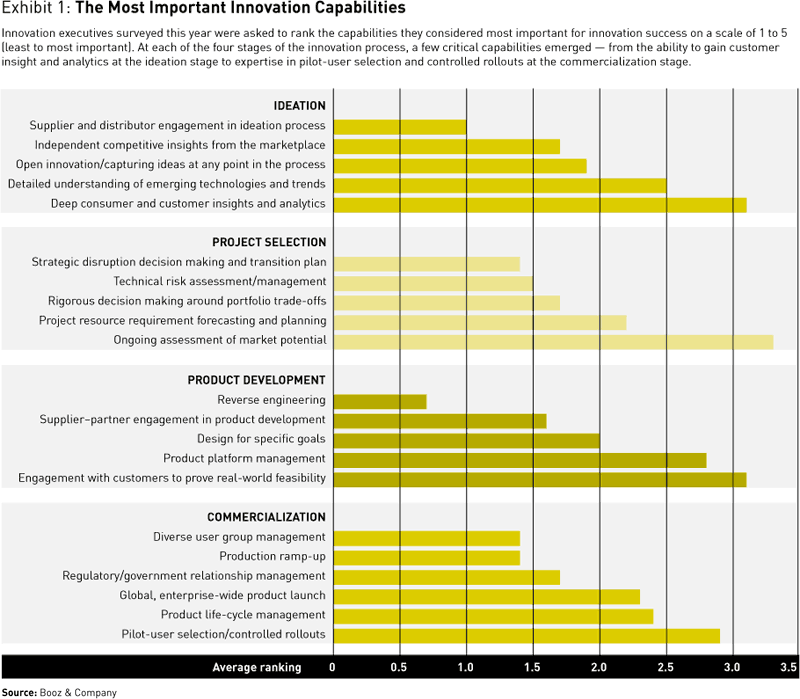
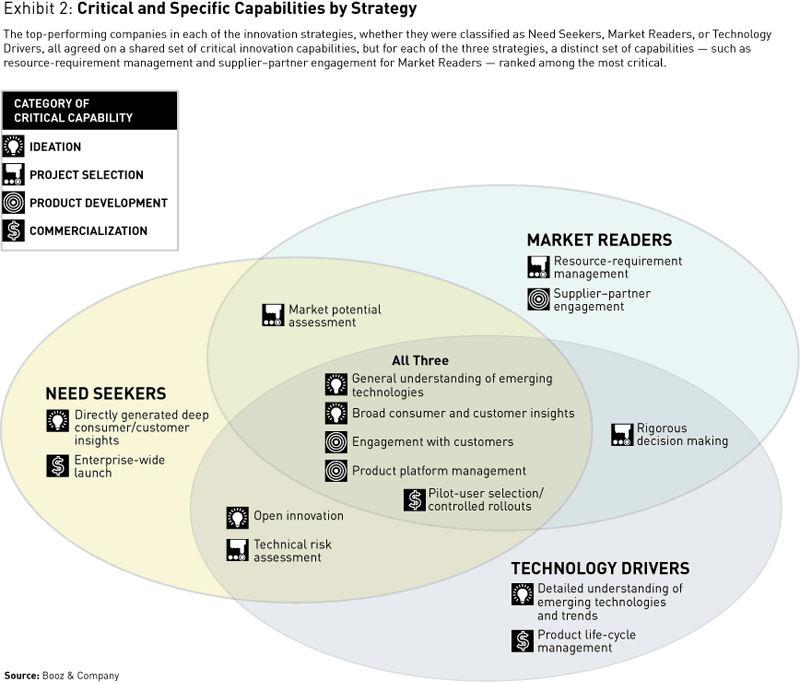
Innovation capabilities enable companies to perform specific functions at all the stages of the R&D value chain — ideation, project selection, product development, and commercialization. We asked respondents to this year’s Global Innovation 1000 survey to identify which capabilities were most important in achieving success at innovation. (See Exhibit 1.) Then, in hopes of getting further insight into which capabilities companies ought to work toward, we looked at the capabilities focused on by the top 25 percent of performers within the group using each of the three innovation strategies. (See Exhibit 2.)


No matter which of the three innovation strategies they pursued, all the successful companies depended on a common set of critical innovation capabilities. These include the ability to gain insights into customer needs and to understand the potential relevance of emerging technologies at the ideation stage, to engage actively with customers to prove the validity of concepts during product development, and to work with pilot users to roll out products carefully during commercialization.
In addition to these common capabilities, companies among the top 25 percent in performance within each strategic group depend on a set of distinct capabilities they feel are critical to achieve success, some of which overlap with those of other strategies. The most successful companies, we found, are those that focus on a particular, narrow set of common and distinct capabilities that enable them to better execute their chosen strategy.

Profiling the 2009 Global Innovation 1000

The global recession finally caught up with the world’s top innovators in 2009. Following a relatively strong 2008, during which total R&D spending continued to grow despite the recessionary headwinds, the 1,000 companies that spent the most on research and development decreased their total R&D spending in 2009 by 3.5 percent, to US$503 billion.
… Revenue for the Global Innovation 1000 plunged at an 11 percent rate, from $15.1 trillion in 2008 to $13.4 trillion in 2009 — nearly three times the rate of decline in R&D spending. The result was that R&D intensity (innovation spending as a percentage of revenue) actually increased, from 3.5 percent to 3.8 percent, indicating that companies attempted to stay the course with their overall innovation programs, and that they continue to see innovation as essential for future growth. (See Exhibit 3.) Compared to the 3.5 percent reduction in R&D spending, the 1,000 top R&D spenders cut much more deeply into both sales, general, and administrative expenses (a 5.4 percent reduction) and capital expenditures (a 17.5 percent drop). (See Exhibit 4.)

The reductions in R&D spending, however, were neither as widespread nor as evenly distributed among industries as the overall numbers might suggest. Just over half of all the companies we tracked this year cut their R&D spending in 2009. Nearly all the cuts, however, came in just three industries: auto, computing and electronics, and industrials. The other industries increased spending to a greater or lesser degree. (See Exhibit 5.)

The auto industry alone accounted for fully two-thirds of the $18 billion contraction in R&D spending — … A large number of auto parts suppliers fell into bankruptcy protection last year, and virtually every company in the industry cut spending in all areas of operations. Still, the industry’s 14 percent decrease in R&D spending was roughly in line with its 12.7 percent decrease in revenue; as a result, the auto industry’s R&D intensity was essentially unchanged, at 3.9 percent.
The computing and electronics industry reported similar but less drastic R&D spending reductions. The industry’s revenues were down by 7 percent from 2008 as a result of the recession and the accompanying drop in sales. Yet as with autos, the decline in R&D spending for computing and electronics — 7 percent — tracked the decline in revenue, so there was virtually no change in the industry’s R&D intensity.
Despite the $9.7 billion decline in its R&D spending, computing and electronics kept its top spot as the biggest spender on innovation, while autos remained at number three. (See Exhibit 6.) The industry in the number two spot, healthcare, increased its R&D spending by 1.5 percent — much slower than the industry’s recession-defying revenue growth rate of 6 percent.

Given the recession’s overall effect on innovation spending, it’s not surprising that companies headquartered in the regions that were hit hardest cut their R&D spending the most, on average. … (See Exhibit 7.)
The innovation programs of companies based in China and India, on the other hand, seemed unaffected by the recession: They boosted R&D spending by 41.8 percent (albeit from a small base; they account for only 1 percent of total Global Innovation 1000 corporate R&D spending). (See Exhibit 8.)

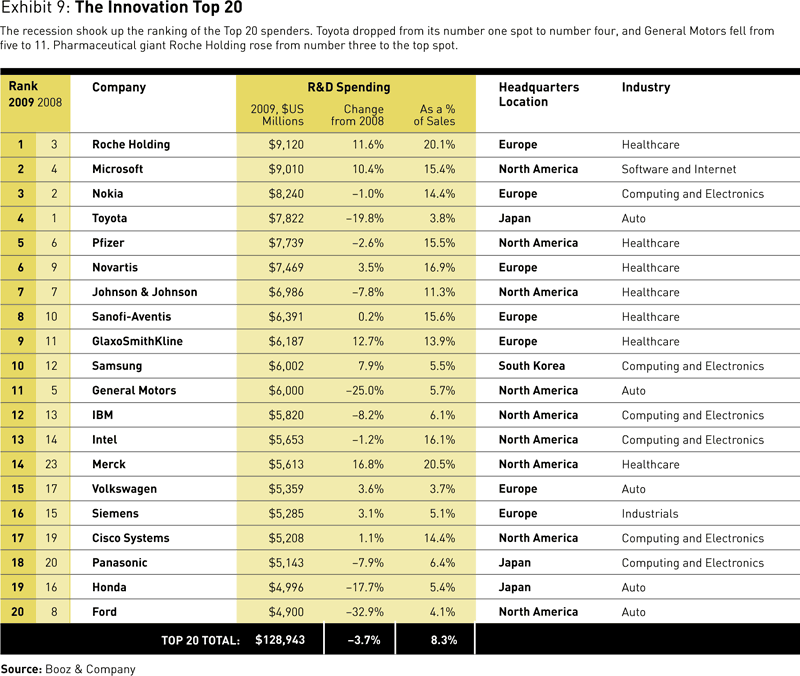
Changes in the list of the top 20 spenders provided further signs of the times. … (See Exhibit 9.) Toyota cut spending almost 20 percent, while its R&D intensity fell to 3.8 percent from 4.4 percent in 2008 — no doubt a direct result of its first-ever loss (more than $4.3 billion that year). Other automakers also fell on the Top 20 list, while most companies in computing and electronics rose a notch or two.

Taking over the number one position was pharmaceutical giant Roche Holding Ltd., which boosted its R&D spending 11.6 percent, to $9.1 billion. Indeed, healthcare companies took six of the top 10 spots on the list, and seven of the top 20. Coming in at number 1,000 was the medical manufacturer Seikagaku Corporation, which spent $59.5 million in 2009, down 7.5 percent from the previous year.
In hindsight, given the severity of the recession and the economic uncertainty that gripped the world, it seems inevitable that companies would cut their innovation budgets in 2009. Still, their overall unwillingness to reduce spending in line with their decline in revenues is a tribute to the importance companies in every industry now place on innovation as a key source of growth. Thus, with the recession drawing to a close and companies continuing to post strong earnings, 2010 will be an important test of their innovation mettle: The most forward-looking companies will move quickly to restore or even increase the R&D spending they cut in 2009 and to deploy it still more effectively.
— B.J. and K.D.
Need Seekers
The distinct strategy of Need Seekers is to ascertain the needs and desires of consumers and then to develop products that address those needs and get them to market before the competition does. The capabilities required for success begin at the ideation stage, where Need Seekers pursue open innovation and directly generated, deep consumer and customer insights and analytics, as well as a detailed understanding of emerging technologies and trends, in order to identify both their customers’ needs and the technology trends that can help them meet those needs.
An example is Stanley Black & Decker Inc.’s DeWalt division, a maker of power tools for professional contractors. In its efforts to connect directly with customers even before it starts selecting which projects to develop, DeWalt regularly sends people out to construction sites to research builders’ needs and observe construction crews in action. One notable result of such efforts was the development of a 12-inch miter saw, which became one of the company’s bestsellers, after researchers watched carpenters struggle to cut large pieces of molding on the industry-standard 10-inch saw.
Need Seekers generally continue to remain connected to customers both during the project selection process, in which ongoing assessment of market potential is a key capability, and during product development, when it is critical for Need Seekers to engage with customers to prove the real-world feasibility of their products. At DeWalt, for instance, once prototypes of new products have been completed, engineers and marketers take them back to the same job sites where the research was originally done. They leave the new tools with the customers, and come back a week or so later to collect information on how the tools performed. That information feeds directly into the company’s iterative development process.
Given that Need Seekers frequently depend for their success on developing technically innovative products, a further key capability at the project selection stage involves technology risk assessment and management. At the Xerox Corporation, for example, Steve Hoover, vice president of R&D in charge of software development for the company’s products, notes the importance of risk management in assessing the potential business value of any project under development. “How big an opportunity are you going after here?” he asks. “What will drive its value? Where are the biggest technical risks? What might cause the project to fail? You’re looking for correlations. Where there’s risk, you have to put in the extra work to ensure you capture the potential value.”
At the commercialization stage, Need Seekers value pilot-user programs and global product launches as crucial for keeping in touch with customers even as they scale up their sales efforts to capture the maximum value of being first to market. Both DeWalt and dental equipment maker Dentsply rigorously assess the percentage of sales coming from new products. For Xerox, which sells its products around the world, managing the launch phase is a critical and highly complex endeavor, designed to accommodate the long lead times, logistics, and training needs involved in selling large and sophisticated machines in very diverse markets.
Market Readers
Market Readers, on the other hand, pursue their customers more cautiously, preferring to innovate incrementally and keeping a close eye on the innovations of competitors. …
Tim Yerdon is director of innovation and design at Visteon, a global auto parts manufacturer. But his real focus, he says, is “to look at market trends and translate those trends and needs into new products and services.” That’s why taking accurate readings of the marketplace at both the ideation and the project selection stages is a key capability for Visteon. A case in point is the company’s development of reconfigurable digital displays for cars. …[Consumers] were clearly happy with the flat-screen TVs they were buying for their homes. Says Yerdon: “We did the market research, we put all these data points together, and we could see where the trends were going.” In late 2009, Visteon successfully launched its first reconfigurable displays.
The success of the Market Readers strategy depends on managers making sure the right products hit the market at the right time. … At the Parker Hannifin Corporation, a diversified manufacturer of industrial equipment, this understanding led to the implementation of a highly disciplined stage-gate process for green-lighting projects, embedded in every division in the company. Parker Hannifin treats its general managers and their staff as venture capitalists who are being asked to invest the company’s money in certain projects. The rigorous value screens that the company has developed as part of this process have enabled management to filter out the good projects from the bad much more successfully than before.
For companies like Visteon, an equally critical capability is engagement with customers to prove real-world feasibility throughout the product development stage. By working actively with automakers, says Visteon’s Yerdon, “we’re taking a substantial amount of risk out of the system. Rather than coming up with an idea, building it, and then bringing it to a customer, only to find out they don’t want it, we’re much better off working together and more openly.”…
Technology Drivers
Technology Drivers begin with a different approach to ideation, using their technological prowess to develop products their customers may not know they need. … In addition, Technology Drivers must ensure that their technical personnel have time to ideate: This is the rationale for Google’s well-known “70-20-10” rule, which directs engineers to spend 70 percent of their time on core business tasks and 20 percent on related projects, but allows them to spend 10 percent of their time pursuing their own ideas.
…The German technology giant Siemens AG, for example, spends 5 percent of its overall R&D budget on planning for the long term, which involves developing detailed technology road maps within individual business units, as well as longer-range scenarios of future technology trends at the corporate level. This dual process has generated perspectives that have enabled the company to expand its large health technologies business into new areas such as personalized healthcare. And Siemens works hard to track the payback from its centralized innovation office in the form of actual new products launched.
The Masco Corporation, an $8 billion building products company, … seeks to be ready to leverage new technologies no matter where they can be found. A few years back, company representatives noticed some interesting technology at a trade show — a wireless, battery-less switch, which they were sure would have applications in the home. “We vetted the technology, brainstormed specific applications for the home, and developed a pilot,” recalls Thom Nealssohn, manager of innovation implementation services at Masco. “Every time we showed it to someone, we learned a little bit more, and that gave us the fuel that we needed to go back and make it better.” Masco launched a new line of innovative programmable lighting products based on the technology — Verve Living Systems — in 2009.
… “In many cases, it’s just a matter of sitting down and saying, ‘Here’s the problem we want to solve,’” Nealssohn says. “What really differentiates us is our willingness to partner with customers, to try not only to understand what issues they’re struggling with today, but to anticipate issues that may arise as a result of what we see going on in the world around us.” That strategy, in turn, demands that Technology Drivers like Masco also focus on rigorous decision making in R&D portfolio trade-offs at the project selection stage, if they are to funnel their wide-ranging ideas into products that can succeed in the market.
Finally, because of the nature of their products, Technology Drivers must pay strict attention to two key capabilities in the commercialization stage: pilot-user selection/controlled rollouts, and product life-cycle management. … Says Nealssohn: “We believe that everyone in the distribution chain has to win. A shift of margin from one partner in the chain to another does not necessarily equate to a winning product. So it doesn’t matter how much the customer wants the product — if the distributor or the home builder doesn’t see the opportunity to make money, chances are that product is going to struggle or even fail.”
Focus Matters
The capabilities required to pursue each strategy form a systematic set of skills, processes, and tools that companies must focus on to succeed at each stage of the innovation process. In contrast to top-performing innovators such as Apple, Google, Xerox, Visteon, and Siemens, the poorest-performing companies within each strategic group — those among the bottom 25 percent — take a less-focused approach to the most critical innovation capabilities.
These lower-performing companies, regardless of which of the three strategies they are pursuing, cite only three common capabilities as important: early customer insight, assessment of market potential during project selection, and engaging with customers at the development stage. …. Notably, there is significantly less overlap among the capabilities that low-performing companies depend on. This suggests that these companies take more of a scattershot approach to building the innovation capabilities systems they need. This lack of focus, we believe, is a primary cause of their inferior performance.
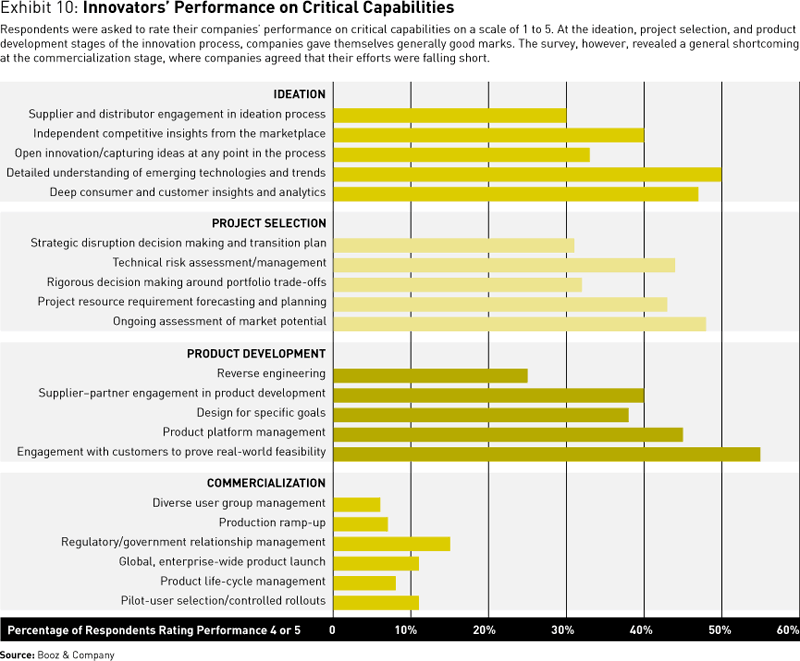
Focusing on a systematic set of capabilities means that companies must first choose the capabilities that matter most to their particular innovation strategy, and then execute them well. Our analysis suggests, however, that although most companies are relatively strong at executing critical capabilities within the areas of ideation, project selection, and product development, they underperform at the commercialization stage. (See Exhibit 10.) Executives agree consistently that there are three customer- and market-oriented capabilities that matter most: Gathering customer insights during the ideation stage, assessing market potential during the selection stage, and engaging with customers during the development stage. Yet when it comes to the capabilities needed to introduce their products into the market, there is no single one consistently named as a strength. …
In commercialization, the top performers stand out by executing well in two critical areas: global product launches and pilot-user selection and rollout. … Xerox’s Hoover acknowledges just how important the company-wide process of launching products in the marketplace is in the ability to capture the business value of innovation. “What do we have to get done, and when, so that we can feed the new product into the global operating companies’ pipeline, and what do they have to have ready so they can push it out? It’s really basic project management, but it has to be executed really well.”
Aligning with Corporate Strategy
Companies that focus on a consistent set of innovation capabilities clearly outperform their rivals. … Innovation — and the particular strategies companies employ to pursue innovation — is just one aspect of every company’s efforts to succeed in the marketplace. (See “The 10 Most Innovative Companies.”) They must also excel in areas outside R&D, including manufacturing, logistics, sales, marketing, and human resources. And their innovation efforts must be in sync with their overall corporate strategy: They must integrate the right innovation capabilities with the right set of firm-wide capabilities, as determined by their overall strategy.

The 10 Most Innovative Companies

Every year, readers of the annual Global Innovation 1000 study — which tracks the companies that spend the most on innovation — ask us which companies are in fact the most innovative. … As part of our survey exploring the relationship between innovation capabilities, corporate strategy, and financial performance, we asked more than 450 innovation leaders in more than 400 companies and 10 industries to name the three companies they considered to be the most innovative in the world.
Our survey participants’ collective opinion suggests that their views are very much in line with popular perception. Apple far and away leads the Top 10, capturing 79 percent of the vote; it is followed by Google, with 49 percent; 3M is in third place, with 20 percent. Apple is an exceptional example of our observation that success in innovation is determined not by how much money you spend, but rather by how you spend it. The company has a long history of bringing innovative and stylish products to market, from the first Apple personal computer in 1976 to the iPod, the iPhone, and the iPad today. Yet it invests just 3.1 percent of its revenues in R&D, less than half the average percentage of the computing and electronics industry. Apple’s financial performance has been stellar: a five-year total shareholder return (TSR) of 63 percent. Second-place Google’s five-year TSR is even more impressive, at 102 percent; its R&D intensity (innovation spending as a percentage of revenue), at 12 percent, is just 1.3 percentage points lower than the average of the software and Internet industry as a whole. Third-place 3M has been seen as a highly innovative company for many years, and its five-year TSR of almost 50 percent shows that it continues to spend its R&D money in the right places. (See Exhibit 11.)

Only three of the companies on the “10 most innovative” list — Toyota, Microsoft, and Samsung — also appear among this year’s top 10 spenders, reiterating the lack of correlation between R&D spending and innovation results. … The results are clear: The most innovative companies outperformed their industry peers on three different indicators of financial success. (See Exhibit 12.)

Companies that are perceived to be highly innovative are clearly successful in creating new products and bringing them to market. Some spend more than others to accomplish this goal, but the real winners, financially speaking, are those companies, like Apple, Google, and 3M, that can innovate successfully without breaking the bank.
— B.J. and K.D.
Why is strategic alignment so critical? As part of corporate strategy, every company needs to ask itself what business it is really in, and how it intends to win — and then ask the individual business units the same question. … On the one hand, the business units, which are so much closer to the customer, must first see an opportunity, and begin to innovate. On the other hand, corporate strategists must manage the companywide R&D and sales agenda necessary to compete successfully, even as they work to minimize spending and make the process as efficient as possible. As we demonstrated in 2007, companies that achieve a tight alignment of their firm-wide and innovation strategies on average generate 40 percent higher operating income growth and 100 percent greater total shareholder return.
The Coherent Innovator
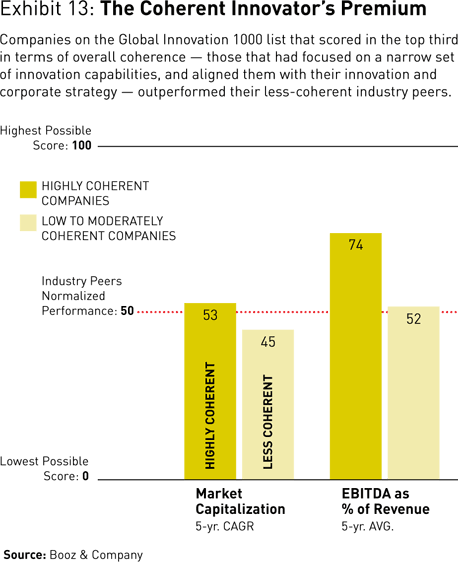
Companies that develop the relatively cohesive set of innovation capabilities we have outlined, and then combine them with similarly distinctive firm-wide capabilities — thus aligning their innovation strategy with the overall corporate strategy — can be said to be coherent. …By comparing the financial results of highly coherent companies in the Global Innovation 1000 to their less-coherent rivals, we found that, when normalized, the profit margins of companies ranked in the top third in terms of coherence were 22 percent higher, on average, than those of companies in the bottom two-thirds, and that the coherent companies achieved 18 percent greater market capitalization growth as well. (See Exhibit 13.) In general, the more coherent a company is, the more competitive success it will have — and the more it will be able to generate the higher margins that result from being truly differentiated.

Why are strong margins associated with higher coherence? Optimizing the proper set of capabilities allows companies to focus on what matters most, and not spread effort and resources across a wide range of capabilities that are less critical. … Regarding market cap growth, as companies gain the differentiating capabilities that give them coherence, their built-in advantage enables them to improve earnings growth, a key metric that the stock market takes into account when pricing a company’s shares.
Apple is the classic example: In the early 1990s, the company squandered enormous resources and billions of dollars on a series of failed products like printers, scanners, and the Newton PDA. … But once Steve Jobs returned as chairman and CEO in 1997, Apple began to focus its portfolio and its capabilities. The company has since concentrated very selectively on what it does well, and what really differentiates it from its peers: deep understanding of end-users, a high-touch consumer experience, intuitive user interfaces, sleek product design, and iconic branding. For example, Apple narrowed its product line and began leveraging the Apple brand through its Apple Store retail strategy.
The results speak for themselves. Apple’s profitability and market cap are well above the industry average, and this year our survey respondents voted it far and away the most innovative company — all of which it achieved while consistently spending far less on R&D as a percentage of sales than the median company in the computing and electronics sector.
Innovators and Strategists
The virtue of thinking about innovation in terms of capabilities and the capabilities systems that enable companies to be coherent is that it provides a specific way of talking about what companies need to focus on to translate their innovation efforts into sustained success. …As Xerox’s Steve Hoover puts it, “If a certain competency has nothing to do with how you’re positioning yourself in your market and creating value for your customers, then don’t oversupply it. Put your energy elsewhere, where you are going to differentiate.”
Companies, by focusing on the capabilities they believe are critical differentiating factors in their efforts to conceive of, develop, and sell their product in their particular markets — on what they need to do better than competitors — can gain the coherence necessary to outperform. And that, of course, is what innovation — and corporate strategy — is really all about.

Booz & Company Global Innovation 1000: Methodology

Booz & Company identified the 1,000 public companies around the world that spent the most on research and development in 2009. … This is the same core approach we have used in the previous five years of the study.
For each of the top 1,000 companies, we obtained key financial metrics for 2002 through 2009, including sales, gross profit, operating profit, net profit, R&D expenditures, and market capitalization. … In addition, total shareholder return was gathered and adjusted for each company’s corresponding local market.
Each company was coded into one of nine industry sectors (or “other”) according to Bloomberg’s standard industry designations, and into one of five regional designations as determined by each company’s reported headquarters location. To enable meaningful comparisons across industries, we indexed the R&D spending levels and financial performance metrics of each company against its industry group’s median values.
This year, to better understand the relationship between innovation strategy and capabilities, we also conducted a Web-based survey of more than 450 senior managers and R&D professionals from more than 400 different companies around the globe. …Respondents came from all industry sectors; 52 percent came from North America, 33 percent from Europe, and 15 percent from the rest of the world.
We asked respondents to evaluate the innovation capabilities they believed were most important across the value chain, as well as their performance in each of these capabilities. Responses were analyzed with a variety of statistical methods to allow us to distinguish the capabilities most important in pursuing each of the three innovation strategies we defined in our 2007 study. Although company names and responses were kept confidential (unless permission to use them was explicitly given), a large number of the respondents identified themselves, enabling us to associate their survey answers with their company’s performance. Financial performance was normalized by industry to compare the impact of capability coherence on corporate financial performance both within strategies and across all companies.
Enhanced by Zemanta